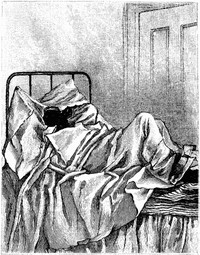
THE FOX-SKIN COAT.
BY ROSE TERRY COOKE.
"It's a dark night, Jenny," said Dr. Putnam to his wife, as he tied on a pair of coarse socks over his boots.
"Dark and cold too, David," said Mrs. Putnam.
"Don't fret, little woman. I've been out in many a worse. I only spoke of it because I doubted whether or no I should take the lantern; but I think I will, since it won't be lighter before I come back."
"Sam!" called Mrs. Putnam, and a curly dark head was thrust in at the door, "fetch father the lantern; light it first."
The Putnam children were trained to prompt obedience. Sam was almost sixteen, but he made neither delay nor objection. When he brought in the old-fashioned tin lantern you saw that he was a tall boy, with an earnest, pleasant face. He followed his father out of the door, hung the lantern by the side of the wagon seat, and tucked in the worn and ragged buffalo-robe as carefully as possible. His father nodded and smiled as he drove off. Sam stopped a moment to inspect the weather: the air was bitter enough, and not a star to be seen.
"Father'll have an awful cold ride," he said, as he re-entered the house; "the wind's northeast, right in his face, and everything is frozen up hard and fast."
"Poor father! he has a hard time winters," sighed Mrs. Putnam.
And indeed he did. A country doctor's life is hard enough; day and night he must drive, in all weather and all seasons; nor does there come to him a time of rest and vacation, for people are always ill somewhere. Dr. Putnam had even a harder time than many others, for the district where he lived was among the hills and forests of upper New Hampshire, where roads were rough, winters bitter, inhabitants few, and doctors scarce. But he had a wife and three children to support, and he could not help himself. Besides, he was a hardy, brave, kindly man, and no night was too stormy, no road too long, if sickness called him. He had always been well till the year before, when an attack of pleurisy took hold of him sharply, and warned him that flesh and blood can not endure more than a given amount of exposure.
All this went through Sam's curly head as he mended the fire in the stove, brought in wood, and then went over to the next neighbor's after Mary Ann, his sister, two years younger than he, who had gone out to take tea. Teddy, the baby of the family, was asleep long ago. Mrs. Putnam still sat by the fire knitting when the children came back, rosy, cold, and laughing.
"Oh, mother, it's awfully cold," said the girl. "I'm so sorry father's gone 'way out to Accomac!"
"Mother," said Sam, "Joe Allen says when he was down to Haverhill last year he saw a man driving stage who had a big coat on all made of fox-skins: wouldn't that be perfectly splendid for father?"
"Yes, indeed, Sam. My father had one; he gave it to Uncle John when he got command of that whaler I've told you about, the Emmeline."
"I wish he hadn't," said Sam. "It's down at the bottom of the sea now; and if you'd had it, just think how warm father might have been!"
"No 'ifs,' Sam; you know we don't allow that little word here."
Sam laughed, and went after his old tin pail of butternuts, and the hammer and stone; but while he cracked them he was thinking very hard indeed, and inside his curly head a plan blossomed which in due time fruited. The little village of Ponds, on whose edge Dr. Putnam's homestead and small farm stood, was nestled in the very heart of the New Hampshire hills. Five miles off a railway ran from the mountains to the sea-board, and there was a station nominally belonging to the town of Sabatis, which lay at least a mile and a half beyond. Ponds, however, was so shut in by the hills that nobody would have suspected a railway near it, except when the south wind brought a shriek of the whistle now and then. North of it lay higher hills, and real mountains miles away, while long stretches of wild forest harbored bears, foxes, even now and then a wild-cat, sometimes a deer, and plenty of smaller game.
Sam had been learning to shoot this summer that was just past, and had become a fair shot. More than one partridge had helped out the meals at home, and many a rabbit pie, for he was skillful also at snaring; but he had never tried his hand at larger game. Now, he thought, if only he could kill foxes enough, his father might have a coat. It is true, he had no hound, and he really did not like to go alone fox-hunting; for although he was no coward, the hills were full of precipices, and the woods of windfalls, where, if his gun should accidentally go off and injure him, or his foot slip on a dangerous edge, he might lie till death came without possible help; and his father had taught him long ago the difference between courage and recklessness--taught him that no man has a right to throw away his life or carelessly risk it. Sam had the best sort of courage, that which is considerate and calm.
But when he had thought over the matter till he fell asleep, and woke up still busy with it, the dawn seemed to have brought counsel: he remembered old Peter Dupont, a Canadian coal-burner, who lived in a shanty half way up Pine Hill, had a pair of fine hounds, and was said to be one of the best hunters about the village. Sam knew him very well; he had gone up to the shanty many a time with medicine from his father when Pete lay sick with a fever, and he had carried gruel and custard and beef tea from his mother as the old man grew better. It was from him Sam had learned all his tricks of woodcraft, and he remembered now how many fox-skins he had seen nailed against the outside of the little shed--skins that Pete sold at Sabatis when he was out of a coal job, and thereby provided himself with many a bag of meal and kit of salt pork.
But Sam must get his mother's consent before he could go hunting with Peter, and it took much coaxing, and many representations of how much his father would enjoy such a coat, to induce her to set aside her fears, and say yes to his repeated prayers. It was harder for her, because both she and Sam did not wish to have the Doctor know anything about it till the success came--if ever it did.
"But, Sam dear," said Mrs. Putnam, "have you ever thought how you shall get it made? Even if you get the skins, it will take a good deal of money to pay for lining and making and all."
Sam's face fell. "I never thought of that, mammy dear; but I am sure there'll be some way. You know what father's always saying--'God helps those that help themselves'; and I'll help myself as hard as I can, and you'll see if there doesn't come a way."
Mrs. Putnam stroked the curly head fondly; she would not say a word to disturb that honest, child-like faith. Perhaps it taught her a lesson, for she was naturally a doubting, grieving woman.
And, to be sure, the very next day the way Sam looked for was opened. A man drove over from Sabatis with an Irish girl who wanted the Doctor to pull a tooth out, for Dr. Pomeroy had gone to New York to see his dying father, and there was no one nearer than Dr. Putnam at the Ponds. But he had gone to the minister's to see a croupy child, so the girl sat down by the fire to wait. As she looked about, her eye fell on a long soft garland of the coral ground-pine which Sam had brought in the day before.
"Sure an' isn't that splindid!" she exclaimed.
"Did you never see any before?" asked Mrs. Putnam.
"'Deed an' I did. I seen it to Bostin--heaps av it; they brings it in from the counthry before Christmas-time, in big wreaths an' strings, an' sells it be the yarrd surely, twinty-five cints for a yarrd, an' it tied no bigger 'n me arrm, to hang up in churches an' houses. An' scarrce it is, too, for there's so many wants it."
A thought flashed across Mrs. Putnam's mind: it was the last day of October now; bitter as the cold was, there would probably be yet many thaws and days of sunshine before winter came, and the hills about them were fairly carpeted with these beautiful trailing evergreens. She gave her idea to Sam in a private interview, and he was greatly pleased with it; then they took Mary Ann into their counsels, and the matter worked so nicely among the three that by the time Sam had killed his first fox there were set away in the cellar two large rough board boxes filled with wreaths, crosses, and coiled lengths of garland beautifully tied by Mrs. Putnam, who had a natural taste for such things. Some were all of the soft coral pine, rich and velvety; some of the lighter ground-pine, darkened with clusters of the white-veined pipsissewa at even distances; and some wreaths were made of glittering kalmia leaves alone, others of all the sorts mixed together, while one or two crosses of tree-pine were set with snow-white bosses of the wild amaranth--"life-everlasting"--a store of which Mary Ann had picked when it first budded, intending to use it for home decorations. These boxes were sent by an obliging neighbor to the Sabatis station, and from there as freight to a cousin of Mrs. Putnam's mother, who kept a variety store in Boston, as specimens, the arrangement having been previously made with him that he should exhibit and dispose of these, and receive orders for others.
It was very lucky for Sam's projects that his father was a doctor, and absent from home three-quarters of the time.
Sam's first fox was a triumph; it repaid him well for a cold and anxious day's work; and as he helped Peter nail the handsome skin against the shed it seemed to him an easy task that lay before him, but he did not find it so. The evergreen business was far more successful: the beautiful and graceful decorations found a rapid market; orders flowed in; Mrs. Putnam and Mary Ann got up early and sat up late to fill them; Sam drew the boards from the saw-mill, sawed them into lengths himself, and nailed the slight boxes together; but this was all he could do on frosty days, though whenever it thawed he worked bravely at gathering the greens and plucking the kalmia boughs; but the foxes were his own peculiar work: he must divide the glory and the gift of the coat with mother and Mary Ann, but after all it was he who would shoot the foxes.
Yet the foxes did not care to be shot by him; his patience and his strength almost gave out as week after week the cunning animals eluded his search and evaded his fire. It was the last week in December before he shot another, and that happy day two fell before him. It was not easy work at all. The long tramps through snow and rain, the treacherous windfalls, the cold winds and freezing mists, were not pleasant accompaniments; but they did not daunt him.
In the mean time the golden returns of their labor had come to mother and Mary Ann. Twenty-five dollars had been sent by Cousin Jakeway, and were carefully hidden away in a cracked tea-pot under the paper of nutmegs.
In January, Sam shot two more; but the first week in February, as he was standing on a high and icy rock watching for a big gray fox to leave her den, into which the hounds had tracked her by another entrance, where Pete was stationed, in a moment of careless excitement he leaned too far, slipped, and lay helpless at the foot of the rock, with his left leg doubled under him, just as the old fox darted out, actually brushing his cap as he lay senseless. Peter heard no report of the gun, and hastening to see why Sam had not fired, found that his leg was broken, and he badly bruised all over. Luckily it was not far to the shanty, and Pete, by aid of a long light hand-sled he used to fetch wood on, contrived to get the boy on his own bed, and restored to consciousness, before he went for the Doctor.