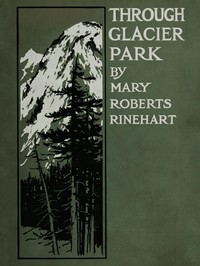
This is about a three-hundred mile trip across the Rocky Mountains on horseback with Howard Eaton. It is about fishing, and cool nights around a camp-fire, and long days on the trail. It is about a party of all sorts, from everywhere, of men and women, old and young, experienced folk and novices, who had yielded to a desire to belong to the sportsmen of the road. And it is by way of being advice also. Your true convert must always preach.
If you are normal and philosophical; if you love your country; if you like bacon, or will eat it anyhow; if you are willing to learn how little you count in the eternal scheme of things; if you are prepared, for the first day or two, to be able to locate every muscle in your body and a few extra ones that seem to have crept in and are crowding, go ride in the Rocky Mountains and save your soul.
If you are of the sort that must have fresh cream in its coffee, and its steak rare, and puts its hair up in curlers at night, and likes to talk gossip in great empty places, don't go. Don't read this. Sit in a moving-picture theater and do your traveling.
But if you go--!
It will not matter that you have never ridden before. The horses are safe and quiet. The Western saddle is designed to keep a cow-puncher in his seat when his rope is around an infuriated steer. Fall off! For the first day or two, dear traveler, you will have to be extracted! After that you will learn that swing of the right leg which clears the saddle, the slicker, a camera, night-clothing, soap, towel, toothbrush, blanket, sweater, fishing-rod, fly-hook, comb, extra boots, and sunburn lotion, and enables you to alight in a vertical position and without jarring your spine up into your skull.
Now and then the United States Government does a very wicked thing. Its treatment of the Indians, for instance, and especially of the Blackfeet, in Montana. But that's another story. The point is that, to offset these lapses, there are occasional Government idealisms. Our National Parks are the expression of such an ideal.
I object to the word "park," especially in connection with the particular National Reserve in northwestern Montana known as Glacier Park. A park is a civilized spot, connected in all our minds with neat paths and clipped lawns. I am just old enough to remember when it meant "Keep-Off-the-Grass" signs also, and my childhood memories of the only park I knew are inseparably connected with a one-armed policeman with a cane and an exaggerated sense of duty.
There are no "Keep-Off-the-Grass" signs in Glacier Park, no graveled paths and clipped lawns. It is the wildest part of America. If the Government had not preserved it, it would have preserved itself. No homesteader would ever have invaded its rugged magnificence or dared its winter snows. But you and I would not have seen it.
True, so far most niggardly provision has been made. The Government offices are a two-roomed wooden cabin. The national warehouse is a barn. To keep it up, to build trails and roads, to give fire protection for its fourteen hundred square miles of great forest, with many millions of dollars worth of timber, are provided thirteen rangers! Thirteen rangers, and an annual allowance less than half of what is given to Yellowstone Park,--with this difference, too, that Yellowstone Park has had money spent on it for thirty-two years while Glacier Park is in the making! It is one of the merry little jests we put over now and then. For seventy-five miles in the north of the park there is no ranger. Government property, you see, and no protection.
But no niggardliness on the part of the Government can cloud the ideal which is the raison d'être for Glacier Park. Here is the last stand of the Rocky Mountain sheep, the Rocky Mountain goat. Here are antelope and deer, black and grizzly bears, mountain lions, trout--well, we are coming to the trout. Here are trails that follow the old game trails along the mountain-side; here are meadows of June roses, true forget-me-nots, larkspur, Indian paintbrush, fireweed,--that first plant to grow after forest fires,--a thousand sorts of flowers, growing beside snow-fields. Here are ice and blazing sun, vile roads, and trails of a beauty to make you gasp.
A congressional committee went out to Glacier Park in 1914 and three of their machines went into the ditch. They went home and voted a little money for roads after that, out of gratitude for their lives. But they will have to vote more money, much more money, for roads. A Government mountain reserve without plenty of roads is as valuable as an automobile without gasoline.
Nevertheless,--bad roads or good or none, thirteen rangers or a thousand,--seen from an automobile or from a horse, Glacier Park is a good place to visit. Howard Eaton thinks so. Last July, with all of the West to draw from, he took his first party through Glacier. This year in June, with his outfit on a pack-horse, he is going to investigate some new trails and in July he will take a party of riders over them.
Forty-two people set out with Howard Eaton last summer to ride through Glacier Park. They were of every age, weight, and temperament. About half were women. But one thing they had in common--the philosophy of true adventure.
Howard Eaton is extremely young. He was born quite a number of years ago, but what is that? He is a boy, and he takes an annual frolic. And, because it means a cracking good time, he takes people with him and puts horses under them and the fear of God in their hearts, and bacon and many other things, including beans, in their stomachs.
He has taken foreign princes and many of the great people of the earth to the tops of high mountains, and shown them grizzly bears, and their own insignificance, at one and the same time. He is a hunter, a sportsman, and a splendid gentleman. And, because equipment is always a matter of much solicitude on the part of the novice, I shall tell you what he wears when, on his big horse, he leads his long line of riders over the trails. He wears a pair of serviceable trousers, a blue shirt, and a vest! Worn by Howard Eaton, believe me, they are real clothes. He has hunted along the Rockies from Alaska to Mexico. He probably knows Montana, Wyoming, and Idaho as well as any man in the country.
When Howard Eaton first went West he located in the Bad Lands. Those were the "buffalo" days, and it was then that he began taking his friends with him on hunting trips. At first they went as his guests. Even now they are his guests in the truest sense of the word.
By their own insistence, as the parties grew larger, they determined to help defray the cost of the expeditions. Every one who knows Howard Eaton knows that his trips are not made for profit. Probably they barely pay for themselves. It is impossible to talk to him about money. Save as a medium of exchange it does not exist for him. Life for him is twenty-four hours in the open air,--half of that time in the saddle,--long vistas, the trail of game, the camp-fire at night, and a few hours of quiet sleep under the stars.
Roosevelt's ranch was near the Eaton ranch when it was in the Bad Lands. Roosevelt and Howard Eaton have taken many hunting trips together. Titled foreigners of all sorts have come over and hunted elk, deer, and other game with him. He has supplied museums, parks, and animal shows in every part of America with game. He was and is a crack shot, of course. He says he always treated the Indians with respect. "I was always a little shy when Indians were in the same country with me, and once when hunting I retired so fast that the boys said I beat my shadow six miles in fifteen minutes."
In those days the town of Sentinel Butte consisted of a canvas saloon with the sign:--
Rev. C. A. Duffy Best Wines, Liquors, and Cigars
"I had a fine chance to steal that sign once," says Howard Eaton, "but some folks are fools, and I overlooked a bet."
The Eaton "boys"--for there are three--left Pittsburg and went West many years ago. Howard was the first. He went in 1879. In 1884 Theodore Roosevelt went out to the same country. It was in 1904 when the Eatons left the Bad Lands and went toward the Big Horn Mountain. There, at the foot of Wolf Creek and in the center of the historic battle-ground of the Arapahoes, Sioux, Crows, and Cheyennes, they established a new ranch at Wolf, Wyoming.
The rendezvous for the Eaton party last summer was at Glacier Park Station on the Great Northern Railway. Getting to that point, remote as it seemed, had been surprisingly easy--almost disappointingly easy. Was this, then, going to the borderland of civilization, to the last stronghold of the old West? Over the flat country, with inquiring prairie dogs sitting up to inspect us, the train of heavy Pullman diners and club car moved steadily toward the purple drop-curtain of the mountains. West, always west.
Now and then we stopped, and passengers got on. They brought with them something new, rather electric. It was enthusiasm. The rest, who had been Eastern and greatly bored, roused and looked out of the windows. For the newcomers were telling fairy tales, with wheat for gold and farmers for princes, and backing everything with figures. They think in bushels over rather a large part of America to-day.
West. Still west. An occasional cowboy silhouetted against the sky; thin range cattle; impassive Indians watching the train go by; a sawmill, and not a tree in sight over a vast horizon! Red raspberries as large as strawberries served in the diner, and trout from the mountains that seemed no nearer by mid-day than at dawn!
Then, at last, at twilight, Glacier Park Station, and Howard Eaton on the platform, and old Chief Three Bears, of the Blackfeet, wonderfully dressed and preserved at ninety-three.
It was rather a picturesque party. Those who had gone up from the Eaton ranch in Wyoming--a trifle of seven hundred miles--wore their riding-clothes to save luggage. Khaki was the rule, the women mostly in breeches and long coats, with high-laced shoes reaching to the knee and soft felt hats, the men in riding-clothes, with sombreros and brilliant bandannas knotted about their throats. One or two had rather overdone the part and were the objects of good-natured chaffing later on by the guides and cowboys.
"Hi!" cried an urchin as we walked about the streets of Billings, Montana, to stretch train-tired muscles. "Here's the 101 Ranch!"
Not very long before I had been to the front in Belgium and in France. I confess that no excursion to the trenches gave me a greater thrill than the one that accompanied that start the next morning from the Glacier Park Hotel to cross the Continental Divide. For we were going to cross the Rockies. Our route was three hundred miles long. It was over six passes, and if you believe, as I did, that a pass is a valley between two mountains, I am here to set you right.
A pass is a bloodcurdling spot up which one's horse climbs like a goat and down the other side of which it slides as you lead it, trampling ever and anon on a tender part of your foot. A pass is the highest place between two peaks. A pass is not an opening, but a barrier which you climb with chills and descend with prayer. A pass is a thing which you try to forget at the time and which you boast about when you get back home. For I have made it clear, I think, that a horseback trip through Glacier Park, across the Rockies, and down the Pacific Slope, is a sporting proposition. It is safe enough. Howard Eaton has never had an accident. But there are times--