The opening · free to read
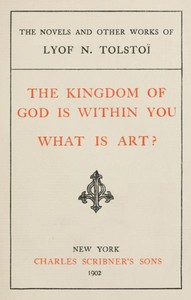
The present volume contains two contrasting treatises. The first is religious, and shows in Count Tolstoï's earnest and eloquent manner the meaning of Christ's words which he takes for his text,--"The Kingdom of God is within you." The outward forms of religion, however helpful they may be to some souls, are not essential; the superstitions with which Faith sometimes clothes or masks herself may or may not be uplifting; but the foundation of Christianity is the truth contained in Christ's words, his simple, plain, undogmatic commands and prohibitions.
One word sums it all up, and that word is Love. If the world should take love for its guiding star, it is evident that all the evils of the world would cease,--wars, crimes, poverty, ambitions; the millennium would come! Count Tolstoï shows how that blessed period may begin in every man. The translation of this beautiful and inspiring book has been made by Mrs. Aline Delano of Boston.
In answering the question, "What is Art?" Count Tolstoï analyzes and tests the various definitions given by other writers. He shows up with merciless severity what he considers the fallacy in the popular delusion that the fetish of Art pardons bestiality, obscenity, and whatever conduces to stimulating the passions. The work is strongly controversial, and attacks unsparingly many of the popular notions of the day, as, for instance, that "Art is the manifestation of some mysterious idea of God," or "the expression of man's emotions by external signs," or the production of pleasing objects. He believes that art has a loftier function, and he proceeds elaborately to argue in favor of this universal activity, which should be to effect a union among men so that they may have the same noble feelings and progress together toward universal and individual well-being. "Art for art's sake" is meaningless to him. It is interesting to notice that the most original and independent of the French critics has recently taken practically the same ground in a lecture, in which he asserts that it is the critic's business to test art and literature, and that art has a most intimate relation with morality.
Much of the book is racy and amusing; much of it is abstruse, and requires close attention. But whether one follows the author in his individual opinions or not, it cannot be denied that the general tone of the treatise is helpful and uplifting, and that it is based on sound common sense. Mr. Aylmer Maude of England is the translator of this work, and has had the benefit of Count Tolstoï's own suggestions in regard to certain points. As the special preface explains, the translation accurately represents the author's views, while the edition published in Russia was in many ways garbled and distorted. The translators of both treatises have seized the opportunity of carefully revising their work.
The book keeps going
Keep reading, and see it illustrated
Reading is free forever. Sign up and watch scenes appear while you read.
Scenes Storieta drew for other classics.