THE BOYHOOD OF SAMUEL.
BY THE REV. BRADFORD K. PEIRCE, D.D.
A long time ago--more than three thousand years--a little boy was born to a loving mother. She was a Jewess, and in those days it was the custom to be called by only one name. Her name was Hannah, or Anna. She lived with the father of her little boy in a mountain village six or eight miles north of the city of Jerusalem.
Hannah was a tender-hearted woman, and as good as she was gentle. She longed to have a little boy who might grow up and be trained to be a teacher of the true God among the people around her, who were very ignorant and wicked in those days. So she prayed, and God heard her prayer. Upon the birth of the little fellow she named him Samuel, which means Asked of God. So happy and grateful to God was this Jewish mother that she wrote a wonderful song, which has been preserved all these years, and may be still read in the Bible.
When her boy was two or three years old she carried him to the place where the people of the country met to worship God, where was the great tent called the Tabernacle, with its different coverings, of which we are told in the second book of the Bible, and where the priest of God and those that assisted him lived. Here she left him, with many warm kisses and tears, that he might be taught by these religious men, and be fitted to become in after-years a prophet or teacher of the true God. His school had no vacations; but once a year regularly his mother came to see him, bringing him a new, rich mantle as a gift of love, and a proper robe for one who assisted in public worship, although a child, to wear.
Every one saw that he was a remarkable boy. The old priest loved him as a son. The blessed God in heaven also loves children, and knows how to express His love to them so that they will understand it. He sometimes intimates to them, when He is about to call them to some great work, that they are by-and-by to become His ministers. Many a little fellow as young as Samuel has felt in his mind, he hardly knew how or why, that he would some time be a preacher of the Gospel.
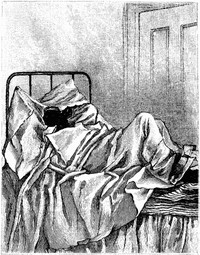
When Samuel was about twelve years of age this wonderful thing happened to him. He had a little room by himself within the great tent where the people worshipped. The aged priest, whose name was Eli, had another quite near to him. In the night, while the lamps were still burning in the Tabernacle, and he had fallen asleep on his bed, he was suddenly awaked by a voice calling him by name. He supposed, of course, it was Eli calling, and he hurried to the old man's chamber, saying, as he entered, "Here am I."
"I did not call you," said Eli; "go, lie down again."
He had hardly dropped into slumber once more, when the same voice awaked him again: "Samuel, Samuel," it said.
He ran again to the room of Eli, and said, "Here am I; for thou didst call me."
The old man thought, probably, that he was disturbed by terrifying dreams, and said to him, "I called not, my son; lie down again."
A third time the voice called. It is wonderful that the lad was not affrighted. But if one loves God and does right, there is nothing that can harm him. The open-faced child of the Tabernacle, obeying without hesitation, although answering twice in vain, hastened to the chamber of Eli with his ready and filial response, "Here am I; for thou didst call me."
The aged minister then knew that it was not a human voice, but the voice of God. He said to the child, "Go, lie down, and if the voice is heard again, say, 'Speak, Lord, for Thy servant heareth.'"
He went alone to his chamber and to his bed in the silence of the night, and once more the voice came, so sweet and gentle as not to terrify him, "Samuel, Samuel."
"Speak, Lord," he answered, as he sat up on his bed, "for Thy servant heareth."
Then God gave him a message to his master, and to the people, and made him at this early age a teacher and a prophet of the Lord.
It was just at this moment, when the boy sits up, solemnly, with his eyes wide-opened, listening to the Divine voice, that the great English painter Sir Joshua Reynolds, in his well-known picture, represents the prophet-child. It is at this moment that his wondering and prayerful face is caught by the artist in the beautiful picture which is given in this paper.
God does not now speak audibly in the sleeping-rooms of little fellows; but when they kneel, night by night, by their bedsides, and say, "Speak, Lord, for Thy servant heareth," He comes into their minds and leads and teaches them just as if He called them by name. There is no prayer goes up to Heaven more readily heard or answered than the simple words of a sincere, praying child.
[Begun in HARPER'S YOUNG PEOPLE No. 53, November 2.]
THE BOY-GENERAL.
BY EDWARD CARY.
When the courier who brought the news that Lafayette had landed again in Boston was introduced to the presence of General Washington, those who were standing by saw tears of joy run down the cheeks of the veteran soldier; and when Lafayette came to him, bearing the glad tidings that ships and men and money were on their way from France to aid in the common cause, the happiness of Washington was beyond words. And well it might be. The help the French had sent the year before was of little use. The country had again fallen into a weary and grumbling mood. The army had shrunken until it was the mere ghost of an army. There was no money in the Treasury. Washington wrote to Lafayette that he had not enough cash at his disposal, or in the whole army, to pay one messenger to ride fifty miles. And here came back the dearly loved friend from France, whose zeal and talent had won from the French government promises of the most generous help. No wonder that the brave American commander welcomed Lafayette with a heart filled with gratitude and love.
The young Marquis resumed his old place at the head of the advance guard of chosen troops. He had brought back from France a thousand little gifts for his old corps--badges for the soldiers, swords for the officers, a bright new silken flag for each battalion--kindly proofs of the affection with which he had constantly remembered them.
The French fleet, and an army under the Count de Rochambeau, followed quickly after Lafayette, and great efforts were made to agree upon a common plan for the campaign. Unluckily only a part of the fleet came at first, and this part got shut up by a larger English fleet at Newport, and was of little value, except that the English ships which were watching it could not ravage the American coasts.
Just at this moment happened one of those little incidents which sometimes have great effect. Washington had gone from near New York over to Connecticut to hold a meeting with the French commanders. On his way back he turned off his road to show to Lafayette the forts at West Point on the Hudson River, of which he was quite proud, and which had been laid out by an intimate friend of Lafayette's. Benedict Arnold, who was in command at West Point, had just arranged to betray the post to the English. Major André, an English officer, had been sent up to close the bargain. On his way back to New York he was captured as a spy, and all the papers on his person were sent to General Arnold, whose treason no one suspected. Arnold received them a half-hour before he expected General Washington. Had he not looked for Washington's arrival he could have released André, and carried out his wicked plan. Instead, he fled straightway to the British camp; so that Washington's love for Lafayette, which made him wish to show him the forts at West Point, was, in this curious fashion, a means of saving the American cause. Had the British captured West Point, and cut off the Eastern from the Central and Southern States, the Americans might easily have been subdued.
The year 1780 passed without any events of importance. But early in 1781 Washington sent Lafayette south into Virginia with a couple of thousand men to capture an English garrison at Portsmouth, near the mouth of the Chesapeake Bay. This he was to do with the help of a French fleet, which was to arrive there at the same time. But an English fleet got ahead of the French fleet, and beat it in a sea-battle off Cape Henry. Lafayette was about to return, when Washington wrote him to stay and try to protect the State of Virginia, which the British were about to overrun. Lafayette staid, of course, but he had a hard time of it. His troops had not expected to remain, and were inclined to desert and go home, the more because they were very badly clothed. Lafayette borrowed $10,000 in his own name, and got them new clothing and shoes. Then he issued an order telling them that he was about to start on a dangerous business, and any man who was afraid to go with him would be sent back. That put a stop to desertion.
Meanwhile, Lord Cornwallis, the ablest General the British had in America, made his appearance with an army much stronger than Lafayette's. He was "a cool, active" man, and was bent on capturing the young Frenchman. Lafayette drew back slowly before him, trying to deceive him as to his real strength.
At last Cornwallis had pushed the little army of Americans away northward to the foot of the mountains, and wrote to New York, "The boy can not now escape me." But marching all night by a back road through the woods, and leaving his baggage and tents and heavy guns behind him, Lafayette appeared to the astonished eyes of the British commander in a strong position, from which he could not be driven. Just at this point Lafayette got some more men from Washington's camp and from Virginia, and then commenced one of the most remarkable campaigns ever known. Lafayette, still much weaker than Cornwallis, was so active, and appeared so confident, that the English slowly withdrew toward the coast. Always seeming anxious to fight, yet never risking a general battle, Lafayette followed Cornwallis until he got him into the village of Yorktown, between the York River and the James River. There the British felt safe, thinking that they could at any time get to New York by water, or with a few more men could sally out and drive Lafayette from Virginia.
But Lafayette expected a French fleet off the coast, and contented himself with carefully watching his enemy, and writing to Washington to hasten south with his army and make the capture of the British certain. At last the French fleet came, and poor Cornwallis, with all his skill and courage, was surrounded. He could hardly believe his eyes, and tried in one way and another to break through; but it was of no use. The French landed in large force, and their commanders urged Lafayette to take Yorktown by storm. They appealed to his love of fame. He had foiled Cornwallis, and shut him up in Yorktown: he ought to have the glory of his capture. But the humane young hero put aside this temptation, and refused to waste his men's lives in a venture which might not succeed. He knew that Cornwallis could not escape, and that when Washington arrived with his army the British would have to surrender, with little or no bloodshed--so admirably combined in his character were courage, prudence, and kindness. At last Washington came, with Count de Rochambeau and a large army, and Cornwallis on the 19th of October was compelled to lay down his arms. And this practically ended the war, although it was not until two years after that peace was declared, and the United States were acknowledged to be free and independent.