
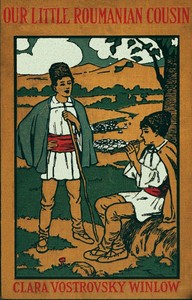
Public-domain ebook
Our Little Roumanian Cousin
Language: en354 downloads on Project Gutenberg
Subjects
In: Children & Young Adult Reading·Novels
Public-domain ebook sourced from Project Gutenberg #43637.
Public-domain ebook
Language: en354 downloads on Project Gutenberg
Subjects
In: Children & Young Adult Reading·Novels
Public-domain ebook sourced from Project Gutenberg #43637.
The opening · free to read
Jonitza lay sprawled out on the warm carpet in the living-room near a big brick stove that reached almost to the ceiling. Beside him were his playthings and two picture books with fancy covers, but he kicked his slippered feet discontentedly at them, until his mother, seated at the other end of the room, arose, put down her sewing, and with a scarcely audible sigh, picked them up and laid them on the table.
Jonitza paid no attention. Ever since he had been seriously ill the month before, he had grown accustomed to having people wait on him. He now turned on his back and began tracing in the air with his finger the pretty stenciled patterns that covered the walls. Tiring of that, he started beating a monotonous tattoo with one foot, until his mother, with the faintest shade of impatience, said: "I think you'd better get up. You've been lying on the floor for a whole hour doing nothing."
Jonitza arose languidly, stretched himself, and walking over to one of the big double windows, plumped himself down into a deep arm chair in front of it.
Jonitza's home was a very comfortable one-story house in the city of Galatz, one of the leading ports on the Danube River, near the border line between Moldavia and Wallachia, the two provinces which with Dobrudja, make up the kingdom of Roumania. It was in one of the best residence districts, at one end of a high earth cliff. Somewhat below this cliff extended the flat level of the Lower Town, made up principally of mills and business houses, immense warehouses for grain, much of which is exported from Roumania, and wharves stretching out to the river.
The little boy could not see much of this, but far below, in between the scattered apricot-trees and lilac bushes in the garden, he could just get a glimpse of an interesting procession of rude carts to which bullocks or buffaloes were harnessed, toiling slowly upward on a wide road. He had become so interested in the struggles of one cart that looked as if it were loaded with the enormous reeds that are used for fuel by the poorer people of Galatz that he did not hear the bell ring and so was quite unprepared to have a hand suddenly laid on his shoulder and to look up into the smiling face of the family Doctor.
Jonitza had a guilty feeling without knowing why and tried his best to scowl and look away. It wasn't easy though.
"Why aren't you out-of-doors?" the Doctor asked in a surprised tone.
It was Jonitza's turn to be surprised. "Why," he stammered, "it's--too cold," here he shivered, "I--I--I am not well enough."
"What nonsense!" the Doctor said. "The air is delightful. I've been traveling around half the day in it. And, even granting that you're not well--why, fresh air is the only thing that will make you well."
Jonitza suppressed a yawn and looked listlessly about him. The Doctor shrugged his shoulders as he said: "I see I must leave a new prescription for you." Saying this, he tore a leaf from his note-book, hastily wrote something on it, folded it, and handed it to Jonitza's mother who stood near by, with: "Please treat what is written here seriously, Mrs. Popescu. I shall have more to say regarding it to your husband. Now I must hurry away."
But Mrs. Popescu barred the entrance.
"Not until you have had some coffee," she said. At the same moment, a maid entered with a tray on which were coffee and sweets, the refreshments usually handed to visitors in Roumania. The Doctor took a taste of the coffee and one of the sweetmeats and laughingly remarked as he left: "It's only fresh air that keeps me from breaking down under the régime to which I am subjected."
It was only after the door had closed behind him that Mrs. Popescu unfolded the paper that he had given her. As she glanced over it she gave an exclamation that caused her son to look up inquiringly.
"Come here," she said to him, and, when he approached, she put her arms around him. "The Doctor asked this to be taken seriously, and he has ordered--"
Jonitza's eyes grew round with something like terror, as he fixed them on her.
"It's nothing bad. Do look natural," his mother hastily continued. "He has simply ordered me--to take you to spend a month on a farm near some springs in the foot-hills!"
Evidently the Doctor did see Jonitza's father, for before the week was ended it had been definitely decided that as soon as the weather was a little warmer Mrs. Popescu would leave with her son for a month's stay in the country. Jonitza had been a trifle interested at first, then he had grumbled, and, finally, he had resumed the languid air that was so peculiarly trying to those about him.
There was one thing in particular that he rebelled against even in his languid state and that was the fact that every afternoon he was now bundled up and ordered out-of-doors for an hour.
"I don't want to go," he would say every time; and every time his mother would kiss him and answer sweetly, "It is for your own good. We must do what the Doctor orders."
Then he would go out into the garden with its lilac and acacia bushes that were just beginning to show leaf buds and walk slowly up and down or stand first on one foot and then on the other as if unable to decide what to do. But one day things went differently. Whether it was due to the air having a genuine spring flavor for the first time that year, or to the fact that it was a holiday and he had been left at home with a couple of servants, or to the fact that the departure for the foot-hills had been definitely set for the first day of the following week, or to some other entirely different cause, in any case there was quite an alert look about the boy and even something of a sparkle in his eyes.
Maritza, the maid, noticed it and remarked to the cook: "Master Jonitza looks quite spry to-day. If he were well, I'd warrant he would get into some mischief." Then she forgot all about him.
A group of boys that Jonitza knew slightly passed by and one seeing him called out: "Come on with us. We're going to the marsh." To his own surprise, Jonitza called back, "All right," and joined them.
When they reached a marshy plain bordering on the Danube some of the boys left them, and Jonitza found himself alone with two boys, both younger than himself. All three were tired from the walk, and finding the stump of an old tree, sat down on it and amused themselves counting the ducks that they saw. Suddenly something that his tutor had told him occurred to Jonitza. "Do you know," he said, "that there are more varieties of ducks on the Danube than in most parts of the world? Let's see how many different ones we can make out."
The little boys did not take kindly to the suggestion. "I am hungry," one of them said; "let's go home."
So back the three began to trudge, now and then throwing a stone into the air, or, when they could, into the water.
Jonitza felt more tired than he cared to confess to the two youngsters and inwardly planned to lie down as soon as he came within doors. "I'll be home in less than fifteen minutes, now!" he suddenly exclaimed, thinking aloud.
"How can you and see me dance?" said a voice behind him so unexpectedly that Jonitza jumped. Turning, he saw a laughing peasant all decorated with tiny bells.
"Oh, jolly!" the other boys shouted. "There's going to be a dance! Come on!"
Those little bells must have said "Come on" too, for Jonitza found himself trying to keep up with the peasant's rapid strides.
Down in the Lower Town, before one of the old domed churches, they found a crowd gathered. Although there was nothing unusual about such a gathering, one could see from the faces that something unusual was expected.
It was not a silent expectation, however. Everywhere people were talking and laughing and a few young men were even singing. As soon as the peasant with bells appeared, a shout arose. At the same instant a troop of other peasants, all attired in their gay embroidered national costumes, with bells at their girdles and on their sleeves, came in a body into the square, and taking their places began to dance and shout and sing and stamp their feet. Some one said this was the Pyrrhic Dance that was sacred in ancient mythology, and that had come to the Roumanians from their Roman forefathers; a dance to prevent Saturn from hearing the voice of his infant son Jupiter, lest he devour him. Whether this explained it or not there was no doubt of the audience liking it, for at its conclusion all clapped their hands and burst into boisterous exclamations of delight. Jonitza, feeling some of the excitement, clapped too, and no longer conscious of any tired feeling waited until almost every one had gone before he made his way slowly home.
On Tuesday of the following week Jonitza, his mother, and the maid Maritza, after a short trip on the train, were being driven over the vast level and wonderfully fertile plains of Roumania, that stretched before them like a great green sea. There were already signs that the short spring that Roumania has would soon change into summer. Wild flowers were to be seen here and there and birds twittered and flew about.
The way lay among thatched farm-houses whose gleaming walls showed that they had been freshly whitewashed at Easter. Now and then a peasant seated in a rude wagon, drawn by beautiful, creamy, short-legged oxen with wide-spreading horns, saluted them gravely.
At a little elevation in the road they passed a group of dug-outs called bordei, with turf-covered roofs and shapeless clay chimneys. The windows in these bordei were merely irregular holes in the mud walls. At the door leading down into one of these primitive houses stood an attractive looking woman, with a bright yellow kerchief over her head, and another around her neck. She was busily spinning while she crooned a lullaby to a baby who lay blinking its eyes in an oval wooden box swinging from the branches of a tree near by.
Not far from these bordei was a cemetery filled with crosses of the oddest possible shapes. It really seemed as if the people had tried to find a new design for each new grave.
They passed wayside crosses also, before some of which peasants were kneeling in prayer.
But, despite these interesting things, there was something tiring in the long journey over the monotonously level plains, and Jonitza grew more and more restless. His pretty mother noticed it and drawing him to her she began to tell him the most interesting stories. First of all about Trajan, the great Roman Emperor, who came to their country so many centuries ago and conquered the people who then inhabited it. She described to him the great column in Rome commemorating his victory, and told him how proud every Roumanian was that he was descended from the soldiers that the Emperor left to guard the new possessions.
"Is that why we call the thunder Trajan's voice?" asked Jonitza.
"Perhaps," his mother answered. "We certainly love to call things by his name."
"The Milky Way is Trajan's Road, isn't it?" again inquired Jonitza.
The book keeps going
Reading is free forever. Sign up and watch scenes appear while you read.



Scenes Storieta drew for other classics.
New illustrated classics
Once or twice a month: the latest books to get full character casts, scene art, and free comic editions. No account needed.

![Cover of Peter Pan: [Peter and Wendy]](/covers/16.jpg)