Public-domain ebook
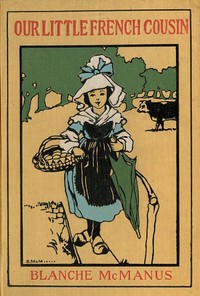
Our Little French Cousin
Language: en304 downloads on Project Gutenberg
Subjects
In: Historical Novels·Children & Young Adult Reading·Novels
Public-domain ebook sourced from Project Gutenberg #43831.
Public-domain ebook
Language: en304 downloads on Project Gutenberg
Subjects
In: Historical Novels·Children & Young Adult Reading·Novels
Public-domain ebook sourced from Project Gutenberg #43831.
The opening · free to read
"OH, mamma!" cried little Germaine, as she jumped out of bed and ran to the window, "how glad I am it is such a beautiful day."
Germaine was up bright and early on this sunshiny day, for many pleasant things were going to happen. However, this was not her only reason for early rising. French people always do so, and little French children are not allowed to lie in bed and to be lazy.
At the first peep of daylight Germaine's papa and mamma were up, and soon the "little breakfast," as it is called, was ready in the big kitchen of the farmhouse. Even the well-to-do farmers, like Germaine's papa, eat their meals in their kitchens, which are also used as a general sitting-room.
Everything about a French house is very neat, but especially so is the kitchen, whose bare wooden or stone floor is waxed and polished every day until it shines like polished mahogany. On the mantelpiece of the kitchen of Germaine's home, which was more than twice as tall as Germaine herself, was a long row of brass candlesticks, a vase or two, and a little statue of the Madonna with flowers before it.
The fireplace took up nearly all of one side of the room, and was so large that it held a bench in either side where one could sit and keep nice and warm in winter. Hanging in the centre, over the fire, was a big crane,--a chain with a hook on the end of it on which to hang pots and kettles to boil. There were beautiful blue tiles all around the fireplace, and a ruffle of cloth along the edge of the mantel-shelf.
Not far from the fireplace was a good cooking-stove, for the better class farmers do not cook much on the open fire, as do the peasants.
All about the walls were hung row after row of copper cooking utensils of all kinds and shapes, all highly polished with "_eau de cuivre_." Madame Lafond, Germaine's mamma, prided herself on having all her pots and pans shine like mirrors.
"Be quick, my little one," said Madame Lafond, as Germaine seated herself at the table in the centre of the room. "You have much to do, for, as you know, we are to see M. Auguste before we go to meet Marie; and we must finish our work here, so as to be off at an early hour."
Germaine's breakfast was a great bowl of hot milk, with coffee and a slice from the big loaf lying on the bare table. The French have many nice kinds of bread, and what they call household bread, made partly of flour and partly of rye, is the kind generally eaten by the country people. It is a little dark in colour, but very good.
It was to-day that Germaine was to go with Madame Lafond to the station at Petit Andelys to meet her sister Marie, who had been away at a convent school at Evreux, and who was coming home for the summer holidays. On their way they were to stop at the Hôtel Belle Étoile, for it was the birthday--the fête-day, as the French call it--of their good friend the proprietor, M. Auguste, and Madame Lafond was taking him a little present of some fine white strawberries which are quite a delicacy, and which are grown only round about. M. Lafond was to meet them at the station, and all were to take dinner with her Uncle Daboll at his house in the village, to celebrate Marie's home-coming.
So, as may be imagined, Germaine did not linger over her breakfast, but set to work at her morning tasks with a will.
"Blanche, you want your breakfast, too," she said, as she stroked her pet white turtledove, who had been walking over the table trying to attract her attention with soft, deep "coos," "and you shall have it here in the sunshine," and, putting her pet on the deep window-ledge, she sprinkled before it a bountiful supply of crumbs. "That, now, must last until I get back."
"Now, come, Raton," she called to their big dog. "We must feed the rabbits," and, taking a basket of green stuff, she ran across the courtyard into the garden.
In France the farm buildings are often built around an open square, which is entered by a large gate. This is called a closed farm. In olden times there were also the fortified farms, which were built strongly enough to withstand the assaults of marauders, and some of these can still be seen in various parts of the country.
The gateway was rather a grand affair, with big stone pillars, on top of which was a stone vase, and in the gate was a smaller one, which could be used when there was no need to open the large one to allow a carriage or wagon to enter.
On one side of the yard was the laiterie, where the cows were kept and milked. There were a number of cows, for M. Lafond sold milk and butter, carrying it into the market at Grand Andelys.
On another side was the stable, where were kept the big farm-horses,--Norman horses as we know them, one of the three celebrated breeds of horses in France. Near by were the wire-enclosed houses for the chickens and geese and the ducks, which ran about the yard at will and paddled in the little pond in one corner.
In the centre was the pigeon-house, a large, round, stone building, such as will be seen on all the old farms like this of M. Lafond's. It was an imposing structure, and looked as if it could shelter hundreds of pigeon families. Under a low shed stood the farm-wagons and the farming tools and implements.
La Chaumière, as the farm was known, took its name from the thatch-covered cottage. Many of the houses in this part of the country have roofs thatched with straw, as had the other buildings on the farm. Germaine's home, however, had a red tile roof, though it was thatched in the olden days, for it had been in M. Lafond's family for many generations.
On the opposite side of the house was the garden, surrounded by a high wall finished off with a sort of roof of red tiles. The square beds of fine vegetables were bordered by flowers, for in France the two are usually cultivated together in one garden. Against the wall were trained peach, pear, and plum trees, as if they were vines; this to ripen the fruit well. In a corner were piled up the glass globes,--shaped like a bell or a beehive,--which are used to put over the young and tender plants to protect them and hasten their growth.
Against one corner of the wall were the hutches for the rabbits, built in tiers, one above the other, and full of dozens of pretty "bunnies," white, black and white, and some quite black.
It was Germaine's duty to feed them night and morning, and she liked nothing better than to give them crisp lettuce and cabbage leaves and see them nibble them up, wriggling their funny little noses all the time. "Well, bunnies, you will have to eat your breakfast alone this morning; I cannot spare you much time," Germaine told them, as she gave them the contents of her basket. Raton was leaping beside her and barking, for he was a great pet, and more of a companion than most dogs in French farms. They are usually kept strictly for watch purposes, the poor things being tied up in the yard all of the time; but Germaine's people were very kind to animals, and Raton did much as he pleased.
"I am ready, mamma," said Germaine, running into the kitchen.
"So am I, my dear," and Madame Lafond took from behind a copper saucepan hanging on the wall a bag of money, from which she took some coins and put the bag back again in this queer money-box. She then placed the basket of strawberries on their bed of green leaves on her arm, and she, Germaine, and Raton set off.
Madame Lafond had on a neat black dress, very short, and gathered full around the waist, and a blue apron. Her hair was brushed back under her white cap, and on her feet she wore sabots, the wooden shoes all the working people in the country wear.
Germaine's dress was her mother's in miniature, and her little sabots clacked as she ran down the road, carrying in her hand a pot holding a flower, carefully wrapped about with white paper for M. Auguste. It was a beautiful walk through the fields and apple orchards, into the road, shaded by old trees that led to the top of the hill, and then down the hillside past the old Château Gaillard; that wonderful castle whose history Germaine never wearied of hearing.
It seemed to her like a fairy-tale that such things could have happened so near her papa's farm, though it all took place many hundreds of years ago, when there was nothing but wild woods where now stands their farm and those of their neighbours.
The château was built by the great Norman who became an English king. He was known as Richard the Lion-hearted, because he was so brave and fearless. Perhaps our little English cousins will remember him best by this romantic story. Once King Richard was imprisoned by his enemies, no one knew where; his friends had given him up for lost--all but his faithful court musician Blondel, who went from castle to castle, the length and breadth of Europe, singing the favourite songs that he and his royal master had sung together. One day his devotion was rewarded, for, while singing under the windows of a castle in Austria, he heard a voice join with his, and he knew he had found his master.
At that time France was not the big country it is now. Normandy belonged to the English Crown, and the Kings of France were always trying to conquer it for their own.
So Richard built this strong fortress on the river Seine, at the most important point where the dominion of France joined that of Normandy. He planned it all himself, and, it is said, even helped to put up the stones with his own hands. It was begun and finished in one year, and when the last stone was placed in the big central tower, King Richard cried out: "Behold my beautiful daughter of a year." Then he named it Château Gaillard, which is the French for "Saucy Castle," and stood on its high walls and defied the French king, Philippe-Auguste, who was encamped across the river, to come and take it from him,--just as a naughty boy puts a chip on his shoulder and dares another boy to knock it off. Well, the French king took his dare, but he also took care to wait until the great, brave Richard had been killed by an arrow in warfare. Then for five months he and his army besieged the castle, and a desperate fight it was on both sides. At last the French forced an entrance. After that, for several hundred years, its story was one of bloody deeds and fierce fights, until another French king, Henri IV., practically destroyed it, in order to show his power over the Norman barons whom he feared; and so it stands to-day only a big ruin--but one of the most splendid in France.
Germaine often wondered why it was called "Saucy," for it did not look so to her now. The big central tower with its broken windows seemed to her like an old face, with half-shut eyes and great yawning mouth, weary with its struggles, leaning with a tired air against the few jagged walls that still stood around it.
But it looked very grand for all that, and Germaine was fond of it, and she with her cousin Jean often played about its crumbling walls. Jean would stand in the great broken window and play he was one of the archers of King Richard's time, with a big bow six feet long in his hand, and arrows at his belt, and that he was watching for the enemy who always travelled by the river, for in those days there were few roads, and journeying by boat on the river was the most convenient way to come and go.
The book keeps going
Reading is free forever. Sign up and watch scenes appear while you read.



Scenes Storieta drew for other classics.
New illustrated classics
Once or twice a month: the latest books to get full character casts, scene art, and free comic editions. No account needed.