Public-domain ebook
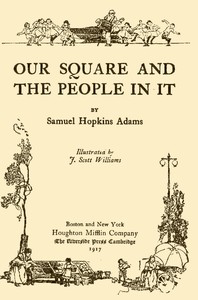
Our Square and the People in It
Language: en736 downloads on Project Gutenberg
Subjects
In: Novels·American Literature
Public-domain ebook sourced from Project Gutenberg #44328.
Public-domain ebook
Language: en736 downloads on Project Gutenberg
Subjects
In: Novels·American Literature
Public-domain ebook sourced from Project Gutenberg #44328.
The opening · free to read
OUR Square lies broad and green and busy, in the forgotten depths of the great city. By day it is bright with the laughter of children and shrill with the bickering of neighbors. By night the voice of the spellbinder is strident on its corners, but from the remoter benches float murmurs where the young couples sit, and sighs where the old folk relax their weariness. New York knows little of Our Square, submerged as we are in a circle of slums. Yet for us, as for more Elysian fields, the crocus springs in the happy grass, the flash and song of the birds stir our trees, and Romance fans us with the wind of its imperishable wing.
The first robin was singing in our one lone lilac when the Bonnie Lassie came out of the Somewhere Else into Our Square and possessed herself of the ground floor of our smallest house, the nestly little dwelling with the quaint old door and the broad, friendly vestibule, next but one to the Greek church. Before she had been there a month she had established eminent domain over all of us. Even MacLachan, the dour tailor on the corner, used to burst into song when she passed. It was he who dubbed her the Bonnie Lassie, and as it was the first decent word he'd spoken of living being within the memory of Our Square, the name stuck. Apart from that, it was eminently appropriate. She was a small girl who might have been perhaps twenty-three or twenty-four if she hadn't (more probably) been twenty, and looked a good deal like a thoughtful kitten when she wasn't twinkling at or with somebody. When she twinkled--and she did it with eyes, voice, heart, and soul all at once--the cart-peddlers stopped business to look and listen. You can't go further than that, not in Our Square at least.
How long Cyrus the Gaunt had been there before she discovered him is a matter of conjecture. He slipped in from the Outer Darkness quite unobtrusively and sat about looking thoughtful and lonely. He was exaggeratedly long and loose and mussed-up and melancholy-looking, and first attracted local attention on a bench which several other people wanted more than he did. So he got up and gave it to them. Later, when the huskiest of them met him and explained, by way of putting him in his proper place, what would have happened to him if he hadn't been so obliging, Cyrus absent-mindedly said, “Oh, yes,” threw the belligerent one into our fountain, held him under water quite as long as was safe, dragged him out, hauled him over to Schwartz's, and bought him a drink. Thereafter Cyrus was still considered an outlander, but nobody actively objected to his sitting around Our Square, looking as melancholy and queer as he chose. Nobody, that is, until the Bonnie Lassie took him in hand.
Nothing could have been more correct than their first meeting, sanctioned as it was by the majesty of the law. Terry the Cop, who presides over the destinies of Our Square, led the Bonnie Lassie to Cyrus's bench and said; “Miss, this is the young feller you asked me about. Make you two acquainted.”
Thereupon the young man got up and said, “How-d'ye-do?” wonderingly, and the young woman nodded and said, “How-d'ye-do?” non-committally, and the young policeman strolled away, serene in the consciousness of a social duty well performed.
The Bonnie Lassie regarded her new acquaintance with soft, studious eyes. There was something discomfortingly dehumanizing in that intent appraisal. He wriggled.
“Yes, I think you'll do,” she ruminated slowly.
“Thanks,” murmured Cyrus, wondering for what.
“Suppose we sit down and talk it over,” said she.
Studying her unobtrusively from his characteristically drooping position, Cyrus wondered what this half-fairy, half-flower, with the decisive manner of a mistress of destiny, was doing in so grubby an environment.
On her part, she reflected that she had seldom encountered so homely a face, and speculated as to whether that was its sole claim to interest. Then he lifted his head; his eyes met hers, and she modified her estimate, substituting for “homely,” first “queer,” then “quaint,” and finally “unusual.” Also there was something impersonally but hauntingly reminiscent about him; something baffling and disconcerting, too. The face wasn't right.
“Do you mind answering some questions?” she asked.
“Depends,” he replied guardedly. “Well, I'll try. Do you live here?”
“Just around the corner.”
“What do you do?”
“Nothing much.”
“How long have you been doing it?”
“Too long.”
“Why don't you stop?”
For the second time Cyrus the Gaunt lifted his long, thin face and looked her in the eye. “Beautiful Incognita,” he drawled with mild impertinence, “did you write the Shorter Catechism or are you merely plagiarizing?”
“Oh!” she said. Surprise and the slightest touch of dismay were in the monosyllable. “I'm afraid I've made a mistake. I thought--the policeman said you were a down-and-outer.”
“I'm the First Honorary Vice-President of the Life Branch of the Organization.”
He slumped back into his former attitude. Again she studied him. “No, I don't understand,” she said slowly.
But the dehumanizing tone had gone from the soft voice. Cyrus began to rescue his personality from her impersonal ignoring of it. He also felt suddenly a livelier interest in life. Then, unexpectedly, she turned his flank.
“You lurk and stare at my house in the dark,” she accused.
“Which house?” he asked, startled.
“You know quite well. You shouldn't stare at strange houses. It embarrasses them.”
“Is that the miniature mansion with the little bronzes of dancing street-children in the windows?”
She nodded.
“Why shouldn't I stare? There's a secret in that house!”
“A secret? What secret?”
“The secret of happiness. Those dancing kiddies have got it. I want it. I want to know what makes'em so happy.”
“I do,” said the girl promptly.
“Yes. I shouldn't be surprised,” he assented, lifting his head to contemplate her with his direct and grave regard. “Do you live there with them?”
“They're mine. I model them. I'm a sculptor.”
“Good Lord! You! But you're a very good one, aren't you?--if you did those.”
“I've been a very bad one. Now I'm trying to be a very good one.”
A gleam of comprehension lit his eye. “Oh, then it's as a subject that you thought I'd do. You wanted to sculp me.”
“Yes, I do. For my collection. You see, I've adopted this Square.”
“And now you're sculping it. I see.” He raised himself to peer across at the windows where the blithe figures danced, tiny mænads of the gutter, Bacchæ of the asphalt. “But I don't see why on earth you want me. Do you think you could make me happy?”
The book keeps going
Reading is free forever. Sign up and watch scenes appear while you read.



Scenes Storieta drew for other classics.
New illustrated classics
Once or twice a month: the latest books to get full character casts, scene art, and free comic editions. No account needed.