Public-domain ebook
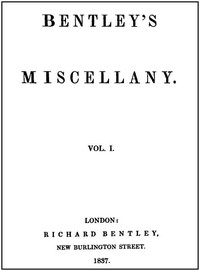
Bentley's Miscellany, Volume I
by Various
Language: en1,771 downloads on Project Gutenberg
Subjects
In: Short Stories·Poetry·Essays, Letters & Speeches
Public-domain ebook sourced from Project Gutenberg #44578.
Public-domain ebook
by Various
Language: en1,771 downloads on Project Gutenberg
Subjects
In: Short Stories·Poetry·Essays, Letters & Speeches
Public-domain ebook sourced from Project Gutenberg #44578.
Bentley’s Miscellany, Volume I is a Victorian‑era compendium of prose, poetry and satire assembled by the Bentleys’ London publishing house in 1837. The work opens with a self‑conscious “Editor’s Address,” in which the unnamed manager boasts of a six‑month run of “orders,” promises to avoid political or personal controversy, and outlines the forthcoming second volume. From there the contents list reveals a dizzying array of contributions by such names as “Father Prout,” Dr Maginn, Samuel Lover, Boz and Theodore Hook, ranging from “Songs of the Month” and light‑hearted sketches to longer pieces like “The Marine Ghost” and “Oliver Twist, or the Parish Boy’s Progress.” The opening also includes a mock‑heroic “Song of the Month” for January and a prologue that lampoons the very notion of a “Wits’ Miscellany,” setting a tone of playful self‑parody.
The voice is unmistakably mid‑nineteenth‑century, mixing witty epigrams, mock‑heroic verse and a conversational, sometimes rambling, editorial tone. Illustrations by George Cruikshank and other artists punctuate the text, reinforcing its period charm. Readers who enjoy the eclectic spirit of early Victorian periodicals, those who relish the humor of Charles Dickens’s early sketches, the literary gossip of a bygone press, and the occasional gothic or nautical tale, will find this volume a rewarding window into the lively, if occasionally chaotic, world of 1830s London literary culture.
The opening · free to read
'I pluck'd his gown, to share the good man's smile;
a game at romps constantly ensued, and we were always cordial friends, and merry play-fellows.
"Foote's earliest notices of me were far from flattering; but, though they had none of Goldsmith's tenderness, they had none of Johnson's ferocity; and when he accosted me with his usual salutation of 'Blow your nose, child!' there was a whimsical manner, and a broad grin upon his features, which always made me laugh.
"His own nose was generally begrimed with snuff; and, if he had never been more facetious than upon the subject of my emunctories, which, by the bye, did not went cleansing, I need not tell the reader, that he would not have been distinguished as a wit;--he afterwards condescended to pass better jokes upon me.
"The paradoxical celebrity which he maintained upon the stage was very singular; his satirical sketches were scarcely dramas, and he could not be called a good legitimate performer. Yet there is no Shakspeare or Roscius upon record who, like Foote, supported a theatre for a series of years by his own acting, in his own writings, and, for ten years of the time, upon a wooden leg!"
The reader, if he have not seen these passages before, will, we are sure, sympathise with us in our regrets that the work from which we extract them, carries us only in its two volumes to the year 1785,--a period at which Colman's fame and reputation had yet to be made.
His first decidedly successful drama was "Inkle and Yarico:" this at once established his character as an author. "Ways and Means," "The Mountaineers," and "The Iron Chest" followed; and in 1798 he published those admirable poems known as "My Night-gown and Slippers." His greatest literary triumphs were, however, yet to come. "The Heir at Law" was his first regular comedy; and we doubt very much whether he ever excelled it, or, indeed, if it has been excelled by more than a very few plays in the English language. We know that the theatrical world, and we believe the author himself, gave a decided preference to "John Bull;" but we admit that as we are unfashionable enough to prefer Sheridan's "Rivals" to his "School for Scandal," so are we prepared unhesitatingly to declare our opinion that "The Heir at Law" is Colman's chef d'oeuvre.
"The Poor Gentleman" is an excellent play; and "Who wants a Guinea?" although not so decidedly successful as its predecessors, teems with that rich humour and quaintness of thought which so strongly characterise the writing of its author. His farces of "The Review," "Love laughs at Locksmiths," "We fly by Night," and several others, are all admirable in their way. These were given to the town as the reductions of Arthur Griffinhoofe, a nom de guerre, however, which proved quite inefficient in making the public mistake the source whence their amusement was derived.
In 1819, Mr. Colman finally retired from the proprietorship and management of the Haymarket Theatre. Upon the escape and flight from England of Captain Davis, the lieutenant of the Yeoman Guard, his Majesty George the Fourth appointed Mr. Colman to succeed him; and on the death of Mr. Larpent he also received the appointment of Examiner of Plays. The former office he relinquished in favour of Sir John Gete, some three or four years since; and in the latter he has, as our readers know, been succeeded by Mr. Charles Kemble.
It would be unjust and unfair to the memory of Mr. Colman were we to let slip this opportunity of saying a few words upon the subject of his conduct in the execution of the duties of this situation; because it has been made the object of attack even by men of the highest talent and reputation, as well as the low ribald abuse of their literary inferiors,--which, however, considering the source whence it came, is not worth noticing.
It has been alleged that Mr. Colman was unnecessarily rigid in his exclusion of oaths and profane sayings from the dramatic works submitted to his inspection; and the gist of the arguments against him touching this rigour went to show that he ought not to expunge such expressions as examiner, because he had used such expressions himself as an author. This reasoning is absurd, the conclusion inconsequential. When Mr. Colman wrote plays, he was not bound by oath to regulate their language by any fixed standard; and, as all other dramatists of the day had done, in a dialogue or depicting a character he used in some--perhaps all his dramas--occasional expletives. But Mr. Colman's plays then had to be submitted to an examiner, who, conscientiously, did his duty; and, from the high moral character of the late licenser, there can be little lesson for doubting that he, like his successor, drew his pen across any expression which he might have considered objectionable; but no one ever complained of this, because Mr. Larpent had never written a play, or used an oath in its dialogues.
When Mr. Colman assumed the legal and necessary power of correction, he had but one course to pursue: he was sworn to perform a certain duty assigned to him to the best of his judgment, and to correct any expressions which he might consider injurious to the state or to morality. What had he to do, as licenser, with what he had himself done as author? The tu quoque principle in this use is even more than usually absurd; it is as if a schoolmaster were to be prevented from flogging a boy for breaking windows, because, when he was a boy, he had broken windows himself.
As we have already stated that it is not our intention to make these few pages a piece of biography, we shall leave to some better qualified person to give the more minute details of Mr. Colman's life. The following lines, written by himself, now many years since, and when he himself was under fifty, give as good an epitome of his career up to that period as fifty pages of matter-of-fact; and from that time until the occurrence of the sad event to which the last stanza, so pathetically--as it now reads--refers, he lived on in happiness and comfort.
A RECKONING WITH TIME.
I. Come on, old Time!--Nay, that is stuff; Gaffer! thou comest fast enough; Wing'd foe to feather'd Cupid!-- But tell me, Sand-man, ere thy grains Have multiplied upon my brains, So thick to make me stupid;--
II. Tell me, Death's journeyman!--But no! Hear thou my speech: I will not grow Irreverent while I try it; For, though I mock thy flight, 'tis said The forelock fills me with such dread, I never take thee by it.
III. List, then, old Is, Was, and To-be; I'll state accounts 'twixt thee and me. Thou gav'st me, first, the measles; With teething would'st have ta'en me off; Then mad'st me, with the hooping-cough, Thinner than fifty weasels;
IV. Thou gav'st small-pox, (the dragon now That Jenner combats on a cow,) And then some seeds of knowledge,-- Grains of Grammar, which the flails Of pedants thresh upon our tails, To fit us for a college.
V. And, when at Christ-Church, 'twas thy sport To rack my brains with sloe-juice port, And lectures out of number! There Freshman Folly quaffs and sings, While Graduate Dullness clogs thy wings With mathematic lumber.
VI. Thy pinions next,--which, while they wave, Fan all our birth-days to the grave,-- I think, ere it was prudent, Balloon'd me from the schools to town, Where I was parachuted down, A dapper Temple student.
VII. Then, much in dramas did I look,-- Much slighted thee and great Lord Coke: Congreve beat Blackstone hollow; Shakspeare made all the statues stale, And in my crown no pleas had Hale To supersede Apollo.
VIII. Ah! Time, those raging heats, I find, Were the mere dog-star of my mind; How cool is retrospection! Youth's gaudy summer solstice o'er, Experience yields a mellow store,-- An autumn of reflection!
IX. Why did I let the God of song Lure me from law to join his throng, Gull'd by some slight applauses? What's verse to A. when versus B.? Or what John Bull, a comedy, To pleading John Bull's causes!
X. Yet, though my childhood felt disease,-- Though my lank purse, unswoll'n by fees, Some ragged Muse has netted,-- Still, honest Chronos! 'tis most true, To thee (and, 'faith! to others too,) I'm very much indebted.
XI. For thou hast made me gaily tough, Inured me to each day that's rough, In hopes of calm to-morrow. And when, old mower of us all, Beneath thy sweeping scythe I fall, Some few dear friends will sorrow.
XII. Then, though my idle prose or rhyme Should, half an hour, outlive me, Time, Pray bid the stone-engravers, Where'er my bones find church-yard room, Simply to chisel on my tomb,-- "Thank Time for all his favours!"
It is a curious coincidence--although considering the proximity of their ages there may be nothing really strange in it--that Mr. Colman and his intimate friend Bannister should have quitted this mortal world so nearly at the same time. The circumstance, however, gives us an opportunity of bringing their names together in a manner honourable to both. We derive the anecdote from the "Random Records;" and we think it will be at this juncture favourably received by those who admire dramatic authors and actors, and who rejoice to see traits of private worth the concomitants of public excellence.
After recounting the circumstances of his first acquaintance with Bannister, Mr. Colman says,
"In the year of my return from Aberdeen, 1784, unconscious of fear through ignorance of danger, I rushed into early publicity as an avowed dramatist. My father's illness in 1789 obliged me to undertake the management of his theatre; which, having purchased at his demise, I continued to manage as my own. During such progression, up to the year 1796 inclusive, I scribbled many dramas for the Haymarket, and one for Drury-lane; in almost all of which the younger Bannister (being engaged at both theatres) performed a prominent character; so that, for most of the thirteen years I have enumerated, he was of the greatest importance to my theatrical prosperity in my double capacity of author and manager; while I was of some service to him by supplying him with new characters. These reciprocal interests made us, of course, such close colleagues, that our almost daily consultations promoted amity, while they forwarded business.
"From this last-mentioned period, (1796,) we were led by our speculations, one after the other, into different tracks. He had arrived at that height of London popularity when his visits to various provincial theatres in the summer were productive of much more money than my scale of expense in the Haymarket could afford to give him. As he wintered it, however, in Drury-lane, I profited for two years more by his acting in the pieces which I produced there. I then began to write for the rival house in Covent Garden, and this parted us as author and actor: but separating, as we did, through accident, and with the kindest sentiments for each other, it was not likely that we should forget or neglect further to cultivate our mutual regard: that regard is now so mellowed by time that it will never cease till Time himself,--who, in ripening our friendship, has been all the while whetting his scythe for the friends,--shall have mowed down the men, and gathered in his harvest.
The book keeps going
Reading is free forever. Sign up and watch scenes appear while you read.



Scenes Storieta drew for other classics.
New illustrated classics
Once or twice a month: the latest books to get full character casts, scene art, and free comic editions. No account needed.