Public-domain ebook
Wood Engraving
Language: en420 downloads on Project Gutenberg
Subjects
In: Art·How To ...
Public-domain ebook sourced from Project Gutenberg #44606.
Public-domain ebook
Language: en420 downloads on Project Gutenberg
Subjects
In: Art·How To ...
Public-domain ebook sourced from Project Gutenberg #44606.
The opening · free to read
Although Mr. Eric Gill in his introduction has explained that this book is not a treatise on the art of wood-engraving, I feel constrained to add a chapter to the present edition of the work, chiefly on the past and modern styles of wood engraving; also to give some information to the younger craftsmen, some of whom, having lived only in an age of photo-mechanical reproduction, are quite unaware of the important part that wood engraving has had in the past for the purposes of book-illustration.
It is a very old craft, older than book-printing from type. It quickly became the chief means of decorating and illustrating books, and continued to be so until the invention of photographic processes, which, for general purposes have supplanted it. Some of the old blocks, cut in simple outline, fit the printed page in a most admirable manner; in their particular style they have not been surpassed. An example of this is the re-cut from The Decameron 1492 on page 47. These early blocks were all cut on the long grain of the wood, a method that continued until it was discovered that the end grain was a better medium for cutting of fine lines for shading or outline.
It is a disputed point whether artists like Dürer or Holbein engraved their own work. It was probably left to the expert to cut in faithful facsimile the drawings done by the artist on wood. With a few notable exceptions, this method of the division of labour, the artist being one person and the engraver another, continued until wood-engraving was supplanted by process. For reproductive purposes it was a natural division. After that a completely new style of engraving, that of the present day, came into being.
Thomas Bewick was one of the great exceptions to this division of artist and engraver. Not only did he engrave his own drawings, but he evolved a completely new style. He abandoned elaborate cross hatching, and for the most part cut in the most direct and simple way. Nevertheless, for ordinary reproductive purposes the artist and engraver continued to be different persons; the artist continued to draw on the wood, filling the shading with a wash of Indian ink and finishing by means of pen or pencil lines, or perhaps using the pen alone, but whether drawn by pen or pencil the engraver faithfully reproduced it, line by line. This necessitated great skill on the part of the engraver, for the merest thickening or thinning of the lines altered the effect of the drawing. But sometimes the drawing was done by wash only, in which case the engraver kept as nearly as he could to the shade or tone of the original without the aid of cross-hatching.
This continued until photography made itself felt. It is remarkable that a vast industry, of which the cinema is the latest development, should have arisen as the result of the discovery that certain substances changed their colour and character in the presence of light. It first greatly influenced wood-engraving and finally ousted it as a means of reproduction. Photographers found a way of photographing on to the wood not only drawings but other photographs, and the engraver had to adjust his style to the new medium, for to cut direct from a photograph was very different from cutting facsimile from a drawing. The black lines of cross-hatching disappeared and white lines took their place. Whenever possible a white line was cut and cross-hatching, where it was necessary, consisted of white lines crossing each other. Not only so but a method of cutting short white lines or dots, known generally as stippling, came to be used. Reproductive engraving speeded up and became a miracle of skill. The use of stipple reached its outstanding development in the work of the American, Timothy Cole. In his engravings of the Old Masters he got amazing effects of atmosphere by means of stippling alone.
The same photographic influence made itself felt amongst the commercial engravers of machinery. The black outlines of the machine became altered to white lines whenever possible, and as in the pictorial field, the style became completely altered. Here let me say that the engraving of machinery for commercial catalogues is one of the most exacting forms of engraving that I know. As a means of showing the object perfectly it holds its own to the present day. There are a rapidly dwindling few who still manage to get a living from it.
The great skill of the reproductive engraver was amazing. On the staff of some of the periodicals, where speed joined to excellence of cutting was essential, there were engravers who could cut a good portrait in two hours, and this in the style just described, line upon line in the perfectly free precision of the time. But this skill of the old reproductive engraver, skill largely for its own sake I fear, made more easy his undoing. Individuality became partly lost in the skill of technique. It sometimes seemed as if he were imitating his great competitor, the process block. The Americans were, I think, great offenders in this. Though a most lovely craft, wood-engraving, just before it was superseded by process, had not within it sufficient originality and power to hold its own. It was largely reproductive only: the real artist was too often left out. Process developed rapidly as the more effective way of reproducing originals of one sort or another, and the reproductive engraver was bereft of his craft. The output of engravings had been enormous. Some of the old-established printing and publishing firms cherish their old wood blocks: they belong to the furniture of the past. Others sold their blocks to the boxwood merchant, not by the block but by the ton!
The period just preceding the influence of photography was one, in the writer’s opinion, when reproductive engraving reached its highest level for book illustration. The engravings of this period, if properly printed, appeal for the quality of their softness, their skill, and a sweetness of effect seldom accomplished by the modern style. In many of the volumes of this period are wood-engravings unequalled in their fidelity to the objects shown, and that have a beauty not surpassed by modern or any other engraving. But the days when they were engraved are long since past. We wait again for their revival, which I believe will come, for it is too good a thing to be entirely lost. But it cannot come as it came before: that never happens. The difference will be that the artist will do his own engraving. There are engravers of the present time, who, almost unconsciously, are doing work much in the style of this period.
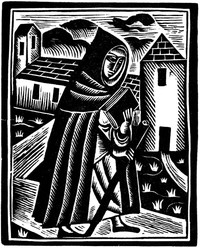
The modern revival of wood-engraving, which came just after the war, is quite different in style from any that preceded it. The artist and engraver are now one, as they should be where original work is to be done, and every exponent of the craft expresses his or her own individuality. The technique of the old school was swept completely away. “Start engraving with an axe” was an exhortation overheard, and some of the earliest examples, with their masses of unrelieved black, rather look as if they had been engraved by that implement. Design is the outstanding quality of the present style. Twenty years has brought command of the engraving tool and now most excellent work is produced with the originality of the artist-craftsman upon it. The early crudeness having gone, the modern engraver brings to the printed page a decoration outstanding in effect. Amongst the mass of process reproduction is the Wood-engraver, engraving his own designs, thereby expressing an originality which will most certainly mark the present age of book-production as something well worth examination. It is therefore essential that the modern engraver design his own engravings and he will select the kind of tools which will best express his own individuality, for it is this individuality of the artist which alone amongst all its competitors will keep alive Wood-engraving as a vital craft.
Ten engraving tools are as many as will be required for ordinary purposes. The beginner can start with five, but labour is often saved by having a sufficient number. They should be about 3½ inches in length, according to the size of the worker’s hand, and when held in correct position the point of the tool should not extend beyond the end of the thumb more than half an inch. In practice the greatest freedom is obtained when the point extends but little beyond the thumb, but as some allowance must be made for repeated sharpening away on the oilstone, the half-inch extension is recommended. When purchased they are generally much longer, 6 inches, but this length is much too great to allow the tool to be used with ease. The makers will generally grind them down to the required length for the purchaser, an ink mark or piece of stamp paper stuck to the tool indicating exactly the amount to be taken off. One side of the handle is flat, and the tool, as it enters the handle, is slightly curved upwards. This is to allow for free passage of the hand and tool over the surface of the wood, and though tools may be without this upward curve they lose freedom of action by being so.
Of the ten tools, six will be known as tint-tools, three as spit-sticks, one as scauper. The tint-tools cut lines of uniform width from extreme fineness (No. 1) to much greater width (No. 6). They are used for tinting, that is, cutting a series of lines to produce a tint or shade; for outlining, especially lettering; and for scauping. The numbers used here are for descriptive convenience only. When ordering, the actual width of cut required should be given, otherwise the purchaser may receive something very different from what was expected.
The spit-sticks (Nos. 1 to 3) are tools by which the cut can be easily broadened by gradually pressing the point deeper into the wood. By keeping to one depth they can also be used in the same manner as tint-rounded sides and cut through the wood with smooth ease. Instead of spit-sticks, tools known as gravers are often used. They are flat-sided, as tint-tools are, but the spread is much greater. The cut made is the same as that made with spit-sticks but a much greater spread is possible. The finest is known as the lozenge graver, the broadest as the square graver. They are used in the same manner as spit-sticks and often preferred to them, but they lack the smooth ease of cutting which is the special feature of spit-sticks.
The scauper, the tool of greatest width, is used for clearing away the wood round the engraving. It is desirable that the belly part of this tool should be sufficiently rounded: a point too square will not cut through the wood easily. An extra tool with a square point, about the size of the largest tint-tool, may be found useful for taking out corners.
A good selection for the beginner starting with five tools only would be two spit-sticks (1 & 3, Fig. 3), two tint tools (4 & 6, Fig. 2), and one scauper.
It must be clearly borne in mind that the style or character of the work is greatly influenced by the shape of the point used. The craftsman will be able, after a little time, to select the shape of tool which best suits his work. Once a tool is made up, and found to be good, to alter it is not desirable. To convert it to its old form is not easy. Rather keep an old one to experiment with, if needful, and never chance the spoiling of a proved tool.
The book keeps going
Reading is free forever. Sign up and watch scenes appear while you read.



Scenes Storieta drew for other classics.
New illustrated classics
Once or twice a month: the latest books to get full character casts, scene art, and free comic editions. No account needed.