Public-domain ebook
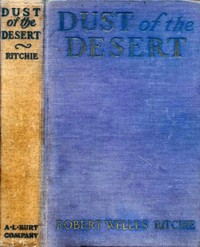
Dust of the Desert
Language: en619 downloads on Project Gutenberg
Subjects
Public-domain ebook sourced from Project Gutenberg #44691.
Public-domain ebook
Language: en619 downloads on Project Gutenberg
Subjects
Public-domain ebook sourced from Project Gutenberg #44691.
The opening · free to read
Roads of men thread the world. They thunder with a life flood. They are vibrant with a pulse of affairs. By land and water and air they link to-day to to-morrow. But El Camino de los Muertos (the Road of the Dead Men) is a dim highway leading nowhere but back and back to forgotten yesterdays. Its faint sign-posts once were vivid in lettering of tears and blood. Its stages were measured by the sum of all human hardihood. Faith, valour, reckless adventuring, thirst for gold, love o’ women--these the links in the measuring chain that marked its course through a dead land. And black crosses formed of lava stones laid down in the sand; these abide over all the length of the Road of the Dead Men from Caborca to Yuma to cry to the white-hot sky of slain hopes and faith betrayed in those buried years gone.
The priest-adventurers of New Spain first blazed this trail through an unknown wilderness. Restless pioneers of the Society of Jesus and the Order of St. Francis, men with the zeal to dare, pushed out from the northernmost limits of the Spanish settlements in a new world with their soldier guards and their Indian guides. They fought death in a land of thirst northward, ever northward. The cross fell from the hands of spent zealots at some waterhole where water was not, and other hands followed to snatch up the sacred emblem and push it deeper into Papagueria. North and west through El Infiernillo to the red waters of the Colorado where the Yumas had their reed huts. Thence on to the west through a land that stank of death until at last the end of the trail was smothered in the soft green of Californian valleys--good ground for the seed of Faith.
The overland trail of the padres became the single trail from Mexico to gold when the madness of ’49 called to all peoples. Then the Road of the Dead Men took its toll by the score and doublescore. Then men fought for precious water at Tinajas Altas; many crosses of malapais mark the sands there. Bandits lurked at Tule Wells, ninety miles over blistering desert from the nearest water, to shoot men for the gold they were bringing back from California. The Pock-Marked Woman, mad with thirst--so runs the legend--walked at nights with the Virgin in the flats beyond Pitiquito and found water with celestial candles burning all about the pool.
So passed the wraiths of the gold madness. A railroad was laid down from the Pacific eastward across the desert. What once was called Papagueria had come to be known as Sonora, in Mexico, and Arizona in the Republic of the North. The Road of the Dead Men at its California end became a way through green and watered valleys where bungalows mushroom overnight; along its course in southwestern Arizona and northern Sonora it lapsed to a faint trail from waterhole to waterhole of a heat scourged desert. To-day this forgotten remnant of a high road of adventure and hot romance exists a streak in an incandescent inferno of sand and lava slag, wherein death is the omnipresent fact. Occasionally a prospector putters along its dreary stretches, chipping at ledge and rimrock. A Papago or a Cocopa creeps over caliche-stained flats with baskets of salt from the Pinacate marshes near the Gulf.
That is all. The Dead Men hold their road inviolable. It is dust of the desert.
That is all, did I say? No, the spirit of romance and the shape of illusion have not completely passed from El Camino de los Muertos. Remains that tale which carries itself over a span of a century and a half, linking lives of the present to lives of men and women whose very graves long since have passed from sight of folk. A tale strangely like the desert trail along whose course its episodes of hot passion and swift action befell; for its beginnings are laid in a mirage of an elder day which we of the present can see but dimly, and its ending is beyond the horizon of to-day. Would you know the full story of the Lost Mission de los Cuatros Evangelistas: how the baleful spell of its green pearls of the Virgin worked upon the fortunes of the House of O’Donoju and how the last of that house wrought expiation for the sin of a forbear through heroism and the fire of a great love--would you know the full story, I say, you must see with me the substance of a beginning.
No more can one plump into the middle of this the last of the romance tales of the Road of the Dead Men than could one drop onto the Road itself midway of its length.
A King in Spain once followed a practice of careless munificence. Whenever one of his generals in the great wars appeared worthy of reward His Majesty used to ink the ball of his thumb and with a grand and free gesture he would make a print somewhere on the map of Mexico, then called New Spain. Then the lucky general, taking this patent of royal favor across the seas with him, would hire surveyors to translate the print of Philip’s thumb into terms of square miles of domain. These square miles were his and his heirs’ to govern like little kings, with justice in their hands, the Church to give them countenance and Indians by the hundreds to serve them under a modified code of slavery. No man has lived since as did those magnificent possessors of Philip’s thumbprints.
The Rancho del Refugio in the little known reaches of Papagueria was one of these fiefs of the king. Michael O’Donohue, a wild man of the red Irish who had fought English kings and queens under the banner of Spain, had come by the grant originally and had taken a lady of Granada to the new world to bear him heirs worthy of their inheritance. Michael O’Donohue became Don Miguel O’Donoju, lord of a desert principality and a power at the Viceroy’s court in the City of Mexico. He established two rigid precedents to be followed by the house of O’Donoju: pride of race and jealous conservation of the family principality. It became a rule of the O’Donoju that none of the clan marry outside the pure Castilian blood--Irish excepted if Irish could be found; and a rule that, come what might, no O’Donoju pass title to so much as a foot of the Rancho del Refugio.
It was a day in April, the year 1780, that the clan O’Donoju came to the Mission of the Four Evangelists to lend the dignity of their presence to the solemn service of re-dedication. More than that, Don Padraic O’Donoju, venerable head of the house and master of the Casa O’Donoju in the oasis named the Garden of Solitude, was come to witness a personal triumph. For it had been his money that had gone to the Franciscan College to be used in the rebuilding of the frontier post of God after the Apaches had raided and burned it fifty years before. And one of his own sons, Padre Felice, had been the architect and builder of the restored mission and was to continue the priest in charge. Padre Felice was fourth in a line of O’Donojus to take orders, one from each generation since the establishment of the grant.
The O’Donojus--grandchildren, cousins and kin by marriage--had ridden five days and upwards from various sections of the Rancho del Refugio, up and out through the Altar desert to this remote sanctuary of God in the country of the Sand People. They came by the way called the Road of the Dead Men. Its asperities were softened by the quick desert spring which tipped each thorny cactus cone with candelabra tufts of golden and carmine flowers. The desert’s usual heat was tempered by the snows that lay in unnamed mountains to the north.
They came in a lengthy caravan of horses and burros, with half naked Indians to herd the goats and the yearling steers that were to be barbecued for the secular feast to follow the religious rites; with a half-company of foot soldiers from the Presidio del Refugio to guard the company against roving Apaches; Indian maids on mule back to serve the needs of their mistresses, regally mounted on ponies of the Cortez strain; baggage porters, cooks, roustabouts. Fully a hundred of the clan O’Donoju and satellites on pilgrimage over the Road of the Dead Men.
All of the O’Donoju were there but one, El Rojo--the Red One. The “Red One” was he because of the throw-back to the red Irish strain of his fighting ancestor Don Miguel. Red with the pugnacious red of Donegal was his hair; his cheeks had none of the sallow tan of the Spanish but were dyed with the stain of Irish bog winds; his eyes were blue lamps of the devil. A fatherless grandson of old Don Padraic, El Rojo had played the wild youth in the City of Mexico with only occasional visits of penance to the Casa O’Donoju in the desert country of the north until, when the tang of youth still was his, he had tainted his name with scandal. Followed his formal expulsion from the clan at the hands of the old aristocrat, his grandfather, and the closing of all doors of his kindred in Papagueria against him. El Rojo had ridden out to the wide world of sand and mountains an outcast but with a laugh on his lips; this a full year before the gathering of the family at the Mission of the Four Evangelists.
When El Rojo had turned lone wolf, a sadness that was not the sadness of shame settled upon the heart of one of the O’Donoju. Frecia Mayortorena, a cousin, one of the flowers of girlhood that caused old Hermosillo to be named the Little Garden, sat behind her barred windows on many a night with heart wild to hear once more the love song only El Rojo knew how to sing. Frecia Mayortorena, all fire under the cold ice of her schooled and decorous features, knew that the reckless devil with the flame-blue eyes had but to come and strum a love call on his guitar; she would go with him into banishment and worse. So on this pilgrimage to the shrine of the four holy men the girl, who rode with her father and brothers, allowed her imagination to frame the figure of a phantom horseman on every ragged mountain top. At each camp fire along the Road of the Dead Men, when the vast sea of desert round about was stilled under the stars, Frecia Mayortorena sat with tiny pointed chin cupped in a propping palm and seemed to hear in the clink of a mule’s hobble chain the opening chord of that song of songs,
Red as the pomegranate flower, my love, The heart of him who sings.
The cavalcade came to the mission with the firing of guns and with shouts. The reed-and-mud huts of the Sand People beyond the cloisters disgorged their shouting savages to welcome the travellers. Padre Felice, a gaunt man with the face of an ascetic above the folds of his rough brown cowl, hurried out from the doors of the new sanctuary to meet and give embrace to his father, Don Padraic, and then in turn to all his next of kin; behind him followed his two novitiate priests who were, with Padre Felice, the only white men in all the stretch of Papagueria from the Rancho del Refugio westward to the Sea of Cortez. Five days’ travel were they from the nearest of their kind, and to west and north stretched unguessed leagues of the desert. Only the Road of the Dead Men linked them with the first of the Californian missions thirty days over the western horizon.
The book keeps going
Reading is free forever. Sign up and watch scenes appear while you read.



Scenes Storieta drew for other classics.
New illustrated classics
Once or twice a month: the latest books to get full character casts, scene art, and free comic editions. No account needed.