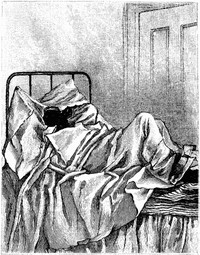
KITTY'S FIRST PIE.
Baked in a patty-pan, Flaky and light, Done to a turn, And seasoned just right, By a recipe taken From mother's big book, And some words of advice Thrown in by the cook, Is Kitty's first pie.
She made it herself, Did little Miss Kit, Without the least help, Not one tiny bit. But in eating it she'll have Assistance enough; For there's Bertha her sister, And little dog Buff, And dear Mrs. Purr
(Who's a cat, as you know), And all the sweet dolls Sitting up in a row, Each waiting her turn For a piece of the pie; And all the young people Besides you and I Would, if asked, take a bit Of Kitty's first pie.
Of course 'twill go round, For it's round as a wheel, Though I doubt if for all It would make a full meal. But I'm sure there's enough For each one to taste, And pass an opinion On the mince and the paste Of Kitty's first pie.
HAKON AND RAGON.
A TRUE INCIDENT OF THE ORCADES.
BY LILLIE E. BARR.
Oh, how the wild north winds stormed loud in the Pentland Firth, Beating the shores of the Orcades Isles, all white with foam! Oh, 'mid the shuddering cold and frost, was life aught worth? Yes, for they saw through the blackness the lights of Home.
Hakon and Ragon alone were left of the gallant crew That had sailed to the arctic seas more than a year ago. Some had perished of hunger, and some where great winds blew: Only they two on the ship, sinking so surely below.
But when the morning dawned, and the ship broke slowly apart, They saw men launching the life-boat. Ah, would it come too late! Naught was left but a three-foot spar. Each saw, with a sinking heart, It would keep but one afloat. Then Hakon said, sadly: "My mate,
"Thou hast a wife and lasses and lads, and I am only one. Good-by! I'll give thee a chance, Ragon. God bless thee, mate! Good-by!" And down he sank with a smiling face, his duty bravely done. Little he cared for fame: he'd found a noble way to die.
Then, when the tide beat inland, and Hakon came to his place, All the little Orcades town brought back the hero's clay, And bore him to Ragon's cottage with loving tears and grace. Many were there to weep for him, many were there to pray.
The dominie kissed his brave cold hand, and said, "Hakon, well done! Mothers, I bid you tell your sons how Hakon lived and died. Nay, do not weep; this sailor boy a noble crown has won: He rests in God, and in our hearts his memory shall abide."
And in that "Court of Peace" that lies in Stromness old and gray There is a spot where, spite of cold, the long green grasses wave, Where youths and maidens wander, and little children play. Ask them its charm, they'll answer you, "Why, this is Hakon's grave!"
THE RAISING OF THE OBELISK.
BY E. MASON.
It was a beautiful day, and ever since early morning people had been pouring into the great square in front of St. Peter's, at Rome, and now at noon the square was filled with a silent crowd, the neighboring balconies with groups, silent too, and all gazing intently in the same direction. Not at the Pope, who, in his robes, and attended by his suite, was conspicuous in one of the balconies, nor at the strange sight at the four corners of the square--four empty gibbets which rose threateningly against the blue sky--but at the centre, where were a number of workmen, with machinery, grouped about the obelisk.
This huge mass of stone had hitherto defied all efforts made by different architects to raise it to its pedestal; many lives had been lost in the attempts, much money and time wasted; and the Pope had at last declared that the next architect who should volunteer for the task would, if unsuccessful, be severely punished. There was one, however, Fontana, who felt confident that he could raise the obelisk, and well knew, if he did succeed, he should have an assured career before him; so, carefully making his preparations, he applied to the Pope for permission, only stipulating that, in order to insure success, there must be perfect quiet during the operation. This was why the gibbets stood at the corners, the Pope having officially announced that, as unbroken stillness must be preserved, and the workmen not disturbed by cries or acclamations from the excited spectators, any one who made a noise or spoke during the time set apart for the raising should be hanged; and with this wholesome terror before their eyes, it was believed the crowd would not be tempted to disobey the order.
All were intent on the one thing, and watched anxiously the workmen, as cautiously they heaved the ropes, and slowly the mighty obelisk began to move, then gradually to assume a more erect position, and finally hung suspended in mid-air, needing but one more effort, when it would stand on its pedestal, its lofty spire pointing heavenward.
But, alas! the strained, overwrought ropes seemed able to bear no more; already tense with the enormous weight, they were slowly beginning to separate. It was a moment of breathless suspense; the mighty crowd stood motionless, scarce daring to breathe, so great was their anxiety; and the wretched Fontana, foreseeing the overthrow of all his hopes of fame and wealth, and his destruction in the downfall, now imminent, of the ponderous column, in his despair hid his face in his hands. Suddenly a voice broke the death-like silence. It uttered but one word--"Aqua" (water); but no word ever sounded sweeter or brought more hope than did that to Fontana, whose energy revived. With a gesture he pointed to the fountains in the square, and the crowd aiding the workmen, they dashed the water over the smoking, quivering ropes; the final haul was given, and the obelisk stood firm and straight on its pedestal.
One long, heart-felt acclamation broke from the throng, and the lately wretched Fontana saw himself in one brief moment rescued from the depths of despair. The acclamations ceased, and the Pope, commanding silence, ordered the workman who had disobeyed the decree of silence to be brought before him, and asked what reason he had to give why the forewarned punishment should not be executed upon him. The poor fellow pleaded the benefit which the pronouncing of the one word had caused, and the Pope not only graciously admitted the plea, but bade him ask any favor, and it should be granted.
With humility, the workman asked only for the privilege of selling palms on Palm-Sunday in the great square of St. Peter's; and if we only knew his name, which unfortunately was not thought worthy of being recorded, we could tell, when in Rome on Palm-Sunday, if his descendants still enjoy the grant given by the Pope.
[Begun in No. 58 of HARPER'S YOUNG PEOPLE, December 7.]
The boy tried to rise to his feet, but his head whirled so, and he felt so dizzy and sick from the effects of his fall, that he was obliged to sit down again until he should feel able to stand. Meanwhile the crowd around the wagon paid no attention to him, and he lay there quietly enough, until he heard the hateful voice of Mr. Lord, asking if his boy was hurt.
The sound of this voice affected Toby very much as the chills and fever affect any one, and he shook so with fear, and his heart beat so loudly, that he thought Mr. Lord must know where he was by the sound. Seeing that his employer did not come directly toward him, the thought flashed upon his mind that now would be a good chance for him to run away, and he acted upon it at once. He rolled himself over in the mud until he reached a low growth of fir-trees that skirted the road, and when once he was beneath their friendly shade, he arose to his feet, and walked swiftly toward the woods, following the same direction that the monkeys had taken.
He no longer felt dizzy and sick; the fear of Mr. Lord had taken all that from him, and made him as strong as he ever was in his life.
He had walked rapidly for some distance, and was nearly beyond the sound of the voices in the road, when he was startled by seeing quite a procession of men emerge from the trees, coming directly toward him.
He could not understand the meaning of this strange company, and it frightened him so that he attempted to hide behind a tree, in the hope that they might pass without seeing him. But no sooner had he secreted himself than a strange, shrill chattering came from the foremost of the group, and in an instant Toby was out from his place of concealment.
He had recognized the peculiar sound as that of the old monkey who had left him a few moments previous, and he knew now what he did not know before, owing to the darkness. The new-comers were the monkeys that had escaped from the cage, and had been overtaken and compelled to come back by the old monkey, who seemed to have the most perfect control over them.
The old fellow was leading the band, and each one had clasped hands with the others, which gave the whole crowd a most comical appearance, as they came up to Toby, half hopping, half walking upright, and all chattering and screaming like a crowd of children out on a holiday.
Toby stepped toward the noisy crowd, held out his hand gravely to the old monkey, and said, in tones of heart-felt sorrow:
"I felt awful bad because I thought you had gone off an' left me, when you only went off to find the other fellows. You're awful good, Mr. Stubbs; an' now, instead of runnin' away as I was goin' to do, we'll all go back together."
The old monkey had grasped Toby's extended hand with his disengaged paw, and, clinging firmly to it, the entire crowd followed, without breaking the line, chattering and scolding at the most furious rate, while every now and then Mr. Stubbs would look back and scream something, which would cause the confusion to cease for an instant.
It was really a comical sight, but Toby seemed to think it the most natural thing in the world that they should follow him in this manner, and he chattered to the old monkey quite as fast as any of the others were doing. He told him very gravely all that he knew about the accident, explained why it was that he conceived the idea of running away, and really believed that Mr. Stubbs understood every word he was saying.
Very shortly after Toby had started to run away, the proprietor of the circus drove up to the scene of the disaster, and, after seeing that the wagon was being rapidly fixed up so that it could be hauled to the next town, he ordered that search should be made for the monkeys. It was very important that they should be captured at once, and he appeared to think more of the loss of the animals than of the damage done the wagon.
While the men were forming some plan for the search, so that in case of a capture they could let each other know, the noise made by Toby and his party was heard, and the men stood still to learn what it meant.
The entire party, who were waiting to learn the reason of the confusion, burst into shouts of laughter as Toby and his companions walked into the circle of light formed by the glare of the lanterns, and the merriment was by no means abated at Toby's serious demeanor. The wagon was now standing upright, with the door open, and Toby led his companions directly to it, gravely motioning them to enter.