Public-domain ebook
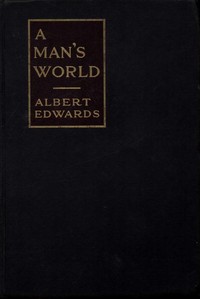
A Man's World
Language: en524 downloads on Project Gutenberg
Subjects
In: Novels·American Literature
Public-domain ebook sourced from Project Gutenberg #44878.
Public-domain ebook
Language: en524 downloads on Project Gutenberg
Subjects
In: Novels·American Literature
Public-domain ebook sourced from Project Gutenberg #44878.
The opening · free to read
All books should have a preface, to tell what they are about and why they were written.
This one is about myself--Arnold Whitman.
I have sought in vain for a title which would be truly descriptive of the subject and form of my book. It is not a "Journal" nor a "Diary" for these words signify a daily noting down of events. Neither "Memoirs" nor "Recollections" meet the case, for much which I have written might better be called "Meditations." It certainly is not a "Novel," for that term implies a traditional "literary form," a beginning, development and end. I am quite sure that my beginning goes back to the primordial day when dead matter first organized itself--or was organized--into a living cell. And whether or not I will ever "end" is an open question. There is no "unity" in the form of my narrative except the frame of mind which led me to write it, which has held me to task till now.
It is the story of how I, born at the close of The Great War, lived and of the things--common-place and unusual--which happened to me, how they felt at the time and how I feel about them now.
"Autobiography" is the term which most truly describes what I have tried to do. But that word is associated with the idea of great men. The fact that I am not "great" has been my main incentive in writing. We have text books a plenty on how to become Emperor, at least they tell how a man named Napoleon did it. There are endless volumes to which you may refer if you wish to become President of these United States--or rival the career of Captain Kidd. But such ambitions are rare among boys over eighteen.
Even before that age I began to wish for a book like the one I have tried to write. I wanted to know how ordinary people lived. It was no help in those days to read how this Caesar or that came and saw and conquered. I shared the ambitions of the boys about me. To be sure there were day-dreaming moments when we planned to explore Central Africa or found dynasties. But this was pure make-believe. We knew that not one man in thousands wins fame. For each moment we dreamed of greatness there were days on end when we looked out questioningly on the real world. We got no answers from our teachers. Most of the boys who were in school with me are today running a store, practicing law or medicine. They were prepared for it by reading Plutarch in class and Nick Carter on the sly.
As a youth I wanted of course to gain a comfortable living. I wanted mildly to win some measure of distinction, but all this was subordinate to a more definite desire to be a man, and not to be ashamed. A book about the ordinary life I was to enter, would have been a God-send to me.
This then is to be the story of my life as it appears to me now, and how, in the face of the things which happened to me, I tried to be decent.
I have only two apologies to offer. All the rest of my writing has been scientific--on the subject of criminology. I am unpracticed in narration. And I have been enough in courts to realize the difference between "evidence" and "truth." At best I can only give "evidence." Others who knew me would tell of my life differently, perhaps more truly. But it will be as near truth as I can make it.
And now to my story.
My earliest distinct memory is of an undeserved flogging. But from this grew my conception of Justice. It was, I think, my first abstract idea.
My parents died long before I can remember and I was brought up in the home of the Rev. Josiah Drake, a Cumberland Presbyterian minister of the Tennessee Mountains. He was my uncle, but I always called him "the Father." He was the big fact of my childhood and my memory holds a more vivid picture of him than of any person I have known since.
He was very tall, but stooped heavily. If he had shaved he would have resembled Lincoln, and this, I suppose, is why he wore so long and full a beard. For he was a Southerner and hated the Northern leader with all the bitterness of the defeated. And yet he was a Christian. I have never known one who served his God more earnestly, more devotedly. He was a scholar of the old type. He knew his Latin and Greek and Hebrew. And as those were rare accomplishments among the mountain clergy of Tennessee it gave him a great prestige. In all but name he was the Bishop of the country-side. His faith was that of Pym and Knox and Jonathan Edwards, a militant Puritan, fearless before the world, abject in humility before his God.
Of his wife, my aunt Martha, I have scarcely a memory. When I was very young she must have been important to me, but as I grew to boyhood she faded into indistinct haziness. I recall most clearly how she looked at church, not so much her face as her clothes. In all those years she must have had some new ones, but if so, they were always of the same stuff and pattern as the old. Sharpest of all I remember the ridges the bones of her corset made in the back of her dress as she leaned forward, resting her forehead on the pew in front of us, during the "long prayer." There was always a flush on her face when it was over. I think her clothing cramped her somehow.
I have also a picture of her heated, flurried look over the kitchen stove when she was engaged in the annual ordeal of "putting up" preserves. Even when making apple-butter she maintained a certain formality. The one time when she would lapse from her dignity was when one of the negroes would rush into the kitchen with the news that a buggy was turning into our yard. The sudden scurry, the dash into her bedroom, the speed with which the hot faced woman of the kitchen would transform herself into a composed minister's wife in black silk, was the chief wonder of my childhood. It was very rarely that the guests reached the parlor before her.
All of her children had died in infancy except Oliver. As the Father's religion frowned on earthly love, she idealized him in secret. I think she tried to do her Christian duty towards me, but it was decidedly perfunctory. She was very busy with the big house to keep in order, endless church work and the burden of preserving the appearances her husband's position demanded.
There was a large lawn before the house down to a picket fence. Mowing the grass and whitewashing that fence were the bitterest chores of my childhood. The main street of the village was so little used for traffic that once or twice every summer it was necessary to cut down the tall grass and weeds. Next to our house was the church, it was an unattractive box. I remember that once in a long while it was painted, but the spire was never completed above the belfry. There was a straggling line of houses on each side of the street and two stores. Beyond the Episcopal Church, the road turned sharply to the right and slipped precipitously down into the valley. Far below us was the county seat. About five hundred people lived there, and the place boasted of six stores and a railroad station.
That was its greatest charm to my schoolmates. From any of the fields, on the hill-side beyond the village, we could look down and watch the two daily trains as they made a wide sweep up into this forgotten country. There was one lad whom I remember with envy. His father was carter for our community and sometimes he took his son down with him. They slept in the great covered wagon in the square before the county court house, and came back the next day. The boy's name was Stonewall Jackson Clarke. He lorded it over the rest of us because he had seen a locomotive at close quarters. And he used to tell us that the court house was bigger than our two churches "with Blake's store on top."
I think that as a boy I knew the names of one or two stations on each side of the county seat. But it never occurred to me that the trains down there could take you to the cities and countries I studied about in my geography. Beyond the valley were Missionary Ridge and Lookout Mountain. But none of the boys I played with realized that the world beyond the mountains was anything like the country we could see. It would have surprised us if the teacher had pointed out to us on the school map the spot where our village stood. The land over which Cinderella's Prince ruled was just as real to us as New York State or the countries of Europe, the names of whose capitals we learned by rote.
My cousin Oliver I disliked. As a youngster I did not know why. But now I can see that he had a craven streak in him, a taint of sneakiness, an inability to be bravely sincere. It was through him that I got my lesson in justice.
He was then about sixteen and I eight. His hobby at the time was carpentry and, as I was supposed to dull his tools if I touched them, I was forbidden to play in the part of the barn where he had his bench. He was going to make an overnight visit to some friends in a neighboring township and at breakfast--he was to start about noon--he asked the Father to reiterate the prohibition. A few hours later I found Oliver smoking a corn-silk cigarette behind the barn. He begged me not "to tell on him." Nothing had been further from my mind. As a bribe for my silence he said I might play with his tools. The spirit of his offer angered me--but I accepted it.
After he had left the Father found me at his bench.
"Ollie said I could," I explained.
"At breakfast," the Father replied, "he distinctly said you could not."
But I stuck to it. The Father had every reason to believe I was lying. It was not in Oliver's nature to be kind to me without reason. And I could not, in honor, explain the reason. The Father was not the kind to spoil his children by sparing the rod, and there was no crime in his code more heinous than falsehood. He tried to flog me into a confession.
There was nothing very tragic to me in being whipped. All the boys I knew were punished so. I had never given the matter any thought. As I would not admit that I had lied, this was the worst beating I ever received. He stopped at last from lack of breath and sent me to bed.
"Oliver will be back to-morrow," he said. "It is no use persisting in your lie. You will be found out. And if you have not confessed...." The threat was left open.
I remember tossing about in bed and wishing that I had lied and taken a whipping for disobedience. It would not have been so bad and would have been over at once. The next morning I sat sullenly in my room waiting for Oliver's return, wondering if he would tell the truth. I was not at all confident. Towards noon, the blackboard turned in at the gate, one of the negroes took the horse and I heard the Father call Oliver into his study.
Then suddenly a door slammed and I heard the Father's step on the stair. He was running. He burst into my room and before I knew what was happening, he had picked me up in his arms. And, wonder of wonders, he was crying. I had never before seen a grown man cry. He was asking me, I could not understand what he meant, but he was asking me to forgive him. Then I heard the Mother's voice at the door.
"What is the matter, Josiah?"
"Oh, Martha. It's horrible! I caned the lad for a lie and he was telling the Truth! Oh, my son, my son, forgive me."
The book keeps going
Reading is free forever. Sign up and watch scenes appear while you read.



Scenes Storieta drew for other classics.
New illustrated classics
Once or twice a month: the latest books to get full character casts, scene art, and free comic editions. No account needed.