TIMOTHY.
BY BISHOP T. U. DUDLEY.
In a little town called Lystra, in Asia Minor, a multitude is gathered in the market-place. Two strangers are the attraction, who have strange tidings to tell. Their story is of one Jesus, a King, who, they say, was born in Judea some fifty years before. They tell of marvellous deeds of mercy which He wrought, and of words as marvellous and as merciful that He spake. They tell that He died on a cross, but that, King of Death, He came back from the grave at His own appointed time. They declare that He did visibly ascend into heaven, and now sitteth there to pardon and to bless all who will believe on Him. And even while the crowd is listening to the words of the chief speaker, whose name is Paul, he looks fixedly upon a poor lame man, a cripple from his birth, who is among his auditors, and cries with a loud voice, "Stand upright on thy feet." Instantly the command is obeyed, and the life-time cripple leaps and walks.
Respectful attention straightway became enthusiasm. The market-place resounds with the shout, "The gods are come down to us in the likeness of men," and the priest who serves in Jupiter's Temple hastens with oxen and garlands to do sacrifice to the miracle-workers, despite their earnest remonstrance that they are but sinful men, come to tell them of the one living God.
But quickly there is interruption as effective as sudden from other strangers of the same distant nation, whose words persuade the fickle populace, and in a little while Paul is being dragged out of the city to all appearance dead. They have stoned the man to whom just now they would do sacrifice!
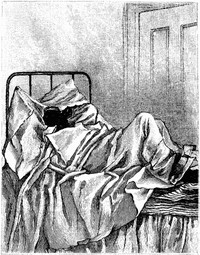
Among the listeners to the gospel Paul had preached, among the wondering spectators of the lame man's healing, among the on-lookers at the deed of violence, stands a boy, generous and warm-hearted, weeping manly tears over that which is done. His name is Timothy, and of him, as he sits there that day in his native town, his heart all aglow with the new hopes whereof he has heard, and his spirit all aflame with admiration for undaunted courage, and with pity for the innocent sufferer, our artist has given us the portrait. The Sacred Scriptures, which he has known from a child, have gained new meaning. He is reading the ancient writings with the new light which Paul has thrown upon them--the light from the open grave of Jesus.
He is the child from a mixed marriage, his mother a Jewess, but his father a Greek, and therefore he is but ill esteemed by the Hebrews who dwell in his town. The records of his life make no mention of his father, and from this fact it has been inferred that he died while Timothy was yet an infant. And we are plainly told that his education was all given by his mother, Eunice, and his grandmother, Lois, and that "from a child he knew the Holy Scriptures."
The face which the artist has drawn will represent to us what we should expect to be the appearance of a boy thus brought up, and the character which we judge him to have possessed, from the warnings and the advice given to him by his master and teacher, Paul. His piety, while sincere and intense, is yet of a feminine cast; his constitution is far from robust; he shrinks from opposition and responsibility; his tears lie close to their outlet, and are ready to flow and hide the suffering object; he will subject his body to denial greater than its strength will bear, and as the natural counterpart of these characteristics, he is in danger of being carried away by "youthful lusts." Such is Timothy when, after seven years have passed away, and the boy is grown to be a man, Paul, returning to Lystra to confirm and comfort the Christians there, will have him to be the companion of his journeyings and the best-loved friend of his heart.
There is not space in this article to recite the events of the career that followed. Let each of our boy readers search them out for himself, and learn of what doughty deeds a gentle spirit in a feeble frame is capable under the impulse of an earnest faith. Let us learn, moreover, from a life of noble devotion to high purpose so to devote our life, not, it may be of necessity, to proclaim a Gospel, as Timothy did, but surely to labor, not alone for self, but for our race.
He died a confessor of that faith he learned from the preacher at Lystra in his boyhood. "Out of weakness he was made strong." He, the timid, girlish, tearful boy, waxed valiant in the great fight, and is known to the Christian world as a saint of God and as the great Bishop of Ephesus.
THE NEW DOLL.
BY GEORGE COOPER.
You're a beautiful, beautiful dolly, And dressed like a sweet little queen; Not to care for you, dear, may seem folly, When I've but a rag-doll so mean. I know that its arms are the queerest, Its head very funny and flat; Its eyes anything but the clearest; Yet old friends are best, for all that.
Your hair falls in ringlets so flaxen, Your eyes are delightfully blue; Your cheeks they are rosy and waxen, You're charming, I'll give you your due. Yet shall I give up Betsy Baker, Who hasn't a shoe nor a hat, Because you've a splendid dressmaker? No! old friends are best, for all that.
You came Christmas morn, in my stocking; I ought to be proud, I suppose; And not to be pleased would be shocking: Do, Betsy dear, turn out your toes. Oh, you are my every-day dolly! And this one in silk dress and hat I'll put on the shelf: call it folly, Yet old friends are best, for all that.
THE SNOW BEN.
BY WILLIAM O. STODDARD.
"We can beat that," said Joe Larkin, contemptuously, as he drew back and began to blow through his red fists. "That isn't any kind of a snow man."
"Like to know why," said Dan Madderley. "He's all right but his ears. We can make them of the same size, easy."
"Yes, but he ain't right anyhow. Everything's just stuck on outside. When I was in the city once, I saw a sculptor chiselling a man out of marble. 'Twasn't much like this thing."
"Well, of course it wasn't. Stone's better'n snow. Everybody knows that, I guess."
"No, it isn't. Not exactly. When you knock off a chunk of marble, you can't stick it on again."
"You might glue it, but I guess it would show the crack."
"Tell you what, boys," exclaimed Joe, with a new idea shining all over his face, "let's make a big snow marble down on the ice, and then let's dig it out into a man, just as the sculptors do."
There was an instant hurrah all around, and not one opposing vote; the half-finished snow man in Deacon Madderley's back yard was left to thaw down all alone, and in ten minutes more the whole crowd of young sculptors was down on the pond.
It was a warm day for winter, and the water was pouring over the dam in a hurry, but the ice was pretty firm up where the boys were, and the soft snow was in just the condition to pack nicely. At it they went, as if they had a whole marble quarry to make, and were afraid some of their marble might get away from them.
"I say, now, Joe," shouted Burr Whitcomb, as the great white pile came up to his shoulders, "who're we going to sculp out? Anybody in partikler?"
"Julius Cæsar."
"No, we can't. You never saw him, nor we didn't either."
"Yes, I did. I saw a picture of him once, with a brass helmet on his head, and a sword in his hand."
"That'd beat us, then," said Dan Madderley. "We'd better try George Washington."
"He's on horseback," said Joe, "and so is Andrew Jackson. No use for us to try a horse. Snow legs won't hold up. He'd come down all in a heap."
A dozen other great names followed, each bringing with it a chorus of doubts as to how he looked, and whether anything like him could be found in that heap of snow; but the shrill voice of little Billy McCoy settled the matter. He had followed his big brothers down upon the ice, and now he eagerly squeaked:
"Boys, why don't you scoop out Ben Franklin? Make him sitting down."
"Hurrah for you, Billy!" exclaimed Joe Larkin. "Guess we all know Ben. He's just the man."
"Guess he is," chirped Billy. "He's fat, too. You can make him real big."
On piled the snow, after that, until they had to reach up with their shovels. When Joe Larkin began to play sculptor, he had to dig his toes into the snow and climb.
"We'll make his head first," he sagely remarked; "and we'll cut out the rest of him to fit that."
"Dig away, Joe," shouted Burr Whitcomb, from the other side of the quarry. "Let's see which of us'll get in first to where old Ben is."
"We'll set him up with his hands in his lap," said Joe; "and we'll part his hair in the middle."