TOMMY TUCKER'S HORSESHOE.
BY MRS. FRANK McCARTHY.
Tommy Tucker lives on a "farm" in the city of New York, near the Central Park. Some people make fun of Tommy's way of living, and call his place the "sunken lots," and say his family are squatters; but it makes very little difference to Tommy what remarks were made about his home or his people, so long as they were happy. And they were happy for a very long time, so happy that they didn't know what it was to be miserable, and it makes a wonderful difference to be able to tell one from the other. Up to the beginning of this winter they had the longest run of luck on record in any family in that neighborhood. A long while since, a horse had been turned out to die in a lot near the Tucker's. It wasn't such a very old horse, but it was dreadfully sick, and something was the matter with its windpipe, so that Mr. Tucker heard it wheezing away while he was at work on the farm. He had a very kind heart, and always did what he could for poor dumb creatures, as well as those that could tell what was the matter with them; and what with kind treatment and a wonderful skill Mr. Tucker had with animals, that horse came around so that you'd hardly know it from a spirited charger of Mr. Croesus--a gentleman who lives up in that neighborhood. It grew so strong that it was able to drag a cart-load of vegetables down town to Mr. Tucker's customers, and Mr. Tucker was able to put another lot or two under cultivation. And if the lots were a little rough and sunken, it was very pretty to see them full of "green things a-growing." Up to this last winter there was almost always something to sell, and pretty soon after Mr. Tucker cured his horse he got a cow. She wasn't a first-class cow when Mr. Tucker first traded off some pigs for her, and gave some silver to boot out of Mother Tucker's stocking. What little milk she had seemed to be turned to gall, and even that couldn't be got from her until she was tied to the side of the house; then she would have kicked the whole mansion down if it hadn't been founded on a rock, like the wise man's house Mr. Tucker read about in the Bible. Mr. Tucker and Tommy think there are only two books worth reading in the whole world: one is the Bible, and the other is Robinson Crusoe. Tommy hadn't minded depending on his goats for milk, because it seemed so much like Crusoe's way of living; but Mrs. Tucker and Tommy's three little brothers liked cow's milk the best; for one thing, there was so much more of it, and Tommy's three little brothers had such excellent appetites. For Mr. Tucker's wisdom extended to the udders of the cow, and pretty soon she was almost as good as an Alderney cow around the corner, so called, Mr. Tucker said, because she belonged to an Alderman.
Tommy Tucker's family prospered exceedingly. The horse drew more and more vegetables to market, the cow gave more and more milk, the hens laid more and more eggs, and the cheery chink in Mother Tucker's stocking became more and more musical to the ear, until the last winter set in. Then the Tucker luck, which was proverbial in that neighborhood, suddenly took an evil turn.
First, and worst, Mr. Tucker fell on the ice and broke his leg. You may know it was a particular kind of ice that could bring Mr. Tucker down. It was about a dozen layers thick, and very treacherous. The winter had closed in some time before in a very unusual way. It was bitter cold, day in and day out; the heavens opened, and the snow fell, and opened again, and more snow came down, and kept on opening, and more snow kept falling, until the familiar gullies were all filled up, and the country around there grew white and level and changed, so that Tommy wondered sometimes if the world had lost its reckoning, and stopped turning when it reached the north pole.
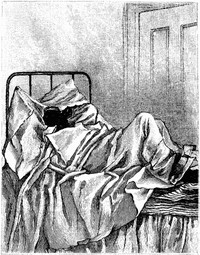
And it gave Tommy a dreadful sickly feeling to know that his father's leg could break. It wasn't natural to see him lying on the bed in the corner, when he had always been up and doing. Nothing ever seemed so far gone that his father couldn't fetch it around, and it shook Tommy's confidence considerably to see the obstinacy of that leg. Tommy had always gone to bed before his father, and his father had always got up before Tommy, so that it was a new experience to Tommy to see his father down.
It took the heart out of all of them, and everything went wrong. It went on freezing, snowing, and blowing outside; and do what Tommy could, the live stock began to give out. That charity waif of a horse yielded to the weakness in his windpipe again, and sprawled his legs and hung his head in the most ungrateful way; the cow went dry; two of the best pigs got frost-bitten, so that their squeal mingled with the melancholy soughing of the north wind around the Tucker mansion; and the hens wouldn't lay an egg for Mr. Tucker, though the doctor had particularly ordered it.
And about that doctor: Tommy used to dread to see him come, for instead of brightening things up, he made them gloomier. He took some of the cheery chink out of Mother Tucker's stocking every time he came, and Mr. Tucker seemed none the better for it, but lay with his face to the wall for hours together, and wouldn't read any book in the Bible but Job; and Tommy's three little brothers went on eating just the same as when milk was plenty and times were good.
The music in Mother Tucker's stocking got away down to the toe; and one morning, when Mr. Tucker had no appetite for anything, and Tommy's three little brothers had an appetite for everything, even their mother's poor share of what was left, Tommy saw the shadow of a big wolf called Hunger prowling around the door-sill, and out he ran and down the road, frightened, and sobbing as if his heart would break. He thought nothing of the poor shivering brutes that were left to his care, or thought they might as well all starve together. Luck was against them; there was no use trying any more; when all at once, over in the middle of the road, he saw through his blinding tears something round and shining. It wasn't a gold piece, nor one of silver, but he plunged through a snow-bank and over a ditch to get it. He dug it out of a chunk of ice, and cut his hands and tore his finger-nails; and his honest little face took the keen and hungry exultation of a miner's just then, though it was neither silver nor gold, but an old battered-out horseshoe.
For all the music in Mother Tucker's stocking hadn't helped his father's leg, but Tommy had heard say that a horseshoe honestly found was the best bit of luck to stumble on in the world.
He warmed the cold bit of metal against his heart, and ran home with it as fast as he could, never stopping until he reached his father's bed.
"Cheer up, Pop!" he cried. "See! Everything'll come right now. I've found a horseshoe."
Poor Mr. Tucker turned to look at it with a sickly sort of smile, but the hope that illumined his boy's face lent a feeble glow to his own.
"Heaven bless the boy!" he said. "I'm very weak, I suppose. But hang it up where I can see it."
Mother Tucker fastened it to a beam over the foot of the bed, having the good cry over it she'd been longing for, and out Tommy ran to see to the live stock.
He rubbed that horse into such a glow that before he left him the wheeze in his windpipe wasn't worth mentioning, and he held his head and legs up in the style of Mr. Croesus' steed; then he fed the cow, and drove the hens around to the manure heap, where they could keep warm in the steaming side next the sun; and while he was hard at work he heard a terrible racket up the road, and he thought it must be Mr. Croesus himself shouting and screaming for dear life, while his charger was flying along on the wings of the wind. Tommy dropped his pitchfork, and got there just in time to feel the hot breath from the runaway's nostrils, and make a spring for the bridle. They all went plunging along together a bit, then came to a stand-still, trembling all over, all of them. What was Tommy's delight to find that instead of Mr. Croesus, it was only their old doctor! He trembled more than his horse, and puffed like a grampus.
"Well done, sonny," he said. "I might have been in a worse plight than your father, if it hadn't been for you. My horse never cut up such a tantrum before."
Tommy knew what it was; it was the horseshoe. Something had to be done to soften that doctor's heart. Tommy plucked up courage to beg of him to take no more music from his mother's stocking, seeing it was away down to the toe.
"Why, no, sonny," said the doctor; "I'll take none out, but I'll put some in."
After that scare with the horse, nothing would do but Tommy must go around with the doctor to take care of it, and the doctor made a bargain with Tommy that paid him handsomely for three or four hours every day.
When Tommy reached home that night he found his father propped up in bed making a supper off of new-laid eggs. His father said it was driving the hens round on the sunny side of the farm, but Tommy stuck to it that it was the horseshoe. After that it was like the house that Jack built. The hens began to lay; Pop began to eat and get well, and read the Psalms instead of Job; the cow had a pretty calf, and began to give lots of milk; the winter began to break; and the doctor began telling the Tucker family of a noble way of squatting out West that beat their way all to nothing, and how there was lots of land out there considerably better than the sunken lots, and how, instead of watching one lazy horse, that wouldn't run away without there was a providence in it, Tommy might have a whole drove of chargers like Mr. Croesus', and Mr. Tucker might raise millions of bushels of golden grain, and he shouldn't wonder if Tommy would be President yet, and his three little brothers feeding away at a public crib that never gives out.
Tommy says it's all the horseshoe, but the doctor's made a sum of it in this way:
PXP=P.
Pluck multiplied by Perseverance equals Prosperity. The doctor says the example is to be followed in a general sort of way, but principally by stopping a runaway horse when there's an old coward of a doctor behind him.
SOMETHING ABOUT SHIPS.
BY LIEUTENANT J. A. LOCKWOOD.
After the hull of a ship is built, she is launched before her spars are put in. This launching is usually done stern foremost; sometimes bow foremost, and, in very narrow rivers, side foremost. The Great Eastern was launched side foremost in the river Thames.
Under the general name of spars are included the masts, bowsprit, yards, booms, and gaffs of a ship. It will not be necessary to inform the boys who live near our seaports what masts and yards are; but perhaps some of America's future admirals, who have yet to see their first ship, will be interested in knowing that a mast is a stick perpendicular to the deck, and yards are sticks to which sails are bent, and are at right angles with the masts; the bowsprit is a stick projecting over the bow to carry sail forward.
Each of the three masts of all but very small vessels consists of a number of sticks one above another. The "heel" of the topmast comes a little below the "head" of the lower mast, and is secured by a "cap," a sort of iron band, and a bar, called a "fid." Above the topmast comes the top-gallant-mast, and above that the royal-mast.