Public-domain ebook
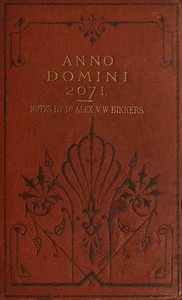
Anno Domini 2071 Translated from the Dutch Original
Language: en377 downloads on Project Gutenberg
Subjects
In: Science-Fiction & Fantasy·Novels
Public-domain ebook sourced from Project Gutenberg #45350.
Public-domain ebook
Language: en377 downloads on Project Gutenberg
Subjects
In: Science-Fiction & Fantasy·Novels
Public-domain ebook sourced from Project Gutenberg #45350.
The opening · free to read
"I have no doubt that this must be a considerable improvement on your town-life throughout winter; but in summer-time I should say this must be intolerably hot."
"Not at all; the same society which undertakes the supply of warm air in winter also provides for us during the summer months a cooling draught. Nothing can be easier than that. You are doubtless aware of ice having been manufactured in the middle of summer for at least a couple of centuries. During the warm season the air is made to pass over the glass vault above us before it reaches the pavement through the sieve-like plate, and if the warm-air inspectors properly attend to their duties, there is scarcely any difference in our temperature throughout the year."
"Then probably you warm your houses by a similar process, and you never use any stoves or fireplaces now?"
Neither of my companions could help smiling at these words, betraying again, as they did, my very old-fashioned notions. Bacon, however, gave me a kindly nod of assent as he proceeded to explain: "Just as a cold-water bath may be heated at pleasure by opening the hot-water tap, we can warm the air in our apartments by means of a valve, which when opened, not only affords a supply of warm air, but has the additional advantage of producing a most delightful refreshing of the atmosphere without any idea of draught."
"I really cannot understand," Miss Phantasia here remarked, "how the people in those barbarous times managed to live amid the smoke and ashes and dust of their horrible fireplaces."
"And then their chimneys on fire," added Bacon; "thank Fate, we have done with that too. Poor insurance offices, they don't pay half the premium now of what they used to do."
"One more question," said I, "before we leave this subject. What do you call the metal used for those elegant little bars which connect and support the roof of glass above us? Surely they are not of iron, as they would have been in my time?"
"No," answered my guide; "iron, on account of its greater specific weight, would have been less suitable here than aluminium; the latter not only corresponds in weight with the glass which it supports, but it also withstands the effects of the atmosphere far better than iron. You will very soon perceive in how many instances the new metal has superseded the old one, in additional proof of which I would just mention the fact that the modern antiquarians do not exclusively now speak of the ages of stone, bronze, and iron, but that they have formally recognised the
Age of Aluminium.
The latter commenced or dates from the second half of the twentieth century, when it was first discovered how to produce aluminium in large quantities from common clay, old tiles, potsherds, china, and earthenware."
"Ah!" said I, "here, then, we have another striking example to teach us that discoveries simply arrived at by purely scientific processes searched after from the pure motive of increase of knowledge, may often be ultimately productive of the greatest practical use. The same metal which for years after Wöhler's discovery continued to be a curiosity--so much so that a few grains of it were preserved among the collections of chemical preparations--has now become universally beneficial, nay, a perfect godsend to those districts where clay, i.e. aluminium ore, is the only underground wealth."
Following up this idea, at the risk of being ridiculed or, perhaps, reprimanded for my impertinent garrulousness, I continued in the following strain:
"Think of the phosphorus discovered by Brandt and Künckel as early as 1669, yet never getting into common use until the lucifers, fusees, and 'flamers' made their appearance some two hundred years afterwards; and of chloroform, now the greatest alleviation of suffering humanity, although Dumas, when he first compounded it, did but little dream of its application. Then, again, when Sir Humphry Davy's remarkable experiments taught him the refrigerating power of metal gas, did this not ultimately lead to the invention of the safety lamp? and not only has the latter already preserved thousands of human lives, but, more than that, the principle of Davy's invention has actually become the basis upon which all steam-engines are constructed, as well as those by which ice can be made at any time. With regard to the invention of the art of photography, how could it have become a reality, a possibility, without the number of purely scientific discoveries that preceded it; aye, purely scientific discoveries, such as Porta's so-called camera obscura [3] (sixteenth century); Scheele's discovery of the discoloration of chloride of silver by light, at which he did not arrive until two hundred years afterwards; Courtois's finding of the iodine, 1811; or the invention of gun cotton, from which Schönbein learned to make collodion; nor would it be difficult to name several other materials, all found by regular chemical processes, to fix the photographic images, and to make them permanent."
Encouraged by my companion's "line of non-intervention," I ventured to continue to speak my thoughts aloud.
"If any art more than another," said I, "is calculated to illustrate the fact that the most important discoveries--such as have been most universally brought to bear upon the joint social condition of mankind--have simply resulted from the inventions of scientific men who never dreamt of the practical application of their discoveries; if any such thing exists, surely it is the telegraph. Could these magic wires have lurked in the mind of Thales when he found out, now twenty-five centuries ago, that a piece of amber, when rubbed, attracts light bodies, even although it led him to discover the very first of those phenomena, the cause of which must be sought in that mysterious power which now we call electricity? Did Galvani think of the telegraphic art when he noticed how the muscles of his frogs contracted under the influence of electricity? [4] or Volta, when, following up Galvani's experiments, he produced the pile that bears his name? And yet that was, so to speak, the embryo of those modern batteries of ours whence proceeds the marvellous action along the wire. Nor is it in any way presumable that Oerstedt ever thought of the application of his discovery to telegraphy, when he first noticed that the magnetic needle is deflected under the influence of electricity; [5] no more than Arago, who found that iron becomes magnetic when an electric current runs along it through a metal wire.
"No, no!" cried I; "none of those men could ever have foreseen the ultimate beneficial results of these discoveries of natural truths." [6]
"You are perfectly right in your remarks," said Bacon, as I paused. "From my own personal knowledge of what has come to pass in the field of industry during the last two centuries, I could adduce a good many more examples to show that many of your nineteenth-century discoveries, which for a long time afterwards merely bore a purely scientific significance or character, have now become prolific sources of material benefit to society at large. Nor does any one now-a-days doubt the importance of pure science; all governments look upon it as an urgent duty on their part to promote the same wherever they can; nor is it too anxiously asked whether it does bear, in every instance, immediate results to benefit the material condition of society. Moreover, it should not be here forgotten that every man of judgment and discrimination has long since learned to see that the furtherance of material advantages as the aim and end of human endeavours is an idea as narrow in itself as it is unworthy of rational beings. Surely there exists another and infinitely higher mainspring of happiness in the enjoyment of gathering such knowledge as will enable us to perceive the causal connection between the phenomena of nature, or teach us the history of man and all his surroundings. The pursuit of material gratification is essentially a thing which man shares with the brute; but our desire to ennoble that which is spiritual or immaterial in us--that is exclusively human; the gratification of such desire is the genuine 'trade-mark' of real civilization. So much is the bulk of modern society already convinced of these truths, that no government could now-a-days afford to neglect the encouragement of scientific pursuit, although the utmost discretion be left to the men of science themselves with regard to the other question: how and in what direction the extension of knowledge ought to take place."
"Then you hear nothing more now of what was once termed 'official science'?"
"I really do not know," said Bacon, "what you are alluding to; but if you use the word 'official' in its usual acceptation--meaning that which can no longer be doubted, since it emanated from a responsible government--then, my dear sir, you will pardon me the remark that the expression is anything but felicitous, nay, very shallow indeed. A government may protect, support, and promote science, but it can never stamp it with the seal of genuineness. Such seal is held by truth alone!"
Somewhat ashamed of my apparently antiquated notions and childish observations, I walked on in silence until Miss Phantasia all of a sudden exclaimed: "Here we have actually got to the exhibition of
oh, do let us go in. I should very much like to know whether they come at all up to those enormous golden placards outside, and whether the highest of the fine arts is here equalled by reality."
There was something spiteful in the remarks of the young lady; and at my question of what was meant by heliochromes, she again sarcastically replied, "Oh! nothing but photographs in the natural colours of the objects as pencilled by the sun himself; so, at least, in her extravagant style, says my friend Realia." [7]
"Ha!" exclaimed I, "the ultimate triumph of the life-long endeavours of that plucky Frenchman, De Saint-Victor! final fruits of the prix Trémont awarded him by the French Academy!"
Bacon looked at me with a smile clearly indicative of his contempt for my helpless ignorance. But all he said was this: "Come inside, please, and you will have something else to see than those rude and perishable experiments of Victor of the nineteenth century."
We entered, and I could not trust my eyes. The walls of the building were covered with innumerable pictures, landscapes, portraits, and genre-pieces, some of the figures life-size; and all these pictures were mere photographs, yet photographs differing as much from those that I was familiar with as an oil painting does from a crayon drawing.
"Unhappy artists! poor arts!" I exclaimed; "what have you come to at last?"
But Miss Phantasia appeared to share my delight no more than my sympathy. "Unhappy artists, indeed," was her reply, "if by such honourable name you designate those knights of the brush whose sole aim and end is the faithful imitation of reality; but do not say poor arts! They have by no means died out, the worthy successors of Raphael and Corregio, of Rubens and Rembrandt, of those whose calling was not to imitate nature, but to idealise it. And that is the vocation of art. Simple imitation is mere handicraft. And although the monuments and statues of living persons are now mechanically taken from photographs, aye, by a common workman who has no notion of art; yet have we sculptors who are genuine artists, creators of the ideal."
The book keeps going
Reading is free forever. Sign up and watch scenes appear while you read.



Scenes Storieta drew for other classics.
New illustrated classics
Once or twice a month: the latest books to get full character casts, scene art, and free comic editions. No account needed.