Public-domain ebook
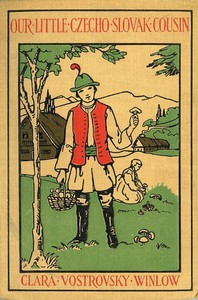
Our Little Czecho-Slovak Cousin
Language: en352 downloads on Project Gutenberg
Subjects
In: Historical Novels·Children & Young Adult Reading·Novels
Public-domain ebook sourced from Project Gutenberg #45616.
Public-domain ebook
Language: en352 downloads on Project Gutenberg
Subjects
In: Historical Novels·Children & Young Adult Reading·Novels
Public-domain ebook sourced from Project Gutenberg #45616.
The opening · free to read
THERE was mourning in the little village high up in the Tatras, as the Carpathian Mountains are called by the Slovaks. Nine men and women lay dead and four lay wounded behind carefully closed doors of the little homes. Scarcely a person except Magyar gendarmes was to be seen on the one main street. Now and then the curious, frightened face of a child peeped out from behind the shaded windows, and again quickly disappeared.
The day before, Magyar officers and priests had come to consecrate the little square church that had just been erected. It had cost the villagers many sacrifices, but they were proud of it. They had come dressed in their best and full of gayety to the services, never dreaming but that their beloved Slovak pastor would be allowed to assist. When they found, however, that he had been ignored, they pressed closely around those in charge and begged that he be allowed to take part, that they might feel that the church was actually their own.
Did they beg too hard? Was it because they were loyal to a leader who loved and sympathized with his own people? Was that why Magyar guns suddenly boomed, and why the ground lay covered with blood?
The news of the happening spread even to the little village in the more fertile plains, where Jozef lived. The twelve-year-old boy heard it discussed the very next day as he accompanied the haymakers to the fields. In order to hear, he found it necessary to keep close to the men and women, for they spoke only in half whispers, fearing spies sent out by the Notary, chief officer of the Commune, who seemed to count it among his duties to keep tab on their very thoughts. They knew that they could do nothing, and it gave them a cowed, dejected air. Never had a haying been so dismal.
The killing, dangerous as the topic was, drew the men to the tavern at night. They sat at the plain deal tables in small groups and drank and smoked their long pipes. Now and then one had something to say. Perhaps it concerned the fate of some woman who had resisted the officers during the mad effort at Slovak denationalization in 1892, when forcible transportation of children to purely Magyar districts had been undertaken. Or it may have dealt with the imprisonment of some editor who had had the courage to denounce some new injustice or atrocity.
A tall athletic-looking man with a broad smooth-shaven face, and hair worn rather long, seemed to be listened to with greatest attention. He was plainly from some other district, for his attire was different from that of his companions. It consisted of felt trousers, the seams piped with red, a linen shirt and a sheepskin waistcoat with the wool inside, heavily embroidered on the leather side. His shoes were of soft leather, laced with rawhide thongs across the ankle, and he wore a low, black hat decorated with a red ribbon band.
"I was living in Turciansky Sv. Martin, our one national center, when the effort was made to establish a cellulose factory there," he was saying. "It was one of the many efforts on the part of Slovaks to be more prosperous and progressive. Like other citizens, I invested considerable money in it. The building was erected and the machinery installed and we were awaiting our license from the government, when word came that it could not be given to the present management. We were dumbfounded, although we understood. We were not to be allowed to run our own factory because we did not help oppress our fellow citizens; because we were loyal to our Slovak traditions and to our Slovak land.
"We did not give in without making an effort to secure justice. But, after several months, we knew that we were defeated. During all this time we had not been allowed to do any work in the factory. One thing, finally, the authorities permitted, and that was to run the costly machinery once a week, so that it should not grow rusty. Of course we had to sell, and at a heavy loss to people eagerly awaiting to develop what we had started."
The peasants near nodded their appreciation of the conditions. One more excitable than his fellows jumped up.
"Will a time never come when we shall be free? Will a time never come when the world recognizes the crime of using force to make people false to their own traditions?" he exclaimed. "To outsiders the Magyars boast of their liberal constitution, of the freedom granted to other nations in the kingdom. We who have no opportunities, who are not allowed a single higher school of our own, nor even a single Magyar Higher School where our language is taught, know what a lie this is. And what advantage is the Magyar language to our children outside of Hungary? Go even to Vienna or anywhere else in the monarchy, and try to make yourself understood with it! You'll see! And we were here before the Magyars; we helped them to know the glorious religion of Jesus Christ; we fought and bled as well as they for our native land." Here his voice changed curiously and a sort of exaltation lit up his face as he said softly: "We must have faith." Then he began to repeat some lines taken from the great Slovak poet Kollar's "Slavy Dcera" (The Daughter of Slava).
"Stop! It is holy ground on which you tread. Son of the Tatra, raise your head toward heaven, Or rather guide your steps towards that oak tree, Which yet defies destructive Time. But worse than Time is man who has placed his iron scepter on thy neck, O Slava. Worse than wild War, more fearful than Thunder, than Fire, Is the man who, blinded by hate, rages against his own race."
"He who is worthy of liberty, respects the liberty of all. He who forges irons to enslave others, is himself a slave. Be it that he fetters the language or the hands of others, It is the same, he proves himself unable to respect the rights of others."
"Slavia, Slavia! Thou name of sweet sound but of bitter memory; hundred times divided and destroyed, but yet more honored than ever. "Much hast thou suffered, but ever hast thou survived the evil deeds of thy enemies, the evil ingratitude also of thy sons. "While others have built on soft ground, thou hast established thy throne on the ruins of many centuries."
Here in a rich bass voice he broke forth into the Slovak national song: "Nad Tatrou sa bliska":
Above Tatra the lightnings flash, The thunder wildly roars; But fear not, brothers, The skies will clear, And the Slovak's time will come.
At the conclusion, a peculiar silence brooded in the room. Suddenly, little anxious twitchings might have been noticed. The singer turned. In the doorway stood the Notary with a wicked, sneering smile on his supercilious face.
JOZEF'S home was one of the high-roofed houses whose gable ends faced the broad, whitish main street. It was made of unburnt bricks, plastered outside, with hand-made shingles on the roof. Each window was outlined in pale green and the entrance porch was quite ornamental, having a pretty conventional design, also in green, painted around the door. This, as well as the lines around the window, was the work of Jozef's mother, who enjoyed a certain reputation in the village because she had once been asked to paint some borders around the walls of the rooms of a girls' school in the city of Brno, the capital of Moravia.
Behind the house were the stalls for the cattle and pigs, and, back of all, a small vegetable garden, edged with sweet smelling herbs and brightly colored flowers. This garden ended in an alley way by a brook, surrounded by green meadows in which geese usually pastured.
In the center of the main street was the Church, a small whitewashed building with a square tower. Next to it were a cross and a statue of the village saint.
Through the middle of the street were rows of underground cellars, one belonging to each family, in which it was possible to keep food and milk ice cold. Vehicles made their way on each side of these cellars.
Around the village were meadows dotted with red poppies and blue corn flowers. Some distance further were fields of potatoes, a few vineyards, and a large, privately owned wood.
It was Helena, Jozef's cousin, who planned the day in the wood for a mushroom hunt, and secured the necessary permission from the forester in charge. She invited Jozef, his ten-year-old sister Ruzena, and two of Ruzena's girl friends to go with her.
"Goody!" the little girls shouted, and ran for the permission which was readily granted on the one condition that they do not spend all the time in play but really bring home mushrooms, which are highly valued as food.
First each little girl took her herd of geese to the meadow by the brook, and left her flock in charge of an old woman who had nothing else to do but tend geese. Then they met Jozef, who had finished his chores of feeding the cattle and pigs, and Helena, who was older and helped her mother at home. All were dressed in old but bright colored clothes, and all were barefoot and bareheaded, the girls' corn-colored hair hanging in long braids down their backs. All carried baskets in which now lay a little lunch. When they started, Jozef did not walk beside the others, but ran on ahead or lagged behind. He was afraid, since this was a girls' party, that some of his boy friends might call him a "sissy." He wouldn't have been left out, however, for the world.
It was still early in the morning, but there was already a heavy warmth in the air, so that the coolness they found underneath the tall trees when they reached them, was very welcome. The road had been dusty, but here the moss and grass were still wet with dew and gave forth a fragrant, pungent odor.
The owner did not live in the wood, the only buildings in it being the picturesque log cabin of the forester or caretaker, and a beautiful hunting lodge.
Soon the fun began.
"Hurrah!" shouted Jozef, discovering two mushrooms, or champignons, showing a brown and a red head above the moss.
Such a scampering as there was among the trees until every basket was filled to overflowing.
Here Etelka, the youngest of the party, found one that she thought the prize of all. It was red with white raised spots.
"Come here!" she cried. "I have found a new kind. Shall I taste it?"
Helena took two rapid leaps toward her.
"Drop it! Drop it!" she exclaimed. "That's a poison muchomurka. Never, never taste anything of which you are not certain if you don't wish to die."
"I thought it prettier than the red ones you found," said Etelka, somewhat abashed.
"It is entirely different," and then Helena showed her how it differed and again impressed on all to confine themselves to those they knew.
Then the baskets were put down in a circle and the children played hide-and-seek among brown trunked firs with long gray mosses festooned from branch to branch, knotted larch trees, and pines dripping with balsam. At last, tired, they sank down on some netted roots and ate their lunch of thick slices of rye bread spread with goose fat.
"I found some sweet-root here once," Jozef volunteered when they had eaten every morsel.
"Where?" the girls asked eagerly.
Jozef had very vague notions as to where.
The book keeps going
Reading is free forever. Sign up and watch scenes appear while you read.



Scenes Storieta drew for other classics.
New illustrated classics
Once or twice a month: the latest books to get full character casts, scene art, and free comic editions. No account needed.