Public-domain ebook
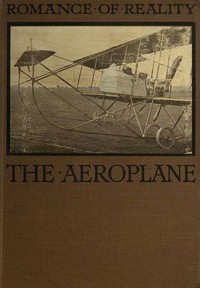
The Aeroplane
by Grahame-White, Claude; Harper, Harry
Language: en628 downloads on Project Gutenberg
Subjects
In: History - Other
Public-domain ebook sourced from Project Gutenberg #45825.
Public-domain ebook
by Grahame-White, Claude; Harper, Harry
Language: en628 downloads on Project Gutenberg
Subjects
In: History - Other
Public-domain ebook sourced from Project Gutenberg #45825.
The opening · free to read
Our aim in these pages is to tell a complete story of the aerial conquest, beginning from crude experiments, made hundreds of years ago; passing thence to the first serious experimenters, with their difficulties and triumphs; and so carrying on the tale to present-day achievements and the latest-type machines.
There is one aspect of this history which has an especial fascination; and it is the personality of the men who--braving ridicule and scorn and surmounting obstacles without number--laid the foundation-stones of flight. Instead of being a compilation of dates, with certain explanatory matter added, our book endeavours to make these men live: to show what induced them to embark upon their seemingly hopeless quest; to tell of their dreams and longings, and how they built their first frail craft; to trace them to their boyhood and their play with kites; to reveal them, in a word, as living beings, and not merely as names.
With this strongly human note, emphasizing the romance of the tale, there goes also a series of explanations--made clearer by drawings and diagrams--and tending always to show how, link by link and step by step, data and experience were secured; how each pioneer, however humble, played his individual and useful part; and how in the end, by sifting all such knowledge and carrying experiment to its final stage, the Wrights achieved the apparent miracle, and flew safely and successfully in a power-driven machine.
The book divides itself naturally into sections. First there is the story of the very early and haphazard tests, and of the notes and speculations of scientists; then of the advent of the practical, patient experimenter--the man who, taking a hint from the birds, realized that ere he could hope to fly he must learn first to balance himself when in the air. This stage, of course, introduces Otto Lilienthal--the German engineer who, by his gliding flights from hilltops with outstretched, bird-like wings, has won the honour of being styled “the father of the aeroplane.”
From a narration of his work, so vital a link in the chain of progress, the story passes to those two men--unflurried, reserved, and infinitely painstaking--who at last evolved order out of chaos: Wilbur and Orville Wright. Their diligent study is described; their perfected glider; the building of their own motor; and, finally, that great day of triumph which came in 1903--just eleven years ago.
The world being given thus an aeroplane which would fly, the steps which followed were mainly those of perfection and improvement. One by one the limitations were removed. At first men dared only to fly above a smooth-surfaced aerodrome, in case their motors should stop and send them gliding back to earth; but soon, gaining confidence in themselves and in their engines, they were passing high across country. So, also, in regard to their enemy the wind. Dreading even a gentle gust at first, for fear it might overturn them, they have gained so rapidly in skill that, thanks to their experience and the stability of their machines, the airmen of to-day will do battle with a gale. In this section of our book is a description of the greatest feats, both of early days and of modern times--such as speed flying, altitude records, and the touring of continents by air.
Thus logically may the tale be told: with digressions of course to cover the risks of aviation, and to explain how they are being overcome; to deal with aerial warfare and its many problems; to describe the advent of the sea-plane; and to discuss the day when--a perfected passenger craft being available--men will journey by air as they do now by land or sea.
CLAUDE GRAHAME-WHITE. HARRY HARPER.
LONDON, 1914.
NOTE.--_The authors thank most cordially the proprietors of_ The Daily Mirror for permission to reproduce certain photographs, of an historical interest, which depict incidents from the cross-Channel flying both of Latham and Bleriot; also F. N. Birkett, Esq., the Topical Postcard Company, and The Central News for permission to use photographs illustrative of modern aviation.
The book keeps going
Reading is free forever. Sign up and watch scenes appear while you read.



Scenes Storieta drew for other classics.
New illustrated classics
Once or twice a month: the latest books to get full character casts, scene art, and free comic editions. No account needed.