
Public-domain ebook
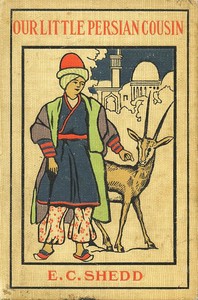
Our Little Persian Cousin
Language: en378 downloads on Project Gutenberg
Subjects
In: Children & Young Adult Reading·Novels
Public-domain ebook sourced from Project Gutenberg #45844.
Public-domain ebook
Language: en378 downloads on Project Gutenberg
Subjects
In: Children & Young Adult Reading·Novels
Public-domain ebook sourced from Project Gutenberg #45844.
The opening · free to read
EVERY one in the house of Abdullah was smiling on the day when a boy was born. Even Ashak the donkey, as he was bringing big bundles of wheat from the field, did not get half as many pokes as usual from the nail pointed stick that took the place of a whip, and was actually let alone for a whole afternoon to eat the dead grass and crisp thistles by the roadside.
Old Bajee, who was caring for the baby, ran as fast as she could to be the first to tell the news to Abdullah, calling out all the way, "Good news! a boy! a boy!"
"Praise be to God!" exclaimed Abdullah, and gave her a piece of silver money worth half a dollar. Laughing from joy she clutched this tight in her fist, and almost touched the ground with her forehead as she bowed to him. She had never owned half a dollar at one time except twice before in her life.
Abdullah hurried to the little shop around the corner and bought a loaf of sugar and some tea, and the tea urn, or samovar, was soon steaming. His neighbours--all men--came to congratulate him. Some brought raisins as a present, some melons. One brought another small loaf of sugar.
"May his foot be blessed!" they said. (They meant the baby's foot.) "This is light to your eyes!" "May you be the father of eight boys and no girls!"
Said Abdullah, "Praise be to God!" and gave them all small tumblers of tea that was nearly boiling and as sweet as sugar could make it.
Meantime the women were coming to see the baby. Old Bajee had rubbed him all over with salt; then she had tied a dark handkerchief over his eyes and wrapped him up in strips of cotton cloth and a little quilt. He was now lying by his mother. She was thinking about the Evil Eye,--an evil spirit or fairy who was always trying to do bad things,--and looked anxiously at the baby's arm.
"Where is the charm, Bajee?" she asked.
"Yes," said a neighbour, "he needs a charm at once, for he is so very pretty."
"Oh, don't say that," exclaimed the mother; "the Evil Eye will hurt him if you do. Bring the charm."
Bajee brought a piece of paper on which the mullah (or preacher) had written a prayer asking the angels to keep the Evil Eye away, and putting this in a tiny bag she tied it to the baby's right arm. "That prayer will frighten the Evil Eye," she said.
All this seemed very interesting to Almas. How delightful it was to have a baby brother. She wondered why her uncle Mashaddi had not seemed greatly pleased when a baby girl had come to his house two weeks before. No one had even called to congratulate him. But now her father was getting up a dinner party, and they were roasting a whole lamb for it, and cooking, oh! so many other delicious things. She could smell the onions even from the street, so she asked her grandmother for something good.
Grandmother laughed and said, "The front door cried for three days when you were born. But God gave you to us, and we are not sorry."
Then she gave Almas a big piece of bread with rice and meat heaped upon it, and some omelet mixed with molasses.
Meantime mother was sleeping with baby by her side. Her last words had been, "Bajee, be sure to keep the light burning, so that the evil spirits will be afraid and not get the baby."
When baby was just a week old, the preacher, whom they called the mullah, came to give him a name. He brought the holy book which was their Bible, and which they called the Koran. No one in that village believed in Jesus Christ in the way in which Christians do, but were in religion what we call Muhammadans. The mullah stood over the baby and read out of this Koran in a loud, sing-song voice.
Baby was frightened, and cried.
The mullah did not stop, but next made a long prayer in words which no one else could understand, because he was speaking in Arabic, the holy language which Muhammad, the prophet who had composed the Koran, had spoken. Then he called out, "Your name is Karim!"
Almas thought it was quite a funny sight to see his long red beard wagging back and forth while he made such strange sounds, and so she broke into a laugh, at which her father turned and struck her. She went out crying softly. She did not like the mullah. Why had he come to frighten baby? He had not named her little cousin. Old Bajee had shouted in her ear, "Your name is Fatima!" and that was all.
After this Karim was laid in a very narrow cradle without any sides, and long strips of cloth were wrapped around and around him and under the bottom of the cradle. His arms were tied down, and a calico curtain kept the light out. He lay in this dark little place nearly all the time for the first six months, generally asleep.
Although Abdullah was very proud of him, he hardly noticed him for over a month, because the evil spirits would wonder what he was looking at and come to see.
Once a day baby's mother would build the fire for cooking, and the room would fill with smoke, because there was no chimney, but only a hole in the middle of the ceiling. At first he cried every time, for the smoke made his eyes smart with pain. His mother put some medicine upon them when she saw how red they had become, and asked Bajee what the matter was.
"How can I tell?" said Bajee. "Babies always have sore eyes."
When the curtain was loose and it was not too dark the flies came to visit him. There seemed to be hundreds of them, and they walked all over his face and even into his mouth, but were especially fond of his red eyes and gathered in black rows around them. He winked and winked, but they did not care. Then he would begin to cry.
After a while mother would come to fix the curtain and rock the cradle, or perhaps--and this was the best of all--she would undo the wrappings and take him in her arms for a few minutes, singing, "My dear baby! my sweet baby! You are my father! and the father of my father!" She meant that she thought as much of him as of her grandfather, and every one always talked as if people cared more for a grandfather than for any one else.
ONE day Karim's mother, whom he was now learning to call "Nana," said to father Abdullah, "Master, your boy--may his eyes have light!--is now five months old, and ought to come out of his cradle. Buy some calico, and I will make another shirt for him. Do not buy red or any bright colour, so that the Evil Eye may not think him too pretty and so become jealous and strike him."
She made the shirt so short that his fat brown legs were bare to the knee.
When he could crawl around in the house sister Almas watched him. It was too dark for him to see much, for all the light came from the door, when that was open, and from the hole, about a foot square, in the middle of the ceiling, where the smoke at last went out. The door was so low that Nana had to stoop every time she went through it. The walls were black from the smoke, which Karim now found poured out each morning from a hole in the floor about as big as a large barrel. Nana did the cooking with the fire which she kept burning in this hole.
One afternoon Karim looked down, and found that its bottom was all bright with light which came from glowing red lumps. It was the prettiest thing he had ever seen, and he grasped the edge and leaned away over to see still better. Just then Almas screamed and jerked him back by his foot so suddenly that the skin of his hands was scratched by the rough edge. Of course he cried.
Nana came running in, and snatching him up exclaimed between her sobs, "Awý! my precious! he might have fallen in!" Then she struck Almas, so that she, too, cried.
After this Karim had to be satisfied with the bright light shining in through the hole above his head, and with the two round trays which, leaning against the wall, shone like polished silver until at last the smoke darkened them. They remained so until the next year, when a man came from the city and polished them over again.
In the daytime there were large piles of bedclothes tightly rolled up near the cradle. A few rugs lay folded beside them. There were no tables or chairs or bedsteads, and the floor was simply the hard earth. In the corner were a few green bowls, and some wooden spoons and copper plates. These were the dishes for the meals. Just across from the door stood a wooden chest, half as high as the room. This was where all the flour was put in the autumn, when Abdullah had packed it down carefully by stamping upon it with his bare feet. Near it was a door opening into darkness, through which Karim was afraid to crawl.
When he tired of these things, he looked at the chickens,--an old rooster dressed in red and black, but without any tail (he had never had any), and two or three clucking old biddies in sober gray, besides a half dozen others, hungry looking, half grown, with long legs. Like the flies, they came into the house whenever the door was open. If Nana left any food standing even for a minute she had to cover it. They came at meal time as regularly as if they had been invited, and fought with each other for the scraps of bread or bits of gristle that Abdullah threw away. Several times the rooster snatched the piece of bread which Karim was eating right out of his hand; but when he laid the bread down to crow for the biddies, one of the half grown chickens caught it up and ran around the room with it, chased by all of his hungry brothers.
The family got up every morning when it was just beginning to become light. All but Karim were busy nearly the whole of the day. When the sun was two or three hours high--no one had a clock--Abdullah came in for breakfast.
At meal time Nana brought the large tray that took the place of a table, and Abdullah set it upon the floor and laid upon it two or three sheets of bread which looked a good deal like brown paper, and was as thick as heavy pasteboard. It was made of whole wheat flour and tasted very good. Nana poured the soup out of a small kettle into one of the green bowls. Sometimes the soup was mixed with pieces of meat and onions, and was red with pepper; sometimes it was made of curded milk and greens. There were also onions and salted cheese and red peppers for side dishes, with cucumbers and melons and other fruits in summer.
Abdullah sat down on the floor upon his heels and ate alone, until Karim was old enough, when he always ate with "Dada," as he called his father, while Nana and Almas waited upon them. They never dreamed of eating with Dada, for that would have been very impolite, but when he had finished they sat down and ate what was left.
There were no knives and forks--what were fingers made for?--and no plates or tumblers, for all ate out of the same bowl and drank from the same water jug.
Between meals Nana was very busy. First came the milking of the cow; then the bedclothes must be rolled up and the stable cleaned out, and there was sweeping and churning to be done. The water must be brought upon her back in a heavy jar from the spring. In winter the cotton and wool was spun into yarn and knit into bright coloured socks, and in summer she helped Abdullah gather the cotton or the tobacco, and worked in the orchard or wheat-field. In the fall she swept up the leaves which fell from the trees growing on the edges of the streams and carried them home on her back to be stored for kindling.
The book keeps going
Reading is free forever. Sign up and watch scenes appear while you read.



Scenes Storieta drew for other classics.
New illustrated classics
Once or twice a month: the latest books to get full character casts, scene art, and free comic editions. No account needed.



![Cover of Peter Pan: [Peter and Wendy]](/covers/16.jpg)