Public-domain ebook
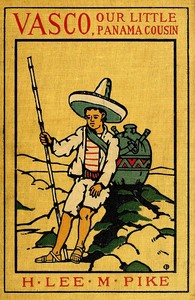
Vasco, Our Little Panama Cousin
Language: en290 downloads on Project Gutenberg
Subjects
In: Historical Novels·Children & Young Adult Reading·Adventure
Public-domain ebook sourced from Project Gutenberg #46043.
Public-domain ebook
Language: en290 downloads on Project Gutenberg
Subjects
In: Historical Novels·Children & Young Adult Reading·Adventure
Public-domain ebook sourced from Project Gutenberg #46043.
The opening · free to read
IN young Vasco Barretas, who had both Spanish and Indian blood in his veins, there had been born a natural desire for excitement and adventure.
Just one thing equalled this desire. That was his dislike for work.
However, we must not blame him for that. His laziness was the result of training, or rather the lack of it. Necessities were few and easily obtained, and he had not learned to care for the luxuries of life.
On account of Vasco's fondness for bustle and excitement the time this story begins was most glorious for him. As his American cousin would say, "something was doing."
A successful revolution had just taken place in Panama.
A revolution was no new thing in the little strip of country that separates the Atlantic from the Pacific. Vasco's father had been through many such affairs. They had been nearly as regular as the rainy seasons.
Vasco did not understand all about it, yet even the boys in the streets knew that this revolution was different from any other.
There had been no bloodshed, but the results seemed likely to be very important to the country.
Do you want to know why?
Then listen to a little bit of history.
The State or Province of Panama, on the narrow bit of land connecting North and South America, had been a part of the country called the United States of Colombia.
The great republic to the north, the United States of America, wanted to dig a canal across Panama, but had been unable to get permission from Colombia. And so it looked as if there might be no canal--at least not in Panama.
The citizens of Panama were disappointed, for the digging of a canal through their country would bring to them many people and much wealth.
For this reason the leading men concluded that it was best to separate from Colombia, organize a government of their own, and come to an agreement with the United States. At the time this story opens the new government had just been set up, and its authority proclaimed.
But, it may be asked, what has all this to do with Vasco?
To begin with, Vasco's father, in private life a very ordinary citizen, who sometimes had been a waiter in a hotel and at other times the servant of an American engineer, was deeply interested in this latest revolution; for was he not an officer in the new National Guard,--Lieutenant Amadeo Barretas?
His position did not require much work, either of mind or body, but little Lieutenant Barretas could assume as much dignity as a seven-foot member of Napoleon's "Old Guard"--and more pomposity. When on parade he would strut about in his gaudy uniform with all the airs possible, and appear very serious--though to you he would have looked more silly than serious.
There was to be a grand review of the Panama "army." The soldiers were to parade through the streets of the city and be inspected by the commander-in-chief. Several officers of the United States army were to be guests of the Panama officials, and occupy a place on the reviewing stand.
Young Vasco meant to have a good sight of the parade. Surely he, the son of a lieutenant in the army, ought to have a place where he might see his father march by, and be able to add his voice to the thousands who would shout huzzas! But, for some reason, the officers in charge had neglected to invite him.
Vasco's home was on a side street in the poorer section of the city, so the soldiers would not pass by that place. How, then, could he get a good view of the parade?
Of course he could stand at the side of the street; but what chance would a small boy have in such a place as that?
Now Vasco was a boy of many resources, and it seemed to him that he might make use of the good nature of a young American friend.
Harlan Webster was the son of an American engineer who was in charge of work on the canal.
Mr. Webster had been for some time upon the Isthmus, and, unlike most of the Americans at work on the canal, he had brought his family, consisting of wife and son, to the city of Panama. They had now lived here over a year. During that time Harlan had learned a good deal about the country. He had also acquired some knowledge of Spanish, the language of the natives. In fact, it was said of him by his Panama friends that he could talk with the people more freely than many older foreigners who had been longer in the country.
The American boy knew many Panama lads, among them Vasco. "Lieutenant" Barretas, as he insisted on being called, had been in Mr. Webster's service at various times, and the two boys had thus become quite intimate and had taken many pleasure trips together.
Harlan was able to tell Vasco a good deal about Panama history. The stories about the buccaneers of old times, about the raid on the city of Panama, about Balboa and his adventures and discoveries, were more familiar to the American lad than they were to the Panama boy.
On the other hand, Vasco could give his friend much information about the every-day habits and customs of the people, and was able to take him to many points of interest. When it came to excursions by water or by land, Vasco was in his element. He could handle a boat with skill, he could swim like a fish, and he knew the windings and curvings of all the highways and byways of the city.
Straight to the hotel where the Webster family lived went Vasco this morning. This hotel was in the better part of the city, not far from the plaza, or great square.
"Hello, Harlan," said Vasco, after he had found his friend.
"Hello, Vasco."
"How would you like to see the great army parade this morning?"
"Fine," was the reply. "Where can we go to get a good view?"
"That's what I'd like to know. I don't want to stand in the crowd on the street, for I could never see anything that way."
"Let's see what my father can do to help us," said Harlan.
Mr. Webster, who was in an adjoining room, greeted his son's friend with a pleasant "Good morning" when the boys appeared before him. Seeing the eager, inquiring look on their faces, he asked what he could do for them.
"The Panama soldiers are going to parade to-day," said Harlan, "and Vasco is anxious to find a place where he can see them."
Mr. Webster smiled. He had an idea that Harlan was as anxious to get a view of the parade as was Vasco.
"Why don't you go into the cathedral and watch from the tower or from one of the upper windows?" asked Mr. Webster.
"None but officials and their families or others holding tickets can enter the cathedral till after the parade," replied Vasco, "and all entrances are guarded."
"If I tell you of a way to get into the cathedral, do you think you can remain within till the soldiers go by?" asked Mr. Webster.
The book keeps going
Reading is free forever. Sign up and watch scenes appear while you read.



Scenes Storieta drew for other classics.
New illustrated classics
Once or twice a month: the latest books to get full character casts, scene art, and free comic editions. No account needed.