Public-domain ebook
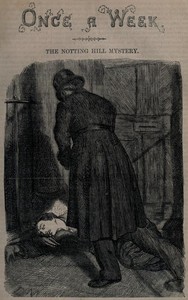
The Notting Hill Mystery
Language: en557 downloads on Project Gutenberg
Subjects
In: Crime, Thrillers and Mystery·Novels·British Literature
Public-domain ebook sourced from Project Gutenberg #46153.
Public-domain ebook
Language: en557 downloads on Project Gutenberg
Subjects
In: Crime, Thrillers and Mystery·Novels·British Literature
Public-domain ebook sourced from Project Gutenberg #46153.
The opening · free to read
Mr. R. Henderson to the Secretary of the ---- Life Assurance Association.
"Private Enquiry Office, Clement's Inn,
"GENTLEMEN, "17th Jan, 1858.
"In laying before you the extraordinary revelations arising from my examination into the case of the late Madame R**, I have to apologise for the delay in carrying out your instructions of November last. It has been occasioned, not by any neglect on my part, but by the unexpected extent and intricacy of the enquiry into which I have been led. I confess that after this minute and laborious investigation I could still have wished a more satisfactory result, but a perusal of the accompanying documents, on the accuracy and completeness of which you may fully rely, will I doubt not satisfy you of the unusual difficulty of the case.
"My enquiries have had reference to a policy of assurance for 5000_l_., the maximum amount permitted by your rules, on the life of the late Madame R, effected in your office by her husband, the Baron R, and bearing date 1st November, 1855. Similar policies were held in the ---- of Manchester, the ---- of Liverpool, the ---- of Edinburgh, and the ---- of Dublin, the whole amounting to 25,000_l_.; the dates, 23rd December, 1855, 10th January, 25th January, and 15th February, 1856, respectively, being in effect almost identical. These companies joined in the instructions under which I have been acting; and, from the voluminous nature of this letter and its enclosures, I shall be obliged by your considering my present reply as addressed to them conjointly with yourselves.
"Before entering upon the subject of my investigations, it may be as well to recapitulate the circumstances under which they were originated. Of these the first was the coincidence of dates, above noticed; and an apparent desire on the part of the assurer to conceal from each of the various offices the fact of similar policies having been elsewhere simultaneously effected. On examining further into the matter your Board was also struck with the peculiar conditions under which the marriage appeared to have taken place, and the relation in which Madame R** had formerly stood to the Baron. To these points, therefore, my attention was especially directed, and the facts thus elicited form a very important link in the singular chain of evidence I have been enabled to put together.
"The chief element of suspicion, however, was to be found in the very unusual circumstances attendant on the death of Madame R, especially following so speedily as it did on the assurance for so large an aggregate amount. This lady died suddenly on the 15th March, 1857, from the effects of a powerful acid taken, it is supposed, in her sleep, from her husband's laboratory. In the Baron's answers to the usual preliminary enquiries, forwarded for my assistance, and herewith returned, there is no admission of any propensity to somnambulism. Shortly, however, after the occurrence had been noticed in the public prints, a letter to the Secretary of the Association from a gentleman recently lodging in the same house with Baron R, gave reason to suspect that in this respect, at least, some concealment had been practised, and the matter was then placed in my hands.
"On receipt of your instructions, I at once put myself in communication with Mr. Aldridge, the writer of the letter in question. That gentleman's evidence certainly goes to show that, within at least a very few months after the date of the latest policy, Baron R** was not only himself aware of such a propensity in his wife, but desirous of concealing it from others. Mr. Aldridge's statements are also to a certain extent supported by those of two other witnesses; but, unfortunately, there are, as will be seen, circumstances calculated to throw considerable doubt upon the whole of this evidence, and especially on that of Mr. Aldridge, from which alone the more important part of the inference is drawn. The same must, unfortunately, be said with regard to some other parts of the evidence, as will be more clearly seen when the case itself is before you.
"From his statement, however, in conjunction with other circumstances, I learned enough to induce me to extend my researches to another very singular case, which not long since had given rise to considerable comment.
"You will, no doubt, remember that in the autumn of 1856 a gentleman of the name of Anderton was arrested on suspicion of having poisoned his wife, and that he committed suicide whilst awaiting the issue of a chemical enquiry into the cause of her death. This enquiry resulted in an acquittal, no traces of the suspected poison being found; and the affair was hushed up as speedily as possible, many of Mr. Anderton's connections being of high standing in society, and naturally anxious for the honour of the family. I must, however, acknowledge the readiness with which, in the interest of justice, I have been furnished by them with every facility for pushing my enquiries, the results of which are now before you.
"In reviewing the whole facts, and more especially the series of remarkable coincidences of dates, &c., to which I beg to direct your most particular attention, two alternatives present themselves. In the first we must altogether ignore a chain of circumstantial evidence so complete and close-fitting in every respect, as it seems almost impossible to disregard; in the second, we are inevitably led to a conclusion so at variance with all the most firmly established laws of nature, as it seems almost equally impossible to accept. The one leaves us precisely at the point from which we started; the other involves the imputation of a series of most horrible and complicated crimes.
"Between these alternatives I am constrained to confess my own inability, after long and careful study, to decide. I have determined, therefore, simply to submit for your consideration the facts of the case as they appear in the depositions of the several parties from whom my information has been obtained. These I have arranged, as far as possible, in the form in which they would be laid before counsel, should it ultimately be deemed advisable to bring the affair into Court. In view, however, of the extreme length of the case, I have given, in a condensed form, the substance of such of the depositions as did not seem likely to suffer from such treatment. The more important I have left to tell their own tale, and, in any case, my abstract may be at once checked by the originals, all of which are enclosed.
"Should your conclusions be such as have been forced upon myself, further deliberation will yet be required with reference to the course to be pursued; a point on which, in such case, I confess myself almost equally unable to advise. Whether in a matter so surrounded with suspicion, it might not be well, in any event, to resist the claim, is certainly a question to be considered. On the other hand, even assuming the fullest proof of the terrible crimes involved, it is a matter calling for no less careful consideration, whether they would be found of a nature to bring the criminal within reach of the law. For the present, however, our concern is with the facts of the case, and ulterior questions had better be left on one side until that issue is decided, when, I conclude, I shall hear further from you on the subject.
"In conclusion, I must trouble you with a few words on a point which seems to require explanation. I allude to the apparent prominence I have been compelled to afford to the workings of what is called 'Mesmeric Agency.' Those, indeed, who are so unfortunate as to be the victims of this delusion, would doubtless find in it a simple, though terrible solution of the mystery we are endeavouring to solve. But while frankly admitting that it was the passage from the 'Zoist Magazine,' quoted in the course of the evidence, which first suggested to my mind the only conclusion I have as yet been able to imagine, I beg at the outset most distinctly to state, that I would rather admit my own researches to have been baffled by an illusory coincidence, than lay myself open to the imputation of giving the slightest credit to that impudent imposture. We must not, however, forget that those whose lives have been passed in the deception of others, not unfrequently end by deceiving themselves. There is, therefore, nothing incredible in the idea that the Baron R** may have given sufficient credence to the statement of the 'Zoist,' above-mentioned, for the suggestion to his own mind of a design, which by the working of a true, though most mysterious, law of Nature, may really have been carried out. Such, at least, is the only theory by which I can attempt, in any way, to elucidate this otherwise unfathomable mystery.
"Awaiting the honour of your further commands,
"I am, Gentlemen, very faithfully yours, "RALPH HENDERSON."
"Oh, auntie, auntie, what shall I do? For three nights I have not closed my eyes, and I would not write even to you, auntie dear, because I kept hoping that, after all, things might come right, and he would come back again. Oh, how I have listened to every sound, and watched the road till my poor eyes ache! And now this is the fourth day since he went away, and, oh, auntie, I am so frightened, for I am sure he is gone after that dreadful man, and, oh, if he should meet him, I know something terrible will happen, for you can't tell how he looked, poor Edward, I mean, when he went away. But, indeed, auntie, you must not be angry with him, for I know it was all my own fault, for I ought to have told him everything long ago, though indeed, indeed, I never cared for him, and I do love dear Edward so dearly. I was afraid....
[Here the MS. becomes in places very blotted and illegible.]
... and I thought it was all at an end, and then ... and only a fortnight ago we were so happy ... married hardly seven months and ... but you must not think I am complaining of him, dear auntie, for you don't know how.... Only if you can, come to me, for I feel getting so ill, and you know it is only God bless you, auntie; oh, do come to me if you can. "GERTRUDE BOLETON."
2. Extract of letter from the Same to the Same, written about four days later.
"I am so sorry to hear you are so ill; don't try to come, darling auntie; I shall do somehow, and if not, anything is better than this horrible suspense.... No tidings yet, but I cannot write more, for I can hardly see to guide the pen, and my poor head seems to open and shut. God bless you, auntie. "G."
"I open my letter to thank you so much for sending dear kind Mrs. Ward; she came in so unexpectedly (in a blue [2]) just as if she had come from heaven. I wonder if she has seen Ed....?
[Here the MS. ends suddenly.]
3. From Mrs. Ward to Honourable C. B**, enclosing the above.
"Beechwood,[3] Tuesday night.
"MY DEAR CATHERINE,
"I fear I have but a poor account to give you of our dear Gertrude. Poor child! when I came into the room, and saw her looking so pale and wan, and with great black circles round her eyes, I could scarcely keep in my own tears. She gave a little cry of joy when she saw me, and threw herself upon my neck; but a moment after, turned to the writing table and tore open the letter I send you with this, and which was lying ready for the post. The long-continued strain seems to have been too much for her, and she had hardly written a line when her head began to wander, as you will see from the conclusion of her postscript, and in trying to write her husband's name she broke down altogether, and went off into a fit of hysterics which lasted for several hours. She is now, I am thankful to say, comparatively calm again, though at times her head still wanders, and she seems quite unable to close her eyes, but lies in her bed looking straight before her, and occasionally talking to herself in a low voice, but without seeming to notice anything. I have endeavoured, as far as I dared, to draw from her the history of this sad affair, but can get nothing, poor child, but eager assurances that it was 'all her fault,' and that 'indeed, indeed, he was not to blame.' It seems as though my coming--though certainly a great relief to her--had had the effect of putting her on her guard lest anything should escape her unfavourable to her husband, and her whole faculties seem to be concentrated in the endeavour to shield him from reproach. I fear, however, there can be no doubt that he has been very seriously to blame; indeed, from all I can gather, the fault seems to have been entirely on his side. What is the precise history of this unhappy business I have not been able to learn; but it seems that Sir Edward, who is certainly a most violent young man, and I fear also of a most jealous temperament, contracted some suspicion with regard to that Mr. Hawker who so perseveringly persecuted poor Gertrude the winter before last, and to have left Beechwood, after a very distressing scene, in pursuit of him. Mr. Hawker is supposed to be on the Continent, and it is known that Sir Edward took the Dover Road, which, as you know, passes close by this place. This is all I can at present learn with any certainty, though I hear but too much from the servants, who are all in such a state of indignation at Sir Edward's treatment of their mistress, that I have the utmost difficulty in restraining it from finding some open vent. Should I hear more, I will of course let you know at once; but meanwhile I cannot conceal from you my deep anxiety for our dear Gertrude, whose poor little heart seems quite broken, and for whom I am in hourly dread of the effect but too likely to be produced, in her present delicate state, by the anxiety and terror from which she is suffering.... You know how much I always disliked the match, and I feel more than ever the impropriety of consigning so young and sensitive a girl to the care of a man of such notoriously uncontrollable temper. Poor thing! this is evidently not the first time she has suffered from it, and even should she herself escape without permanent injury to her constitution, I dread the effect upon the child.... And now I must close this long and sad letter, but will write again should anything fresh occur; meantime, I cannot be longer away just now from Gertrude's side. I hope your own health is improving. My love to little Henry, and tell him to be very good while I am away. "Your affectionate "HELEN WARD."
The book keeps going
Reading is free forever. Sign up and watch scenes appear while you read.



Scenes Storieta drew for other classics.
New illustrated classics
Once or twice a month: the latest books to get full character casts, scene art, and free comic editions. No account needed.