
Public-domain ebook
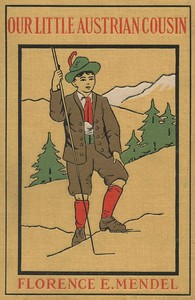
Our Little Austrian Cousin
English417 downloads on Project GutenbergDownload EPUB
Public-domain ebook sourced from Project Gutenberg #46230.
Public-domain ebook
English417 downloads on Project GutenbergDownload EPUB
Public-domain ebook sourced from Project Gutenberg #46230.
The opening · free to read
"HURRAH!" shouted Ferdinand, as he burst into the living-room, just as his mother was having afternoon coffee.
"And what makes my son so joyful?" asked Frau Müller, as she looked up at the rosy cheeks of her young son.
"Hurrah, mother! Don't you know? This is the end of school."
"So it is," replied the mother. "But I had other things in my head."
"And, do you know," the child continued, as he drew up to the table where the hot coffee emitted refreshing odors, "you haven't told me yet where we are to go."
"No, Ferdinand, we've wanted to surprise you. But help yourself to the cakes," and the mother placed a heaping dish of fancy kuchen before the lad.
Ferdinand did not require a second invitation; like all normal boys, he was always hungry; but I doubt very much if he knew what real American-boy-hunger was, because the Austrian eats more frequently than we, having at least five meals a day, three of which are composed of coffee and delicious cakes, so that one seldom has time to become ravenous.
"But, mother," persisted the child, his mouth half filled with kuchen, "I wish I knew. Tell me when we start; will you tell me that?"
"Yes," answered his mother, smiling. "To-day is Wednesday; Saturday morning we shall leave."
"Oh, I just can't wait! I wish I knew."
"Perhaps father will tell you when he comes," suggested the mother. "Do you think you could possibly wait that long?"
"I don't believe I can," answered the lad, frankly; "but I suppose I shall have to."
That evening, when Herr Müller returned from his shop, Ferdinand plied him with questions in an effort to win from him, if possible, the long-withheld secret.
"Well, son, there's no use trying to keep you in the dark any longer. Where do you guess we are going?"
"To see Cousin Leopold in Tyrol."
"Well, that's a very good guess, and not all wrong, either; but guess again."
"Oh, I can't. It must be splendid, if it's better than visiting Cousin Leopold."
"Well, it is better," continued Herr Müller; "for not only are we going to pass a few days with your Tyrolese relations, but we are going to a farm."
The boy's face fell visibly.
"To a farm!" he exclaimed. "Why, Uncle Hofer has a splendid farm in Tyrol; that won't be very new to me, then."
"It won't!" ejaculated his father, a trifle amused. "You wait and see, my boy. This is not to be a tiny farm of a few acres, creeping up the mountain on one side and jumping off into a ravine on the other. We sha'n't have to tie this farm to boulders to keep it from slipping away from us." And Herr Müller chuckled.
"Then it isn't in the mountains?"
"No, it isn't in the mountains; that is, not in any mountains that are like the Tyrolese mountains. But there will be acres and acres of this farm, and you will be miles away from any one. You will see corn growing, too; you've never seen that in Tyrol, my son."
"No," answered the child. After a few moments' silence, he added: "Will there be any young folks, father?"
"Don't let that trouble you, Ferdinand; where there's an Austrian farm there are many children."
"Hurrah for the farm, then!" shouted Ferdinand, much to the astonishment and amusement of his parents, who were unused to such impulsive outbursts. But Ferdinand Müller was a typical boy, even though he had been reared in the heart of the city of Vienna, where the apartment houses stand shoulder to shoulder, and back to back, with no room for play-yards or gardens, even; the outside windows serving the latter duty, while the school building on week-days, and the public parks on holidays, serve the former. Austrian children are never allowed to play on the street; but, as if to make up to their children for the loss of play-space, the Austrian parents take them, upon every available occasion, to the splendid parks where are provided all sorts of amusements and refreshments at a modest sum.
"Father," asked the lad, after a few moments' silence, during which he had sat thinking quietly, "when shall we start?"
"Saturday morning, my son. I believe your mother has everything in readiness, nicht war, meine liebe Frau?" he asked, as he glanced over his paper at his wife.
"Oh, mother, do say you are ready," pleaded the child, who, for all his twelve years, and his finely developed body, was yet a boy, and impulsive.
"Yes, I'm all ready," she replied.
And, for the rest of the evening, silence descended upon the boy, his small brain being filled with visions of the coming pleasure.
When Herr Müller returned to his home the following evening, he found a letter, postmarked "Linz," awaiting him.
"Hello," he said, half aloud, "here's word from our friend Herr Runkel. Wonder if there's anything happened to upset our plans?"
"Oh, father, please don't say it," pleaded the boy; "I shall be so disappointed."
"Well, cheer up," replied his father, "there's better news than you thought for. We shall leave on Saturday morning as planned; but to-morrow Herr Runkel's sister from the convent will come to us. He asks us to take charge of her, as the Sisters find it very inconvenient this year to send an escort with her; and, as we are coming up in a day or two, perhaps we would not mind the extra trouble."
"Oh, father, won't it be fine! How old is she?"
"I believe about your age."
Friday morning Frau Müller and Ferdinand jumped into a fiaker and drove to the railroad station to meet Teresa Runkel. She was a fine-looking child, with round, rosy cheeks; quite tall, with the fair complexion, sunny hair, and soft, Austrian blue eyes that makes the women of that land famed for their beauty. She was overjoyed at this unexpected pleasure of spending a day or two in the city of Vienna, which she had never seen, although she had passed through several times on her way to and from the convent. She enjoyed the brisk drive to the tall apartment house in the Schwanengasse, and she fairly bubbled with chatter.
"After luncheon, my dear," observed Frau Müller, "we shall have Herr Müller take you about our city; for Vienna is vastly different from Linz."
Herr Müller joined the party at luncheon at eleven o'clock, which was really the breakfast hour, because Austrian families take only coffee and cakes or rolls in the early morning, eating their hearty breakfast toward the middle of the day, after which they rest for an hour or two, before beginning their afternoon duties.
The book keeps going
Reading is free forever. Sign up and watch scenes appear while you read.



Scenes Storieta drew for other classics.
New illustrated classics
Once or twice a month: the latest books to get full character casts, scene art, and free comic editions. No account needed.




![Cover of Peter Pan: [Peter and Wendy]](/discover-assets/demos/ba097987ccba0b1fa64013f65177a21403fff86f0ce5aa07c3bfa270666dd2ee/cover.webp)