Public-domain ebook
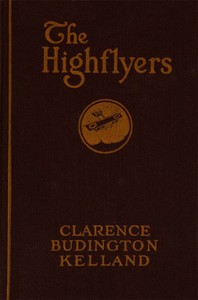
The Highflyers
Language: en493 downloads on Project Gutenberg
Subjects
In: Novels·American Literature
Public-domain ebook sourced from Project Gutenberg #46252.
Public-domain ebook
Language: en493 downloads on Project Gutenberg
Subjects
In: Novels·American Literature
Public-domain ebook sourced from Project Gutenberg #46252.
The opening · free to read
Fred la Mothe was speaking. After a certain number of beverages composed of Scotch whisky, imported soda, and a cube of ice, it was a matter of comparative ease for him to exhibit a notable fluency. After two o'clock in the afternoon Fred was generally fluent.
"''Tain't safe,' I says to him. And the wind was blowin' enough to lift the hair out of your head. 'I wouldn't go up in the thing for the price of it,' I says, 'and, besides, you're seein' two of it. Bad enough drivin' a car when you're lit up,' I says, 'but what these flyin' machines want is a still day and a man that's cold sober. You just let it rest on its little perch in the bird-cage.'"
Fred refreshed his parched throat while his four companions waited for the conclusion of the tale. "'You'll bust your neck,' I told him.
"'Ten to one,' says he, 'I round Windmill Point Light and come back without bustin' my neck. Even money I make it without bustin' anything,' says he.
"'Dinner for four at the Tuller to-night that the least you bust is a leg,' I says, and the wind whipped the hat off my head and whirled it into a tree."
Fred stopped, evidently mourning the loss of his hat.
"Well," said Will Kraemer, impatiently, "what happened? Did he go up?"
"_Him?..._ I paid for that dinner, but, b'lieve me, there were times when I thought I'd have to collect from his estate. Ever see a leaf blowing around in a gale? Well, that's how he looked out over the lake. Just boundin' and twirlin' and twistin', but he went the distance and came back and landed safe. Got out of the dingus just like he was gettin' off a Pullman. Patted the thing on the wing like it was a pet chicken. 'Let's drive down to the Pontchartrain,' he says. 'Likely the crowd's there.' Not another darn word. Just that."
"Trouble with Potter Waite," said Tom Watts, "is that he just naturally don't give a damn. If he's going to pull something he'd as lief pull it in the middle of Woodward Avenue at noon by the village clock as to pull it on the Six Mile Road at midnight."
"No pussy-footin' for him," said Jack Eldredge. "My old man was talking about him the other night. Day after he cleaned up those two taxi-drivers out here in front. 'Don't let me hear of you running around with that young Waite,' he says. 'He's a bad actor. You keep off him.'"
"He's a life-saver," Fred La Mothe joined in. "When dad lights into me I just mention Potter, and dad forgets me entirely. You ought to hear dad when he really gets to going on Potter."
"I'm no Sunday-school boy--" said Brick O'Mera.
"Do tell," gibed Eldredge.
"--but I'll say Potter is crowdin' the mourners. I wouldn't follow his trail a week steady."
The others waggled their heads acquiescently. Even to their minds Potter Waite traveled at too high speed and with too little thought of public opinion. About that table sat five young men who were as much a result of a condition as outlying subdivisions are the result of a local boom. Of them all, La Mothe came from a family which had known moderate wealth for generations, but it had grown swiftly, unbelievably, during the past few wonderful years, to a great fortune. Of the rest, Kraemer and O'Mera were the sons of machinists who, a dozen years before, would have considered carefully before giving their sons fifteen cents to sit in the gallery at the old Whitney Opera House to see sawmill and pile-driver and fire-engine drama. The automobile had caught them up and poured millions into their laps. Eldredge was the son of a bookkeeper who, fifteen years ago, had drawn fifty dollars at the end of each month for his services. For every dollar of that monthly salary he could now show a million. Watts was the son of a lawyer whom sheer good luck had lifted from a practice consisting of the collection of small debts, and made a stockholder in and adviser to a gigantic automobile concern. And these boys were the sons of those swiftly gotten millions. They had forgotten the old days, just as Detroit, their home city, had forgotten its old drowsiness, its mid-Western quietness and conservatism.
One might compare Detroit to a demure village girl, pleasing, beautiful, growing up with no other thought than to become a wife and mother, when, by chance, some great impresario hears her singing about her work and it is discovered that she has one of the world's rarest voices. From her the old things and the old thoughts and the old habits of life are gone forever. The world pours wealth and admiration at her feet and her name rings from continent to continent. So with the lovely old city, straggling along the shores of that inland strait. She has become a prima donna among cities. The old identity is gone, replaced by something else, less homely, but mightier, grander. Her population, which, within the memory of boys not out of high-school, numbered less than three hundred thousand souls, was now reported to be thrice that, and, by the optimistic, even more. Her wealth has not doubled or trebled, but multiplied by an unbelievable figure, and she has spent it with unbelievable lavishness.
Where once were cobblestone pavements and horse-cars are countless swarms of automobiles; where once were meadows, pastures, wood-lots, are tremendous plants employing armies of men, covering scores of acres, turning out annual products which bring to the city hundreds of millions of dollars. In the history of the world no city has come into such a fortune as Detroit, nor has there been such universal prosperity, not to employer alone, but to employees, and to the least of employees. It seemed as if the day had arrived when one asked, not where he should get money, but what he should do with his money. So Detroit spent! It built magnificent hotels; it created palaces for its millionaires, and miles upon miles of homes--luxurious, costly homes for those whose handsome salaries passed the dreams of their youth, or whose fortunes, built up by contact with the trade of purveying automobiles to an eager world, had not even been hoped for ten years before. Even the laborer had his home. Why not, when one manufacturer paid to the man who swept his floors the minimum wage of five dollars a day?
That was before the war, before a solemn covenant became a scrap of paper and the world fell sick of its most horrible disease. Then Detroit was rich, was spending lavishly but not insanely. With the coming of war there was a halt, a fright, a retrenchment, a hesitation, for no man knew what the next day might bring. But as the next day brought no disaster, as it became apparent that the coming days were to bring something quite different from disaster, Detroit went ahead gaily.
Then came strangers from abroad, speaking other languages than ours, and men began to whisper that this plant had a ten-million-dollar contract from Russia for shrapnel fuses; this other plant a twenty-million-dollar contract for trucks; this other a fabulous arrangement for manufacturing this or that bit of the devil's prescription for slaughtering men--and the whispers proved true.
The automobile brought amazingly sudden wealth; munition manufacture added to it with a blinding flash--and Detroit came to know what spending was.
These five young men, sitting in mid-afternoon in the Hotel Pontchartrain bar, were a part of all this; their life was the result of it; the thoughts, or lack of thoughts, in their minds, derived from it inevitably, remorselessly. They were castaways thrown up in a barroom by a golden flood.
To four of them a nickel for candy had been an event; now, without mental anguish, each of them could sign a dinner check which stretched to three figures, or buy a runabout or a yacht, or afford the luxury of acquaintance with the young woman who stood fourth from the end in the front row.
Let them not be chided too harshly. The fault was not theirs wholly, but was the inevitable result of their environment. They played at work, drew salaries--but could spend their afternoons in the Pontchartrain, in the Tuller, on the links or at thé dansant. They knew no responsibility to man, felt but a hazy responsibility to God, and as for their country, they had never thought about its existence.
They talked of the war, were pro-Ally with the exception of Kraemer, whom they baited when the fit was on them. Kraemer had been born on Brady Street. His grandfather was a 'forty-eighter. It was natural that he should see eye to eye with the land from which he derived his blood. Of them all, he alone took the war with seriousness, so they baited him at times, and he raged for their amusement.
They began the sport now.
"If the Kaiser only had the grand duke," said La Mothe, "he might stand some show. Look what he's done and what he had to do it with! I don't figure it'll last much longer. Everybody's lickin' Germany."
Kraemer banged the table. "You'll see," he said, passionately. "The war would be over now if it wasn't for the neutrality of the United States. This country's just prolonging the agony. If it wasn't for the munitions the Allies get from here, we'd be in Paris and London and St. Petersburg. Devil of a neutrality, ain't it? Look here...."
"Rats!" said O'Mera. "Where's Potter, anyhow?"
"Haven't seen him to-day. Ought to be driftin' in."
"He's over at police headquarters," said a new voice, and Tom Randall beckoned a waiter and sat down at the table.
"Pinched again?" came in chorus.
"No, but he'll probably get himself pinched before he's through with it. Know the von Essen girl?"
"Hildegarde, you mean? Sassy one? Swiftest flapper that ever flapped?"
"That's the darlin'. Well, she drives that runabout of hers down Jefferson again, doin' nothin' less than forty-five and makin' real time in spots. Seems she's been fined pretty average regular. Well, traffic cop gets her and makes her haul up to the curb and crawls right in beside her. Uh-huh. And off they go to the station, her lookin' like she could bite off the steerin'-wheel. Well, Potter and I are comin' along in his car, and we see the excitement and tag after. You know Potter?"
"We do!"
"'It's that von Essen kid, isn't it?' he says to me, and I agree with him. 'She's been caught too regular,' he says. 'They'll be nasty. Better trail along and see if we can help out.' So we did. Got to the station simultaneous and adjacent to them, and out jumps Potter.
"'Afternoon, Miss von Essen,' says he.
"'Mr. Waite,' she says, cool as a bisque tortoni.
"'Pinched?' says he.
"'Ask him,' she says, and jerks her head toward the cop, who is clambering down.
The book keeps going
Reading is free forever. Sign up and watch scenes appear while you read.



Scenes Storieta drew for other classics.
New illustrated classics
Once or twice a month: the latest books to get full character casts, scene art, and free comic editions. No account needed.