Public-domain ebook
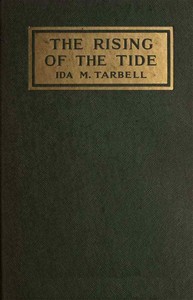
The Rising of the Tide: The Story of Sabinsport
Language: en383 downloads on Project Gutenberg
Subjects
In: Novels·American Literature
Public-domain ebook sourced from Project Gutenberg #46436.
Public-domain ebook
Language: en383 downloads on Project Gutenberg
Subjects
In: Novels·American Literature
Public-domain ebook sourced from Project Gutenberg #46436.
The opening · free to read
"The town is going to the Devil, and the worst of it is nobody will admit it. You won't. You sit there and smile at me, as if you didn't mind having Jake Mulligan and Reub Cowder pry open ballot boxes. You know those two birds are robbing this village every hour of the day. Nobody with pep enough to sit up and fight 'em. Rotten selfishness, that's what ails this town. People getting rich here and spending their money in the city. Women won't even buy their hats here--starving the stores. Can't support a decent theater--don't bring a good singer once a year. Everybody goes to the city, and we have to feed on movies.
"Try to raise an issue, and you get laughed at. Treated like a kid. Tell me to 'cut it out,' not disturb things. Nice place for a man who'd like to help a community! I'm going to get out. Can't stand it. Honest, Dick, I'm losing my self-respect."
"Wrong, Ralph. You're spoiling for a fresh turn with the muck rake. You can't make a garden with one tool. You must have several. I'm serious. You're like the men in the mines that will tackle but one job, always swing a pick. The muck rake did its job in Sabinsport for some time. You've got to pass on to the next tool."
"I don't get you. You're like all the rest. You're lying down. I'm ashamed of you, Parson. Get out of here. You'll end in corrupting me."
"No, only persuading you that taking a city calls for more weapons than one."
Silence fell for a moment. Ralph Gardner was tired. Getting out the daily issue of the Sabinsport Argus was, as he often said, "Some job." To be your own editor-in-chief, leader writer, advertising agent and circulation manager for the only daily in a town of 15,000 or more means hard work and a lot of it. Ralph loved it, "ate it up," they said in the shop. It was only when calm settled over Sabinsport and he felt no violent reaction from his spirited attacks on town iniquities that he was depressed. This was one of these periods. The year before he had fought and won for the Progressive Party of the District a smashing victory. He was eager to follow it up with attacks on the special grafts of the two men who for years had run the town and vicinity. He had ousted their candidates from the County and State tickets. He meant to wrest the town from them, but he couldn't get the support he needed. The town had lain down on him. He didn't understand it and it fretted him.
Now here was his best and wisest friend, advising waiting. He hung his handsome head in sulky silence.
"What a boy!" thought the Reverend Richard Ingraham. They were the best of friends, this eager, active, confident young editor and this cool, humorous-eyed, thoughtful young parson. Wide apart in birth, in type of education, in their contacts with the world, they were close in a love of decency and justice, in contempt for selfishness and vulgarity. Both were accidents in Sabinsport, and so looked at the town in a more or less detached way. This fact, their instinctive trust and liking for each other, and the clinching force of the great tragedy in which they had first met had made them friends.
Ralph Gardner was only 28. He had graduated six years before at a Western university where for the moment the sins of contemporary business and politics absorbed the interest of the greater part of faculty and students. There was a fine contempt for all existing expressions of life, a fine confidence in their power to create social institutions as well as forms of art which would sweep the world of what they called the "worn out." Whatever their professions, they went forth to lay bare the futility and selfishness and greed of the present world. They had no perspective, no charity, no experience, but they had zeal, courage, and the supporting vision of a world where no man knew want, no woman dragged a weary life through factory or mill, no child was not busy and happy.
Never has there poured into the country a group more convinced of its own righteousness and the essential selfishness of all who did not see with their eyes or share their confidence in the possibility of regeneration through system. Like revolutionists in all ages they felt in themselves the power to make over the world and like them they carried their plans carefully diagramed in their pockets.
Gardner was one of the first of the crop of St. Georges in his university. He had chosen journalism for his profession. He began at the bottom on an important Progressive journal of a big Western city. He worked up from cub reporter to a desk in the editor's room. But he chafed at the variety of things which occupied the editorial attention, at the tendency to confine reform to an inside page or even drop it altogether. There were moments when he suspected his crusading spirit was regarded as a nuisance. And finally in a fit of disgust and zeal he put his entire inheritance into the Sabinsport Argus.
Ralph had a real reason in buying the Argus. The town was ruled by two of the cleverest men in the State, giving him a definite enemy. It was not so large but what, as he planned it, he could know every man, woman and child in it. It had the varied collection of problems common to a prosperous Middle-West town, settled at the end of the eighteenth century, and later made rich by coal mines and iron mills. Ralph saw in Sabinsport a perfect model of the dragon he was after, a typical union of Business and Politics, a typical disunion of labor and capital. It was to be his laboratory. His demonstration of how to make a perfect town out of a rotten one should be a model for the world.
In his ambitions and his attacks Richard Ingraham had been his steady backer, and at the same time his surest brake. It would be too much to say that he had always kept him from running his head into stone walls, but the Parson had never failed Ralph even when he made a fool of himself. He never had shown or felt less interest because often the young editor ignored his advice. The relation between the two had grown steadily in confidence and affection. A regular feature of their day was an hour together in Ralph's office after the paper was on the press, and he was getting his breath. They were spending this hour together now, a late afternoon hour of July 28, 1914. It was a pleasant place to talk on a hot afternoon. The second floor back of the three-story building which housed the Argus opened by long windows on to a wide veranda, a touch of the Southern influence in building which was still to be seen in several places in the town. The Parson had been quick to see that this veranda properly latticed would make a capital workroom for Ralph in the summer, and had by insistence overcome the young editor's indifference to his surroundings, and secured for him a cool and quiet office and a delightful summer lounging room. Here they were sitting now, Ralph's feet on the veranda railing, his head hanging--dejection in every muscle.
"Ralph," said the Rev. Richard, "it's your method of attack not your cause, I doubt. I don't believe you can win by going at this thing in your usual way. You must find a new approach. Mulligan and Cowder are no fools, and if you open on them from your old line, they'll be ready for you."
"There's only one way to do this thing," Ralph shouted hotly. "Show 'em up. Shame the town for tolerating them, fight them to a finish. If I could get the proofs that they opened those ballot boxes, do you suppose I'd be quiet? Not on your life."
"You won't get the proof."
"You mean you won't help me to get it?"
"I do."
The Rev. Richard could be very final and very disarming. Ralph knew he could not count on him for help in tracing the gossip. He did not suspect what was true, that his friend knew even the details of the bit of law-breaking Jake Mulligan had carried out. It had come to him by the direct confession of one of his young Irish friends, Micky Flaherty. Micky had listened at the Boys' Club, which Ingraham ran, to a clear and forceful explanation of why the ballot box must be sacred. He had given the talk at the first rumor that there had been a raid on the ballot box by Jake, for the direct purpose of finding exactly how the town stood towards giving him and Reuben Cowder in perpetuity the water, gas and electric light franchises, which they had secured long before Sabinsport dreamed of their importance. He had thought it entirely probable that the rumor was founded on truth, also quite probable that one or more of the likely young politicians in his club had been used as a go-between.
His talk did more than he had even dreamed. Micky was struck with guilt. He was a good Catholic, and confession was necessary to his peace of mind. It was not to the priest, but to Dick, he went; telling him in detail, and with relish too, it must be acknowledged, how at midnight he alone had stolen from the clerk's office in the town hall the ballot boxes, and how he had worked with Jake and two or three faithful followers, carefully piecing together the torn ballots, until a complete roster of the election was tabulated. When this nice piece of investigation was finished and thoroughly finished, Micky had returned the boxes.
Ingraham had never for a moment considered a betrayal of Micky's confession. For one reason, he was keen enough to know it would be useless. Micky's sense of guilt might recognize the confessional, but it did not, and would not, recognize the witness stand. He had no intention of giving his friend the slightest help in unearthing the scandal. He was convinced, as he told him, that a new form of attack must be found.
"You're a queer one, Dick," fretted Ralph. "You don't believe for a moment that Jake and Reub are anything but a pair of pirates. You aren't afraid. What is it?"
"I suppose, Ralph, it is partly because I like Jake and don't despair of him."
"Like him! Like him! Do you know what he calls your mission over on the South Side--sacrilegious rascal. He calls it the Holy Coal Bin. Nice way to talk about a man who saved a neighborhood from freezing to death because he's too blamed obstinate and narrow to listen to the leaders of his own workingmen. 'Runs his business to suit himself!' Think of that in this day! Those men and women would have died of cold if you hadn't turned your club basement into coal bins. And now he laughs at you."
"Do you know who paid for that coal; most of it at least?" asked Ingraham.
"You did, confound you. Of course you did. Everybody knows that."
"No, three quarters of it Jake paid for, on condition I wouldn't tell the men. Couldn't see them suffer. Jake has possibilities. And then there is Jack. You know how he loves that boy. You know how fine and able Jack is. He has already swung the old man into modernizing the 'Emma.' If we will stand by him, I believe in time he will have reformed his father. Give him a chance at least. If you don't do that, I am certain that eventually you will drive Jack himself away from you, and we must not lose Jack. Moreover, you have got to remember that Jake and Reuben made this town."
The book keeps going
Reading is free forever. Sign up and watch scenes appear while you read.



Scenes Storieta drew for other classics.
New illustrated classics
Once or twice a month: the latest books to get full character casts, scene art, and free comic editions. No account needed.