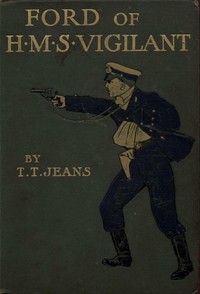
I don’t expect that you have ever heard of Upton Overy, in North Devon, but it is there where Captain Lester, of the Royal Navy, lives, and, at any rate, you must have heard of him. Everyone in the West Country knows him by name and most of them by sight, and whenever he comes back from sea the villagers won’t do any work, and the bellringers ring peals and "changes" on the old church bells all day long, till you’d think that the top stones must be shaken off. The noise always makes my mother’s head ache terribly. You see, my father is the parson of Upton Overy, and our house is so close to the church, that the noise seems to go through and through it.
If he happened to be at home, on leave or on half-pay, the Captain sometimes asked my father to go out shooting with him, and when I was quite a kiddy I was so fearfully keen to go too, that once I crept away and followed them. My father would have sent me back, had not the Captain growled out—and he had an awfully deep growling voice—"Let the nipper come along o’ us, Padré;" and you may be jolly well certain that I did follow them, keeping close behind the Captain, without saying a word, and with my eyes glued on him, just to see exactly what he did. I got so tired, that if I hadn’t been afraid of making a noise I should have cried.
"Send the young ’un to sea. He’ll do," he had said when my father, very angry at having his day’s sport spoilt, had at last to carry me back.
That is the first I remember of Captain Lester, and is why I remember what he said. Afterwards he would often let me go with him, and when I was big enough would let me hold his great mongrel dog "Blucher". The Captain used to take this dog to sea with him, and always brought him out shooting; but he used to get so excited that he would obey nobody, and if let loose, always ranged ahead of the guns, and put up every bird for miles. The result was that he was kept on the chain nearly all the time.
Although he was so useless, the Captain would never leave him behind. "I’ve spoilt the dog taking him to sea", he would growl; "I ain’t going to spoil his bit of sport", and he always let him have a run "on his own" towards the end of the day.
Sometimes his eldest girl, Nan, used to come too, and as she worshipped her father just as much as I did, we became quite chums, and had many a jolly day together, while we hung on to old Blucher’s chain, and he tugged us about.
She worried very much because she was a girl and couldn’t go to sea, but of course that wasn’t her fault—I told her so, often—and it always made me feel what a jolly good thing it was to be a man, and that I was going to sea. I had made up my mind to that, and had never forgotten what the Captain had said. I simply longed for the sea, and used to spend every moment I could down among the fishing boats, helping to spread the nets out along the shore to dry, and sometimes taking a hand in mending them. I made chums, too, of the boys in the smaller smacks, which worked close inshore, and one of them took me out several times in his uncle’s boat.
But just skirting along the coast was not enough for me, so one night I did a very silly thing. Upton Overy owned six deep-sea trawlers, which were generally away on the fishing grounds for a whole week, and one night, I couldn’t stand it any longer, and crept out of the house, round by the back of the church, down a cliff path to the harbour, crawled aboard one of these trawlers, and hid myself under the nets. I knew that they were all going out before daylight, and that I shouldn’t be found till we were right out of sight of land.
When they did pull me out in the morning, old Gurridge—it was his boat I’d crept into—was rather beastly about it, and jawed at me till he was tired. He’d had some row with my father, and thought it a jolly good opportunity of having a "dig" at him, and the way he’d brought me up; but I didn’t mind what he said—not in the least—for all round me was sea, no land whichever way I looked, and I simply felt mad with delight.
It came on to blow, too, and I don’t think that old Gurridge could have taken me back, even if he’d wanted to—and he didn’t want to either, because of that row with my father—and all the time he made me work, scrubbing and cleaning, and jawing at me for being so wicked as to run away.
Of course I got back safely, had a jolly good beating, and was sent to bed; but, honestly, I couldn’t feel wicked, because, right down inside me, I knew that I’d done it because the Captain wanted me to go to sea, and, as I told you before, I simply worshipped him. Most people did—even the "grown-ups"—so it was no wonder that I did.
He heard about it too—my trip in the trawler, I mean—and that was one reason, I fancy, why he gave me a nomination for the Britannia, and when I had passed in, promised to look after me if I did well there.
I can’t help remembering the first time I came home in cadet’s uniform, and rushed up to the House to show myself to Mrs. Lester and the girls. Nan was most respectful, and she’d never been so before, and that pleased me more than anything else. I expect that I put on a frightful amount of "side", and must have been a horrid little bounder.
I only saw Captain Lester twice whilst I was in the Britannia, and then he commissioned the Vigilant for the China station. Of course, what I really wanted to do was to go to his ship, but I thought that probably he’d forgotten all about me. He hadn’t, though; for when, during my last term, my father had to write out to him about some church repairs, he wrote in his reply, "Tell the young ’un he can come out to my ship, if he passes out of the Britannia well".
This news simply made me boil all over, and you may guess how hard I worked that term, and what I felt like when the lists came out. My name—Dick Ford—was seventh of my term, and next below me was Jim Rawlings, my best chum, and we both had just got enough marks to scrape out as midshipmen straight away.
Wasn’t that splendid? It was grand, too, to see the little white badges sewn on the collars of our monkey jackets, and to know that we’d finished being cadets.
The next thing to do was to get Captain Lester to apply for me; but I funked asking Mrs. Lester, and my mother stood rather in awe of her too. However, it turned out that the Captain and Mrs. Lester between them had arranged it all, and one morning, after I’d gone home on Christmas leave, there was a large blue envelope for me in the postbag. I tore it open, and the first thing I saw was the name Vigilant scrawled in among the print. I yelled with delight, for there it was at last. It was grand, and at the end of the print was: "You are to embark on board the P. & O. Steamship Marmora by noon on the 14th January".
My mother ran up to her room directly I had read it aloud and she had looked to make certain, and my father frowned at me and said angrily, "You see what you’ve done? Broken your mother’s heart," and that made me miserable again, though I couldn’t feel miserable for long, and rushed up to the House to show the appointment to Nan and everyone I met. I shall never forget that day and the next three weeks, and at last driving off to the station, with my sea chest on top of the village cab, really, actually—I could hardly believe it—on my way to China—and Captain Lester.
Mrs. Lester and the girls were at the big gates, and I had to stop and wish them goodbye. Nan looked down her nose and pretended she wouldn’t have given her soul to be coming too, and Mrs. Lester, before I knew what was going to happen, actually bent down and kissed me. My mother was so astonished that she left off crying, but I’m almost sure that Mrs. Lester had tears in her eyes. Of course I knew why—because I was off to join the Captain, and would—-with luck—see him in six or seven weeks.
She had a big box of things for me to take out to him too, and it took a great deal of hoisting up alongside my chest.
You can have no idea how many messages were given me for him. Of course everyone in the village knew I was going, and for the last fortnight, I should think, half the village had sent "best respects to the Captain", and news about their children or gardens or the fishing. I stuck them all down in a notebook so as not to forget them—my mother advised me to do this. At the station old Puddock, the station master, gave me a pot of cranberry jam his wife had made—she’d been cook up at the House before she married Puddock—"with our best respects for the Cap’en, Master Dick, and tell him we’re both fair to middling, and I got first prize at Barnton Show for the pigs". Out came the notebook again, and we were off at last—my mother and I.
But the funniest thing of all happened at the next station—Bodington—for there Ned the Poacher—he was an awful nuisance for miles round, and spent half the year in prison—came sheepishly to the carriage and asked me to tell the Captain that he and his pals wouldn’t be too hard on the pheasants this year, as they knew he was coming home for next year’s shooting. "Tell the Cap’en they birds be mighty strong and healthy, and there’ll be plenty of ’em next year when he comes home," and he shuffled away. I suppose he hadn’t the face to come to me at Upton Overy itself.
I wasn’t going to put that down in the notebook, but my mother said I had better do so.
When we went down to the docks next day and went aboard the Marmora, the very first person I saw was Jim Rawlings—on his way out to join another cruiser—and in the excitement of seeing him I hardly wished my mother "goodbye" properly, and it was only when the Marmora shoved off and left her standing alone in the rain, on the dock wall, that I felt what an awful brute I was, and wanted to jump across the bit of water just to say "goodbye" once again.
There were four cadets on board, as well; going out to join different ships. A lieutenant was in charge of all of us, and jolly nasty he made himself too; and we were all jolly glad when we found his ship lying at Singapore, and he cleared out. I’m not going to tell you all about the voyage. It would take too long, and there are too many exciting things for you to hear. For me they began there, and it was Jim who made the discovery. He’d got hold of a Singapore newspaper, and suddenly came flying along the deck, whooping like a madman, and shoved it into my hands. You can imagine how excited I was, for among the telegrams was this:
"Shanghai, February 22nd. Captain Lester, H.M.S. Vigilant, senior officer in the Chusan Archipelago, reports that the Chinese cruiser Huan Min has picked up Mr. Martin P. Hobbs and his daughter, adrift in a boat, and that their steam yacht has been captured by a gang of pirates in possession of a large steamer, and led by a European."
At the end of the telegram followed—"We understand that Captain Lester has been ordered to take the necessary steps to recapture Mr. Hobbs’s yacht."
My Aunt! Wasn’t that news? You can just fancy how I almost felt sick all over with excitement, and how frightfully important I felt at being the only one going to that ship, with a chance of chasing pirates. How I wished it was possible for Jim to come too. We thought and thought of any number of schemes, and then, "Let’s telegraph to Captain Lester," he burst out; and we hunted out every penny we had in our chests, rushed ashore, jumped into a double rickshaw, and went off like mad to the Eastern Telegraph Office. The Marmora was lying at Tanjong Pagar wharf, and we needn’t have gone fifty yards, if we’d known, but we drove right into the town.