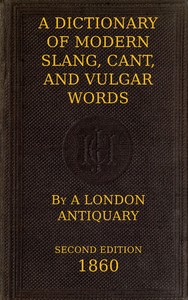
By A LONDON ANTIQUARY.
“Rabble-charming words, which carry so much wild-fire wrapt up in them.”—SOUTH.
SECOND EDITION, REVISED, WITH TWO THOUSAND ADDITIONAL WORDS.
LONDON: JOHN CAMDEN HOTTEN, PICCADILLY. 1860.
LONDON: PRINTED BY TAYLOR AND GREENING, GRAYSTOKE-PLACE, FETTER-LANE, E.C.
PREFACE TO THE SECOND EDITION.
The First Edition of this work had a rapid sale, and within a few weeks after it was published the entire issue passed from the publisher’s shelves into the hands of the public. A Second Edition, although urgently called for, was not immediately attempted. The First had been found incomplete and faulty in many respects, and the author determined to thoroughly revise and recast before again going to press. The present edition, therefore, will be found much more complete than the First; indeed, I may say that it has been entirely rewritten, and that, whereas the First contained but 3,000 words, this gives nearly 5,000, with a mass of fresh illustrations, and extended articles on the more important slang terms—HUMBUG, for instance. The notices of a Lingua Franca element in the language of London vagabonds is peculiar to this edition.
My best thanks are due to several correspondents for valuable hints and suggestions as to the probable etymologies of various colloquial expressions.
One literary journal of high repute recommended a division of cant from slang; but the annoyance of two indices in a small work appeared to me to more than counterbalance the benefit of a stricter philological classification, so I have for the present adhered to the old arrangement; indeed, to separate cant from slang would be almost impossible.
Respecting the HIEROGLYPHICS OF VAGABONDS, I have been unable to obtain further information; but the following extract from a popular manual which I have just met with is worth recording, although, perhaps, somewhat out of place in a Preface.
“Gipseys follow their brethren by numerous marks, such as strewing handfuls of grass in the day time at a four lane or cross roads; the grass being strewn down the road the gang have taken; also, by a cross being made on the ground with a stick or knife, the longest end of the cross denotes the route taken. In the night time a cleft stick is placed in the fence at the cross roads, with an arm pointing down the road their comrades have taken. The marks are always placed on the left-hand side, so that the stragglers can easily and readily find them.”—_Snowden’s Magistrate’s Assistant_, 1852, p. 444.
Piccadilly, March 15th, 1860.
PREFACE TO THE FIRST EDITION.
If any gentleman of a studious turn of mind, who may have acquired the habit of carrying pencils and notebooks, would for one year reside in Monmouth Court, Seven Dials; six months in Orchard Street, Westminster; three months in Mint Street, Borough; and consent to undergo another three months on the extremely popular, but very much disliked treadmill (vulgo the “Everlasting Staircase”), finishing, I will propose, by a six months’ tramp, in the character of a cadger and beggar, over England, I have not the least doubt but that he would be able to write an interesting work on the languages, secret and vulgar, of the lower orders.
In the matter of SLANG, our studious friend would have to divide his time betwixt observation and research. Conversations on the outsides of omnibuses, on steamboat piers, or at railway termini, would demand his most attentive hearing, so would the knots of semi-decayed cabmen, standing about in bundles of worn-out great-coats and haybands, betwixt watering pails, and conversing in a dialect every third word of which is without home or respectable relations. He would also have to station himself for hours near gatherings of ragged boys playing or fighting, but ever and anon contributing to the note-book a pure street term. He would have to “hang about” lobbies, mark the refined word-droppings of magniloquent flunkies, “run after” all the popular preachers, go to the Inns of Court, be up all night and about all day—in fact, be a ubiquitarian, with a note-book and pencil in hand.
As for research, he would have to turn over each page of our popular literature, wander through all the weekly serials, wade through the newspapers, fashionable and unfashionable, and subscribe to Mudie’s, and scour the novels. This done, and if he has been an observant man, I will engage to say, that he has made a choice gathering, and that we may reasonably expect an interesting little book.
I give this outline of preparatory study to show the reason the task has never been undertaken before. People in the present chase after respectability don’t care to turn blackguards, and exchange cards with the Whitechapel Pecker or the Sharp’s-alley Chicken, for the sake of a few vulgar, although curious words; and we may rest assured that it is quite impossible to write any account of vulgar or low language, and remain seated on damask in one’s own drawing room. But a fortunate circumstance attended the compiler of the present work, and he has neither been required to reside in Seven Dials, visit the treadmill, or wander over the country in the character of a vagabond or a cadger.
In collecting old ballads, penny histories, and other printed street narratives, as materials for a History of Cheap or Popular Literature, he frequently had occasion to purchase in Seven Dials and the Borough a few old songs or dying speeches, from the chaunters and patterers who abound in those neighbourhoods. With some of these men (their names would not in the least interest the reader, and would only serve the purpose of making this Preface look like a vulgar page from the London Directory) an arrangement was made, that they should collect the cant and slang words used by the different wandering tribes of London and the country. Some of these chaunters are men of respectable education (although filling a vagabond’s calling), and can write good hands, and express themselves fluently, if not with orthographical correctness. To prevent deception and mistakes, the words and phrases sent in were checked off by other chaunters and tramps. Assistance was also sought and obtained, through an intelligent printer in Seven Dials, from the costermongers in London, and the pedlars and hucksters who traverse the country. In this manner the greater number of cant words were procured, very valuable help being continually derived from Mayhew’s London Labour and London Poor, a work which had gone over much of the same ground. The slang and vulgar expressions were gleaned from every source which appeared to offer any materials; indeed the references attached to words in the Dictionary frequently indicate the channels which afforded them.
Although in the Introduction I have divided cant from slang, and treated the subjects separately, yet in the Dictionary I have only, in a few instances, pointed out which are slang, or which are cant terms. The task would have been a difficult one. Many words which were once cant are slang now. The words PRIG and COVE are instances in point. Once cant and secret terms, they are now only street vulgarisms.
The etymologies attempted are only given as contributions to the subject, and the derivation of no vulgar term is guaranteed. The origin of many street words will, perhaps, never be discovered, having commenced with a knot of illiterate persons, and spread amongst a public that cared not a fig for the history of the word, so long as it came to their tongues to give a vulgar piquancy to a joke, or relish to an exceedingly familiar conversation. The references and authorities given in italics frequently show only the direction or probable source of the etymology. The author, to avoid tedious verbiage, was obliged, in so small a work, to be curt in his notes and suggestions.
He has to explain also that a few words will, probably, be noticed in the Slang and Cant Dictionary that are questionable as coming under either of those designations. These have been admitted because they were originally either vulgar terms, or the compiler had something novel to say concerning them. The makers of our large dictionaries have been exceedingly crotchety in their choice of what they considered respectable words. It is amusing to know that Richardson used the word HUMBUG to explain the sense of other words, but omitted it in the alphabetical arrangement as not sufficiently respectable and ancient. The word SLANG, too, he served in the same way.
Filthy and obscene words have been carefully excluded, although street-talk, unlicensed and unwritten, abounds in these.
“Immodest words admit of no defence, For want of decency is want of sense.”
It appears from the calculations of philologists, that there are 38,000 words in the English language, including derivations. I believe I have, for the first time, in consecutive order, added at least 3,000 words to the previous stock,—vulgar and often very objectionable, but still terms in every-day use, and employed by thousands. It is not generally known, that the polite Lord Chesterfield once desired Dr. Johnson to compile a Slang Dictionary; indeed, it was Chesterfield, some say, who first used the word HUMBUG. Words, like peculiar styles of dress, get into public favour, and come and go in fashion. When great favourites and universal they truly become household words, although generally considered slang, when their origin or antecedents are inquired into.
A few errors of the press, I am sorry to say, may be noticed; but, considering the novelty of the subject, and the fact that no fixed orthography of vulgar speech exists, it will, I hope, be deemed a not uninteresting essay on a new and very singular branch of human inquiry; for, as Mayhew remarks, “the whole subject of cant and slang is, to the philologist, replete with interest of the most profound character.”
THE COMPILER WILL BE MUCH OBLIGED BY THE RECEIPT, THROUGH MR. CAMDEN HOTTEN, THE PUBLISHER, OF ANY CANT, SLANG, OR VULGAR WORDS NOT MENTIONED IN THE DICTIONARY. THE PROBABLE ORIGIN, OR ETYMOLOGY, OF ANY FASHIONABLE OR UNFASHIONABLE VULGARISM, WILL ALSO BE RECEIVED BY HIM WITH THANKS.
Piccadilly, June 30th, 1859.
CONTENTS.
THE HISTORY OF CANT, OR THE SECRET LANGUAGE OF VAGABONDS.