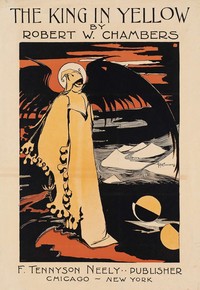
This collection of stories has been labelled "The Veiled Lady" as being the easiest way out of a dilemma; and yet the title may be misleading. While, beyond doubt, there is between these covers a most charming and lovable Houri, to whom the nightingales sing lullabies, there can also be found a surpassingly beautiful Venetian whose love affairs upset a Quarter, a common-sense, motherly nurse whose heart warmed toward her companion in the adjoining berth, a plucky New England girl with the courage of her convictions, and a prim spinster whose only consolation was the boarder who sat opposite.
Nor does the list by any means end here. Rough sea-dogs, with friendly feelings toward other dogs, crop up, as well as brave Titans who make derricks of their arms and fender-piles of their bodies. Here, too, are skinny, sun-dried Excellencies with a taste for revolutions, well-groomed club swells with a taste for adventure and cocktails, not to mention half a dozen gay, rollicking Bohemians with a taste for everything that came their way.
Perhaps it might have been best to enclose each story in a separate cover, and then to dump the unassorted lot upon the table, where those who wished could make their choice. And yet, as I turn the leaves, I must admit that, after all, the present form is best, since each and every incident, situation, and bit of local color has either passed before or was poured into the wide-open eyes and willing ears of your most humble and obedient servant
A Staid Old Painter.
150 East 34th Street, New York, March 13, 1907.
The Veiled Lady of Stamboul
Joe Hornstog told me this story--the first part of it; the last part of it came to me in a way which proves how small the world is.
Joe belongs to that conglomerate mass of heterogeneous nationalities found around the Golden Horn, whose ancestry is as difficult to trace as a gypsy's. He says he is a "Jew gentleman from Germany," but he can't prove it, and he knows he can't.
There is no question about his being part Jew, and there is a strong probability of his being part German, and, strange to say, there is not the slightest doubt of his being part gentleman--in his own estimation; and I must say in mine, when I look back over an acquaintance covering many years and remember how completely my bank account was at his disposal and how little of its contents he appropriated.
And yet, were I required to hold up my hand in open court, I would have to affirm that Joe, whatever his other strains might be, was, after all, ninety-nine per cent. Levantine--which is another way of saying that he is part of every nationality about him.
As to his honesty and loyalty, is he not the chosen dragoman of kings and princes when they journey into far distant lands (he speaks seven languages and many tribal dialects), and is he not today wearing in his buttonhole the ribbon of the order of the Mejidieh, bestowed upon him by his Imperial Highness the Sultan, in reward for his ability and faithfulness?
I must admit that I myself have been his debtor--not once, but many times. It was this same quick-sighted, quick-witted Levantine who lifted me from my sketching stool and stood me on my feet in the plaza of the Hippodrome one morning just in time to prevent my being trodden under foot by six Turks carrying the body of their friend to the cemetery--in time, too, to save me from the unforgivable sin among Orientals, of want of reverence for their dead. I had heard the tramp of the pall-bearers, and supposing it to be that of the Turkish patrol, had kept at work. They were prowling everywhere, day and night, and during those days they passed every ten minutes--nine soldiers in charge of an officer of police--all owing to the fact that some five thousand Armenians, anxious to establish a new form of government, had been wiped out of existence only the week before.
Once on my feet (Joe accomplished his purpose with the help of my suspenders) and the situation clear, I had sense enough left to uncover my head and stand in an attitude of profound reverence until the procession had passed. I can see them now--the coffin wrapped in a camel's-hair shawl, the dead man's fez and turban resting on top. Then I replaced my hat and finished the last of the six minarets of the mosque gleaming like opals in the soft light of the morning.
This act of courtesy, due so little to my own initiative, and so largely to Joe's, gained for me many friends in and about the mosque--not only those of the dead man, one of whom rowed a caique, but among the priests who formed the funeral cortege--a fact unknown to me until Joe imparted it. "Turk-man say you good man, effendi," was the way he put it. "You stoop over yourselluf humble for their dead."
On another occasion Joe again stood by my side when, with hat off and with body in a half kotow, I sat before the Pasha, who was acting chief of police after that stormy Armenian week--it was over really in five days.
"Most High Potentate," Joe began, translating my plain Anglo-Saxon "Please, sir," into Eastern hyperbolics, "I again seek your Excellency's presence to make my obeisance and to crave your permission to transfer to cheap paper some of the glories of this City of Turquoise and Ivory. This, if your Highness will deign to remember, is not the first time I have trespassed. Twice before have I prostrated myself, and twice has your Sublimity granted my request."
"These be troublous times," puffed his Swarthiness through his mustache, his tobacco-stained fingers meanwhile rolling a cigarette; a dark-skinned, heavily-bearded Oriental, this Pasha, with an eye that burned holes in you. "You should await a more peaceful season, effendi, for your art."
"On account of the Armenians, your Excellency?" I ventured to inquire with a smile.
"Yes." This, in translation by Joe, came with a whistling sound, like the escaping steam of a radiator.
"But why should I fear these disturbers of the peace, your Supreme Highness? The Turk is my friend, and has been for years. They know me and my pure and unblemished life. They also know by this time that I have been one of the chosen few among nations who have enjoyed your Highness's confidence, and to whom you have given protection." Here my spine took the form of a horseshoe curve--Moorish pattern. "As to these dogs of Armenians" (this last was Joe's, given with a growl to show his deep detestation of the race--part of his own, if he would but acknowledge it), "your Excellency will look out for them." He WAS looking out for them at the rate of one hundred a day and no questions asked or answered so far as the poor fellows were concerned.
At this the distinguished Oriental finished rolling his cigarette, looked at me blandly--it is astonishing how sweet a smile can overspread the face of a Turk when he is granting you a favor or signing the death warrant of an infidel--clapped his hands, summoning an attendant who came in on all fours, and whispered an order in the left ear of the almost prostrate man. This done, the Pasha rose from his seat, straightened his shoulders (no handsomer men the world over than these high-class Turks), shook my hand warmly, gave me the Turkish salute--heart, mouth, and forehead touched with the tips of flying fingers--and bowed me out.
Once through the flat leather curtain that hid the exit door of the Pasha's office, and into the bare corridor, I led Joe to a corner out of the hearing of the ever-present spy, and, nailing him to the wall, propounded this query:
"What did the High-Pan-Jam say, Joe?"
Hornstog raised his shoulders level with his ears, fanned out his fingers, crooked his elbows, and in his best conglomerate answered:
"He say, effendi, that a guard of ein men, Yusuf, his name--I know him--he is in the Secret Service--oh, we will have no trouble with him--" Here Joe chafed his thumb and forefinger with the movement of a paying teller counting a roll. "He come every morning to Galata Bridge for you me. He say, too, if any trouble while you paint I go him--ah, effendi, it is only Joe Hornstog can do these things. The Pasha, he know me--all good Turk-men know me. Where we paint now, subito? In the plaza, or in the patio of the Valedee, like last year?"
"Neither. We go first to the Mosque of Suleiman. I want the view through the gate of the court-yard, with the mosque in the background. Best place is below the cafe. Pick up those traps and come along."
Thus it was that on this particular summer afternoon Joe and I found ourselves on the shadow side of a wall up a crooked, break-neck street paved with rocks, each as big as a dress-suit case, from which I got a full view of the wonderful mosque tossing its splendors into the still air, its cresting of minarets so much frozen spray against the blue.
The little comedy--or shall I say tragedy?--began a few minutes after I had opened my easel--I sitting crouched in the shadow, my elbow touching the plastered wall. Only Joe and I were present. Yusuf, the guard, a skinny, half-fed Turk in fez and European dress, had as usual betaken himself to the cafe fronting the same sidewalk on which I sat, but half a block away; far enough to be out of hearing, but near enough to miss my presence should I decamp suddenly without notifying him. There he drank some fifty cups of coffee, each one the size of a thimble, and smoked as many cigarettes, their burned stubs locating his seat under the cafe awning as clearly as peanut-shells mark a boy's at the circus. I, of course, paid for both.
So absorbed was I in my work--the mosque never was so beautiful as on that day--I gave no thought to the fact that in my eagerness to hide my canvas from the prying sun I had really backed myself into a small wooden gate, its lintel level with the sidewalk--a dry, dusty, sun-blistered gate, without lock or hasp on the outside, and evidently long closed. Even then I would not have noticed it, had not my ears caught the sound of a voice--two voices, in fact--low, gurgling voices--as if a fountain had just been turned on, spattering the leaves about it. Then my eye lighted, not only on the gate, but upon a seam or split in the wood, half-way up its height, showing where a panel was sometimes pushed back, perhaps for surer identification, before the inside wooden beam would be loosened.
So potent was the spell of the mosque's witchery that the next instant I should have forgotten both door and panel had not Joe touched the toe of my boot with his own--he was sitting close to me--and in explanation lifted his eyebrow a hair's breadth, his eyes fixed on the slowly sliding panel--sliding noiselessly, an inch at a time. Only then did my mind act.
What I saw was first a glow of yellow green, then a mass of blossoms, then a throat, chin and face, one after another, all veiled in a gossamer thin as a spider's web, and last--and these I shall never forget--a pair of eyes shining clear below and above the veil, and which gazed into mine with the same steady, full, unfrightened look one sometimes sees on the face of a summer moon when it bursts through a rift in the clouds.