Public-domain ebook
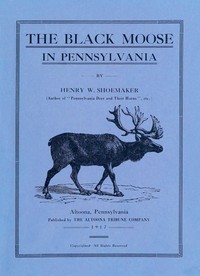
The Black Moose in Pennsylvania
Language: en339 downloads on Project Gutenberg
Subjects
In: History - American·Nature/Gardening/Animals·Environmental Issues
Public-domain ebook sourced from Project Gutenberg #47224.
Public-domain ebook
Language: en339 downloads on Project Gutenberg
Subjects
In: History - American·Nature/Gardening/Animals·Environmental Issues
Public-domain ebook sourced from Project Gutenberg #47224.
The opening · free to read
When the writer first visited the hunting lodge home of Seth Iredell Nelson (1809-1905) at Round Island, Clinton County, in August, 1899, he noticed a medium-sized set of moose-horns hanging on the wall of the great Nimrod's living-room. Having heard traditional stories of the occasional appearance of the Black Moose or Original in Pennsylvania, the thought flashed through his mind, "Those may be the antlers of a Pennsylvania Moose." Upon asking Nelson where the horns came from, the magnificent old hunter replied that they were Canadian horns, sent to him some years before by a party who had once hunted with him in Pennsylvania in deer season. "But," added the old Nimrod, "there once were moose in Pennsylvania." Asked if he had ever seen any, he replied that he never had, that the last were gone long before his day, but that he had killed at least 500 elk, sometimes called "grey moose" in the Pennsylvania forests. That same fall, the writer heard that a farmer named John Hennessy, about 1850, as near as could be ascertained, while grubbing stumps on the edge of the Tamarack Swamp in Northern Clinton County, had unearthed a pair of fresh looking moose horns. When Samuel N. Rhoads published his great work, "Mammals of Pennsylvania and New Jersey," in 1903, the writer found little comfort in the assumption that moose had wandered into Pennsylvania in post-Columbian days. This is what Rhoads has to say under title of "Eastern Moose": "The fossil remains of moose have been found in Pennsylvania caves. Certain statements of earliest travellers imply that the moose was found on the west shores of the Hudson River opposite New York and in Northeastern Pennsylvania. There is a Moosic in Lackawanna County; a Moosehead in Luzerne County, and Chickalacamoose in Clearfield County. In Doughty's 'Cabinet of Natural History,' Volume I, Page 281, a Philadelphia correspondent says that the horns of moose were found in a salt lick in the Allegheny Mountains, Pennsylvania, near the New York State line. These items are here noted in support of the theory that the moose in late pre-Columbian times wandered into the Allegheny Mountains of Pennsylvania from its more favored haunts in the lake regions of New York. Miller states 'it once ranged throughout the State of New York.' If this can be verified by history it would be an interesting fact, at once removing any improbability of its range in parts of Northern Pennsylvania, quite as well suited to its needs." Rhoads further states that fossil remains of the East American Moose (Alces Americanus Jardine) dating from the Pleistocene period were found in the Durham Cave, near Reigelsville, Bucks County, and that a skeleton of Scott's Fossil Moose (cervalces scotti Lydekker) also of the Pleistocene period were unearthed from a shell marl beneath a bog at Mount Hermon, Warren County, New Jersey. It will be the purpose of the following pages to endeavor to show that the Black Moose was present in Pennsylvania as an irregular migrant or straggler within the last one hundred and twenty-five years, citing as evidence, the writings of reliable travellers and historians, and the traditions of old hunters who were themselves sons of old hunters. That it is not a case of confusion of Nomenclature, for Rhoads states that somewhere in Dr. B. S. Barton's writings the grey moose or wapiti is called the "Original," will also be demonstrated, as the old-fashioned hunters were very jealous and proud of their knowledge of the different kinds and species of wild animals.
II. HISTORICAL EVIDENCE.
Historical evidence of the presence of the Black Moose in Pennsylvania, though not plentiful, is convincing. Dr. J. D. Schoepf, the distinguished German army surgeon and naturalist, who travelled through Pennsylvania in 1783-1784, has this to say in his "Travels in the Confederation," Vol. I, Page 161, in speaking of the vicinity of Heller's Tavern, one mile south of the Wind Gap in Northampton County: "The farmers were not well content with their lands. The nearness of the mountains brings them in Winter unpleasant visits from wolves and now and then, bears. And there is no lack of other sort of game; deer and foxes are numerous: elks wander hither at times. From several descriptions furnished by people hereabouts, it seems that they give the name Elk to the Moose as well as to the Canadian stag, and so give rise to errors. Both animals come down from the North, where one is known as Moose, Black Moose or Original, and the other (the Canadian stag) as Grey Moose to distinguish it from the first." On page 243 of the same volume, the talented author, in speaking of the Allegheny Mountains between Carlisle and Fort Pitt (Pittsburg) remarks: "The commonest wild animal is the Virginia deer: the Grey Moose, very similar to the European stag has also been seen in these woods, but it is more numerous in Canada.
The Black Moose or elk, is seen here but rarely." H. Hollister, in his inimitable "History of the Lackawanna Valley," published in 1857, in speaking of Tripp's Meadow, near Scranton, a hunting and camping-ground highly thought of by Indians and early white settlers, says: "Around this camp game was abundant. The elk and the fleeter moose stood among their native pines, or thundered onward like the tread of cavalry, the deer in fearless mood browsed on the juicy leaf, while the mountain sides, though stern with wilderness offered to the panther or the bear little shield from the well-poised arrow of the Indian." On Page 210, the same author says: "The Moose, from which the mountain range bordering the Lackawanna--The Moosic--derived its name, were found here in great abundance. Deer and elk, at that period thronged along the mountains in such numbers that droves often could be seen browsing upon the budding saplings or lazily basking in the noonday sun." In Doughty's "Cabinet of American History," Volume I, Page 281, a Philadelphia correspondent tells of the finding of a fresh-appearing set of Moose antlers in a salt lick near the New York State line. Investigation of this account showed that the antlers in question were unearthed in 1819 by Jim Jacobs, "The Seneca Bear Hunter," a noted Indian hunter at a swamp which was situated in Bradford, McKean County, in the center of what is now the City Park. This would show conclusively that the Moose, in post-Columbian times ranged into Northwestern Pennsylvania. If at one time they "ranged all over New York State" it would be natural that they would frequent the headwaters of the Allegheny River just across the line in Pennsylvania. But as Western New York was opened to civilization they withdrew to their hiding places in the North Woods, only venturing South when driven by severe winters and then through the last unbroken stretch of forest from the Adirondacks to the Catskills, and thence into the wilds of Northeastern Pennsylvania--keeping close to the Catskill-Allegheny Mountain backbone. Tales of the presence of the Moose in the Keystone State will also be found in "More Pennsylvania Mountain Stories," Chapter I (Reading, 1912), "The Indian Steps," Chapter I (Reading, 1912), and "Juniata Memories," Chapters IX, XXIV and XXVI (Philadelphia, 1916), by the author of these pages. Other mention of the Black Moose in Pennsylvania is occasionally made in county histories, romances and poems of the Northern and Eastern parts of the State. Careful research will undoubtedly bring further valuable references to light. The Black Moose has left his name indelibly along the entire route of his latterly migrations through Pennsylvania. There is a Moose's Wood Pond in Kidder Township, Carbon County. There were said to be Moose Ponds in Susquehanna, Wayne and Pike Counties. There is a Moosehead (in Foster Township) and Moosic Mountain--"The Imperial Moosic" of the Poet Caleb Earl Wright, in Luzerne County. In Lackawanna County, in addition to the Moosic Mountain there are two Moosics, one a town of four thousand inhabitants in Old Forge Township, the other a hamlet in Newton Township, and a Moosic Lake in Jefferson Township. There is a Moose Run in Centre County in Boggs Township; the Moshannon, i. e., Moose-hanne or Moose-stream, forms the western boundary of Centre County, dividing it from Clearfield County. The Black Moshannon, or Black Moose-stream is a creek in Centre County. In Clearfield County is found a Moose Run in Huston Township, and Moose Run Station, also Upper Moose Creek, (Lawrence Township), and Moose Creek (Girard Township). Clearfield town, the seat of justice, was formerly called Chickalacamoose. The Moshannon rises near the northern border of Blair County, at the Three Springs. In the extreme southern limit of the range there is said to be a Moose Creek in Somerset County. On account of so many small lakes in Pennsylvania having been renamed with fanciful names by influential summer colonists within the past twenty years, the historic names have been discarded, but old settlers in the neighborhoods can give the real names in every instance; in this way it is thought that eventually some of the "moose" names will be restored. In Sullivan County the beautiful and romantic Lewis' Lake was rechristened "Eagles Mere" by summer boarding-house keepers. It is held by some that Elk Lick, Somerset County, was named for the Moose, which was called "Elk" by many German pioneers, as well as for the true Elk or Wapiti. At any rate Black Moose were seen in the vicinity of this swale shortly before the Revolutionary War. Dr. C. Hart Merriman in his splendid report of the animals of the Adirondack Mountains, published by the Linnean Society in New York in 1884 states that the last moose in the "North Woods" of New York was killed on Raquette Lake, Hamilton County, in August, 1861. The height of this last specimen, which was a female, was seven feet at the hump and weighed 800 pounds. Samuel Merrill in his authoritative and fascinating "Moose Book" published in New York, in 1916, thus describes the slaughter: "A party of four men from Philadelphia, including a lawyer and a physician with two guides, were on a fishing trip in two boats. One sportsman fired a charge of buckshot into her shoulder at 50 yards' distance; another fired a charge of number 6 shot, and the guides each added a rifle ball." Among the last men in New York to kill a moose was Hon. Horatio Seymour, Governor of the State, the antlers of which were admired for many years at his home at Deerfield, Oneida County. The Governor killed his moose at Jock's Lake, Herkimer County, in 1859. Alva Dunning, a well-known hunter, killed several moose on West Canada Creek in 1860. Verplanck Colvin, State Engineer of New York, in his report on the "Adirondack Wilderness" transmitted to the Legislature at Albany in April, 1874, says: "As a matter of Zoological and general interest, I may mention that in a few of the most remote portions of the wilderness, we have met with indications of the Moose, which to some of the guides seemed unmistakable.
The book keeps going
Reading is free forever. Sign up and watch scenes appear while you read.



Scenes Storieta drew for other classics.
New illustrated classics
Once or twice a month: the latest books to get full character casts, scene art, and free comic editions. No account needed.