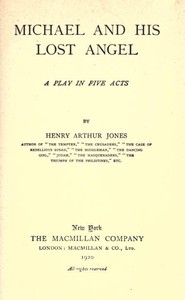
as play has often encountered. Before it saw the light a war had been waged concerning its name. That the name itself involved as some seemed to think a gratuitous insult to any form of religious connection or was even ill chosen I am not prepared to grant. Michael is not a scriptural character, and his functions, civil and militant, and his place in the celestial hierarchy are assigned him by uninspired writers. But for the use made of him in art and by Milton it is doubtful whether his name would be familiar enough to the general public to provoke a discussion. A discussion was, however, provoked and with a portion of those present the verdict was pronounced before the piece had been given. An opening scene, meanwhile, in which the very raison-d'être of the play is found, an indispensable portion of the motive began too soon and was, through the noise and disturbance caused by late arrivals, practically unheard. The difficulty thus caused was never quite overcome, and the nature of Michael Feversham's offence and the value of his expiation were both partially misunderstood.
That the display of human passions in a sacred edifice and the lavish use of ecclesiastical ceremonial might cause offence I could have conceived, had there not been the immediately previous proof of the success of another play in which the very words of the Inspired Teacher are used with a background of pagan revelry and a lavish and superfluous display of nudity of limb. Paul of Tarsus is surely a more recognisable personage, and one more closely connected with Christian faith than a nebulous being such as Michael. While, however, the slight banter in the title of Mr. Jones's play and the reproduction of the rather florid pageant of the highest Anglican service has in a work of earnest purpose and masterly execution wounded sensitive consciences, the presentation as vulgar as inept of a portion of the holiest mysteries of religion has been received with sacerdotal benediction as well as with public applause. Foreign opinion concerning English hypocrisy and prudery finds frequent utterance, and our witty Gallic neighbours have excogitated a word they believe to be English and take as the cant phrase of the Briton, schoking. We do at times our best to furnish foreigners with a justification for their views; and in the present case at least, we have shown our capacity to "strain at a gnat and swallow a camel."
That the author has overburdened his work with dialogue is shown by the result, since a play that the public will not have is naturally a play unsuited to the public.
Some measure of the blame, to my thinking, almost the whole of the blame, rests with the audience. In seeking to interest his world in a series of duologues Mr. Jones has credited it with a knowledge of dramatic art and an interest in psychology it does not possess. His experiment is analogous to that undertaken in France by the younger Dumas. A première of Dumas was one of the most fashionable and intellectual of Parisian "functions." With ears sharpened to acutest attention the Parisian public listened not only to dialogue thrice as long as any Mr. Jones has attempted, but also to monologue of the most didactic kind. In the case of Victor Hugo again there is more than one soliloquy of length absolutely portentous. These things have never wearied a public art-loving, theatre-loving, before all appreciative of literary subtlety and conscious of what are the true springs of dramatic interest.
At the moment when these lines are written, the London playgoer, not perhaps of the most fashionable class, receives with delight a scene in which a hero swims to the rescue of injured innocence, which a generation ago established the fortunes of a dramatist and a theatre. I refer, of course, to the Colleen Bawn of Dion Boucicault, which has once more been revived. The rescue scene in this hit exactly the sense of the English public and fulfilled its ideal. For a year or two afterwards the intellect of our dramatists was exercised as to the means by which virtue imperilled could be rescued, whether by climbing a tower or swinging by a tree, or by any other contrivance involving the risk of a broken neck. Those days, happily, are past. We have not, however, made great progress in our education, and seem yet to have to learn that the most telling drama is the psychological, and that dialogue moves us, or should move us, more than incident. Othello, in some respects the most poignant of tragedies, is nearly all duologue, the gradual poisoning of the Moor's mind by Iago being one of the most tremendous scenes ever attempted. The Greeks, the great art-loving people of antiquity, banished in tragedy all incident from the stage, and in this respect have been copied by the great school of French classicists.
So far, without any very direct purpose or intention, I have been posing, apparently, as the apologist for Mr. Jones's play. Underneath this, perhaps, some few may have traced a design still less definite of apologising for the English public. Nothing is further from my intention than to proffer an excuse for what I regard as a fine and most moving drama. For myself, I can only say that rarely indeed have my entrails been stirred by more forcible pathos, my attention been rapt by more inspiriting a theme, and my intellect been satisfied by dialogue more natural, appropriate, and, in the highest sense, dramatic. In one respect, I am disposed at times to agree with some of Mr. Jones's censors. The logic of events which brings about the scene in the island is, perhaps, not sufficiently inexorable. That Mrs. Lesden is, in the eyes of the world, hopelessly compromised when she spends a night alone on the island with her lover, I will concede. I can conceive, however, Michael treating her with the more delicacy therefor, abandoning to her his house, and spending a summer night, no enormous penalty, in the open air, on the seashore. This, however, only means that the overmastering influence of passion over Michael has not been fully exhibited in action.
With Mr. Jones's previous works--with "Judah," "The Crusaders," "Saints and Sinners"--"Michael and his Lost Angel" is connected by strong, albeit not too evident, links. The bent of Mr. Jones's mind, or the effect of his early environment, seems to force him into showing the struggle between religious or priestly training, and high and sincere aspiration, on the one hand, and, on the other, those influences, half earthly, half divine, of our physical nature, which sap where they cannot escalade, and, in the highest natures, end always in victory. There is nothing in Michael Feversham of the hypocrite, little even of the Puritan. Subject from the outset to priestly influences, and wedded to theories of asceticism, the more binding as self-imposed, he has come to look upon the renegation of the most imperative as well as, in one sense, the holiest functions of our nature as the condition of moral regeneration. Sic itur ad astra. Crime, generally, he holds as condemnable, but murder and theft are things aloof from the human nature with which he has to deal. They are exceptional products of diseased organisations or untoward surroundings. Not one of his flock that he is conducting peacefully and unwittingly to Rome, is coming to him to own in confession to having stolen an umbrella from a rack or a book from a stall, still less to having slain his enemy on a secret path. Had such confession been made, it would have been an episode of comparatively little interest, a mere skirmish in the war he constantly sustains against the forces of evil. Uncleanness, on the other hand, as he elects to describe it, is the one offence against the higher life, in regard to which, whether as concerns inward promptings or outside manifestation, it behooves him to be ever armed and vigilant. Accepting this theory, which, though subversive of the highest and most obvious aims of nature, is still held by a considerable section of civilised humanity, the conduct of Michael wins a measure of sympathy. In imposing upon Rose Gibbard the unutterably shameful and humiliating penance, the nature of which reaches us from the ferocious Calvinism of the Puritan rather than from the gentler moral discipline of the Romish church, to which he is hastening, Michael is thoroughly sincere and conscientious. He believes it the best, nay, the only way to save her soul and restore her to the self-respect and dignity of pure womanhood. So much in earnest is he that, when Mrs. Lesden propounds the theory, which among the virtuous and generous wins acceptance, that "it is nearly always the good girls who are betrayed," he resents the utterance as a levity, not to say a profanity. A character such as this is not only conceivable, it is well known. There is nothing in its psychology to scare the unthinking or alarm the vulgar. In the humiliation which Michael is himself compelled to undergo, I find at once the vindication of a morality immeasurably higher and more Christian than that taught by any of the churches, and a soul tragedy of the most harrowing description. My words will to some appear irreverent. I am sorry, but I cannot help it. It is not I who said of the woman taken in adultery, "Qui sine peccato est vestrum, primus in illa lapidem mittat"; and again, "Nec ego te condemnabo. Vade et jam amplius noli peccare."
That a nature such as that of Michael would be likely to provoke the curiosity and interest of an Audrie Lesden, few will contest. Vain, frivolous, passionate, mutinous, sceptical, defeated, unhappy, with the sweet milk of true womanhood curdled in her breast, Audrie Lesden sets herself the task of breaking through the defences of this "marble saint." She succeeds. Under her temptations the icy image thaws. That she herself thaws also, is a matter of which she scarcely takes cognisance. In her mood of irritation and defiance what happens to herself is a matter of comparative indifference. She has abandoned her positions and called in her reserves, concentrating all her forces for a combat, in which victory is, if possible, more disastrous than rout.
Let us take then the position. A man resolute as he thinks in the maintenance of a standard of scarcely possible and wholly undesirable purity, a woman bent at first in wantonness of spirit upon his subjugation, but finding as she progresses that her heart is in the struggle, and that instead of being engaged in a mere sportive encounter she is playing for her life, her all. Here are the materials for a tragedy, and a tragedy is the outcome. The idea is happy, the execution is superb, and the result is a play that must be pronounced so far Mr. Jones's masterpiece, and that is in effect one of the worthiest and in the highest sense of the word, putting apart the financial result and judging only from the standpoint of art, one of the most successful dramas of the age. For the first time the dramatist has divested himself of all adventitious aid or support, swimming boldly and skilfully on the sea of drama. The melodramatic devices on which he has leant disappear, the sketches of eccentric character by which he strove to fortify past stories have vanished. A tale of ill-starred love is told with simple downright earnestness, simplicity, and good faith. Not a character unnecessary to the action is introduced, not a word that is superfluous or rhetorical is spoken. Free from obstruction, unpolluted and undefiled, a limpid stream of human life and love flows into the ocean of defeat and death.




![Cover of The Works of William Shakespeare [Cambridge Edition] [Vol. 3 of 9]](/covers/50559.jpg)
![Cover of The Works of William Shakespeare [Cambridge Edition] [Vol. 7 of 9]](/covers/47715.jpg)
![Cover of The Works of William Shakespeare [Cambridge Edition] [Vol. 8 of 9]](/covers/49008.jpg)
![Cover of The Works of William Shakespeare [Cambridge Edition] [Vol. 4 of 9]](/covers/50095.jpg)