Public-domain ebook
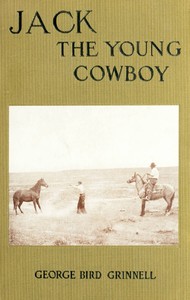
Jack the Young Cowboy: An Eastern Boy's Experiance on a Western Round-up
Language: en398 downloads on Project Gutenberg
Subjects
In: Adventure·Novels·American Literature
Public-domain ebook sourced from Project Gutenberg #47399.
Public-domain ebook
Language: en398 downloads on Project Gutenberg
Subjects
In: Adventure·Novels·American Literature
Public-domain ebook sourced from Project Gutenberg #47399.
The opening · free to read
"Well, Jack," said Mr. Sturgis, "I do not know where you'll find them, but possibly somewhere over on the Little Medicine. If I were you, I'd ride over to Powell's. They are sure to know where the outfit is, and if you can't reach camp to-night, you can stop at Powell's."
"All right, Uncle Will; I'll go over there and probably get to camp to-night."
Jack shook hands with his uncle, and stepping back to his horse threw the reins over Pawnee's head, and swung into the saddle. With a final wave of his hand, he trotted off toward where his string of horses were feeding on the meadow before the house, and riding to and fro behind the scattered bunch, gathered them together and started on down the road.
Mr. Sturgis stood in front of the corral filling his pipe, and watching his nephew grow smaller and smaller, as he moved along down the road close to the pasture fence. It seemed to him a long time since he had first brought Jack out from far New York to the Swift Water Ranch, a little slip of a lad, thin and pale. He remembered their first drive from the railroad: how he had killed a bear crossing the road, and how Jack had seen what he supposed to be an Indian dog, which, of course, was a coyote.
"My!" said Mr. Sturgis to himself, "certainly the years slip by! Then I could have lifted that little fellow and held him out with one hand; and now he is big enough to lift me!"
Jack had risen that morning soon after daylight, and had gone out to get his horses together. The night before, Joe had brought in and put in the small pasture the few saddle horses left at the ranch. That morning they had been driven into the corral, and Jack, aided by Joe's knowledge of the animals, had selected six for his string to ride on the round-up, taking along his old favorite Pawnee for a regular riding horse, but not for a cow horse. Good saddle animal as Pawnee was, Jack thought too much of him to be willing to use him in the long rough work of riding circle or branding calves, or throwing big cows, if any old mavericks should be found. For the most part Pawnee should travel in the cávaya,[A] though sometimes he might be used on night herd. Jack made up his mind that hard work Pawnee should not do. "Give him just enough exercise to make him enjoy his victuals," Joe had said that morning when they were talking the string over.
The horses had been brought into the corral, and one after another of those chosen had been cut out and sent out through the big gate, all except the one that was to carry Jack's bed. That one had been roped and taken out and tied up to the fence. Then Jack had gone up to the house and brought down his blankets and a few extra clothes, and having wrapped them up in his "tarp," the bundle had been put on the horse with the regular cowboy hitch, and the animal had been set free to feed with its fellows. Then had come breakfast, and he was ready.
It was nearly a year since Jack had crossed a horse, and it seemed very pleasant to be trotting along over the prairie, the bunch going nicely ahead of him. They were fat and frisky and every now and then one of them would lay back his ears and nip at his neighbor, and perhaps the sudden motion would start the little bunch into a gallop, from which they would almost at once come down again to the steady trot.
There had been rain enough--so they said at the ranch--during April, May and the first few days of June, but now the prairie was dry and a little cloud of dust rose from under the horses' hoofs. The bottoms and the high hills were brightly green. Moreover, they were dotted with many beautiful flowers--which of course Jack could not see, because he was moving along swiftly--and down on one of the wet meadows the purple iris, already in bloom, had colored the ground blue in spots.
It was a couple of years now since Jack had been to the ranch, and a good many things had happened; for when a boy is from seventeen to nineteen years of age, things are likely to happen to him pretty fast. He receives many new impressions, has new experiences, and certainly picks up knowledge of one sort or another at a rapid rate. Since Jack had last seen these prairies and mountains he had passed his examinations, entered college, and spent nearly two years there. He had certainly had a good time while he was in New Haven. The toughness and endurance that he had picked up during his summers on the plains and in the mountains had stood him in good stead in athletics and he had won a place on one of the football teams. During a part of his sophomore year, he had had the bad fortune to have a long and tiresome illness from which he was only now convalescing, and since he had lost much time, it had been thought best for him to go out to his uncle's ranch before the end of the college year and to spend the vacation there in getting well.
When he reached the Swift Water Ranch two days before, the round-up had already started and now was in full swing; and Mr. Sturgis, after satisfying himself that Jack was strong enough to do the work, had told him that the best thing for him would be to go out and find the round-up, and work with it. Nothing could have suited Jack better. Hugh was along as a sort of camp-keeper. Mr. Powell and Charley Powell were sure to be there, and so were half a dozen other men whom Jack knew very well, and with whom he would be glad to work. He felt that he was going to have a good time. In fact, he was having a good time now. The air was fresh and cool, the sun bright; far off on the green hills he could see here and there a little white speck which he knew was an antelope; from the fence posts along which he passed sounded the clear whistle of the western meadow lark; and everywhere the air was full of sweet songs of birds, though of them all the meadow lark's was the loudest and clearest.
Jack's outfit was that commonly used by the cow puncher. He wore a flannel shirt and woolen trousers, gloves, and shaps--heavy leather trousers without any seat, to protect the legs when riding through underbrush or thorns. About his waist was his pistol-belt filled with cartridges, while the six-shooter hung well down on his right hip.
It must not be supposed that Jack carried a gun with any purpose of using it against his fellow men, but in those old days of wild prairie and wild cattle a pistol was almost a necessity. While sometimes it was used to kill game, or perhaps against dangerous animals, it often came in play to frighten an angry cow, or to turn a bunch of stampeding cattle.
Before long Jack had left behind him the pasture fence, and when he looked back could no longer see the ranch buildings which, low themselves, and placed in a sheltered hollow, were now cut off by the points of the rounded hills. His course lay southeast across the basin. Now and then the horses, uncertain as to the direction they should take, veered to one side or the other, so that the driver had to ride out on the side toward which they turned and shout at them to head them back.
The miles passed quickly. Occasionally, on some nearby hill Jack saw a little bunch of antelopes--old males with long black horns, and yearlings, both males and females. They looked at him as he drew near, and if he approached too close, ran up to the top of some rise and watched him long after he had passed.
It was after he had crossed the valley, and was riding up through the low foothills that stretched out from the bluffs on the other side, that an old doe antelope burst suddenly from a little coulée close to the bunch of horses, and passing in front of them galloped up the hill on the other side. Almost immediately behind her was a coyote running hard. When it saw the horses it checked itself, and an instant later as it saw the rider, turned and ran. The old doe had done her best, but except for the incident of the horses' being there, she would soon have been pulled down. Her black tongue hung far out of her mouth, and she staggered as she ran.
Jack understood very well what was happening. Evidently two or more coyotes had started this doe, and were taking turns chasing her, one relieving the other which, by cutting off the corners, could save itself, and after it had regained its wind, take up the chase again. So the race might have kept up for an hour or more, until finally, the old doe would have been overtaken, pulled down, and devoured.
To Jack all this was a matter of common knowledge, for more than once he had seen almost that very thing happen. It took him only a moment, therefore, to whirl his horse. Giving him a jab with the spurs, he was close upon the coyote almost before it had started to run. He had jerked out his six-shooter, and as two or three balls knocked up puffs of dust about the coyote, the beast put on a tremendous spurt of speed. It was impossible to take aim from the back of the galloping horse, but one ball passing over the coyote's head caused it to whirl and run broadside for a jump or two, and as it did this, it came in collision with another ball, which quickly ended its career.
"Good enough!" said Jack to himself. "That is better luck than I deserved. I didn't hope to do more than scare the beast, and now I have got it." He rode over and sat on his horse looking down at the coyote, from whose hide great patches of fur had been lost, for the animals were now just shedding their winter coats. Evidently the hide was not worth taking off, and so Jack dismounted and cut off the coyote's head, for in those days there was a bounty on these beasts, and the bounty was worth having. He tied the head to the saddle, remounted, and started down toward his horses. They had stopped and were now feeding, but before long he had them moving again.
Riding steadily and fast across the plateau, he saw to his left something moving, and watching it for a few moments saw that it was a badger digging its hole. Every now and then the badger would sit up and look about him, and then again would put its forefeet on the ground and begin to dig. When he had got as close to the badger as the trail would bring him, Jack suddenly turned Pawnee and galloped toward the creature at a good rate. The badger at once noticed the change of direction, and set to work digging harder. By the time Jack had reached the hole, the animal was already twelve or fifteen inches under ground, and was quite covered by the loosened earth of the hole. For a moment Jack was going to shoot down through the earth, which was heaving and moving from the struggles of the beast below, but then it occurred to him that there was no especial reason for doing this, since the badger could not be used in any way. Its hide would be useless, and there was no reason for killing it. Moreover, badgers kill a good many prairie dogs which eat grass, and gophers which destroy gardens, and every badger killed means an increase in the dog and gopher population. There came to him, too, the memory of what Hugh more than once had said to him--that there was no sense in killing things unless you could make some use of them. He watched the moving earth for two or three minutes. If he had had a stick he would have poked it down in the hole, to feel the badger, but he had seen too many badgers to be willing to put his hand down in this hole, even though the hand were protected by a stout glove.
The book keeps going
Reading is free forever. Sign up and watch scenes appear while you read.



Scenes Storieta drew for other classics.
New illustrated classics
Once or twice a month: the latest books to get full character casts, scene art, and free comic editions. No account needed.