"'Ere, stow it, yer 'Ighness; no perjury," exclaimed Mr. Donah. "Yer won't never sing wiv the angels if yer go on in that way." He turned suddenly towards Sir Leopold, and spoke with a certain despairing fierceness upon him: "Look 'ere, guv'nor--I don't want 'is nibs to be tellin' no crams abaht it. I come in 'ere, an' I 'as a jolly good feed--fair wallers in it, I does--till the ole gal breaks dahn, an' reminds me abaht our little nipper at 'ome, wivaht a crust. I goes 'ome that night an' meets the parish doctor on the stairs. 'Dockery'--that's me name w'en I goes a-ridin' in the park--'Dockery,' ses 'e, 'that kid o' yourn wants nourishment--beef tea--good eggs; and you did ought ter get 'im away into the country.' Lor' luv us--w'y didn't 'e tell me to take 'im to 'ave tea alonger the Queen at Buckingham Pallis while 'e was abaht it?"
"You were not able to provide these necessaries for your child?" said Sir Leopold, somewhat unnecessarily.
"I were not," responded Mr. Donah, doggedly. "So that night I sits a-thinkin', an' a-thinkin', till me head fair buzzes, an' all next day I thinks a bit 'arder, till at last it comes over me that it ain't right, arter wot you've said abaht me bein' yer bruvver, that 'is nibs 'ere should be 'avin' roas' duck an' tomater sauce, so ter speak, an' my pore kid a-chewin' 'is fingers fer comfort. An' this mornin', seein' 'im look a bit finner than usual, I got fair desp'rit', an' couldn't stan' it no longer. So I made up me min' as 'ow I'd 'elp meself to a bit of me bruvver's silver stuff."
"To use one of the vulgarisms familiar to your class, my friend," interposed Sir Leopold, "I am afraid that your statement won't wash."
"It'll wash a lump better than some er yer spoutings," retorted Mr. Donah, with some indignation. "Wot's the good er tellin' a man one minute 'e's yer bruvver an' 'as a right ter share everyfink wiv yer, an' lockin' 'im up the nex' fer 'elpin' 'isself? There, I've 'ad me little jaw; now send fer the bloomin amberlance."
Sir Leopold Kershaw was thinking very hard indeed. It would be too much to say that he was in any sense converted; such sudden conversions are rare. But he had a wholesome dread of seeing his principles derided or himself made a laughing-stock; and Mr. Donah's remarkably caustic mode of speech would, he felt, suit the humour of the evening papers to a nicety. Sir Leopold had a mental vision of himself prosecuting in a police-court, and writhing under Mr. Donah's remarks in defence of his crime--the while busy reporters scribbled as if for their lives. Moreover, the man, to do him justice, had a certain honesty of purpose beneath all his ponderous phrases; his only fault lay in the fact that he did not, in any sense, understand the class about whom he talked so much. After a moment or two of thought he sternly dismissed the whole of the servants, cautioning them against chattering about the matter for the present; and was left alone in the room with his little son and Mr. Donah.
"Now, Dockery: I think you said that was your name----"
"C'ristened Sam, at Sin George's in the Borough, on a Toosday--wiv me a 'owlin' proper an' bitin' the parson's little finger," broke in Mr. Dockery.
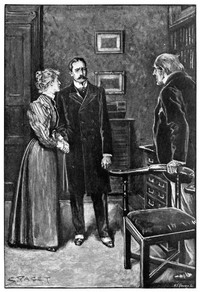
"Well, Dockery, the circumstances attending your offence are somewhat peculiar, and I am disposed to take a lenient view of the matter. I am impelled to this course by the remembrance that my son is, to an extent, concerned in the affair"--Sir Leopold Kershaw felt that he must really make an excuse of some kind or other--"and I am unwilling that he should imagine that the principles I have so strongly laid down in his hearing are sentiments merely, and that I am not prepared to carry them out when opportunity occurs. I deny your right to purloin my property, but I will have inquiry made into your case, and if I find that you are really deserving I will carry my principles into effect. Leave me your name and address--and then go."
Sam Dockery looked all about him for a moment in sheer amazement, put his hat on, and then took it off in a great hurry; took those queer little dancing steps of his, first backwards and then forwards, made a feint of squaring up to Teddy, and finally put his arm before his eyes and broke into unmistakable tears.
"Yer 'Ighness," he observed, in a shaky voice, when he had somewhat recovered, "parss no rude remarks! This is me one an' only; I was thinkin' of the nipper an' of 'ow 'e might 'ave bin wivaht 'is daddy fer a munf er two. Guv'nor"--he turned to Sir Leopold--"I've sed a few fings wot I didn't orter; let it parss. Yer ain't sich a bad sort as yer look--an' Gawd knows yer didn't make yer own chivvy! Ask for Sam Dockery dahn in Dock's Buildings, an' anyone will direck yer to me 'umble cot. An' I'll interdooce yer to the missis an' the nipper."
Despite his levity Mr. Dockery appeared to find some difficulty in getting out of the door. Sir Leopold--amazing man!--opened the hall-door himself, and Teddy fancied he heard the quick chink of money. Curiously, too, Sir Leopold, when he came back into the dining-room, wore a smile on his usually stern face, and told Teddy, in quite a pleasant tone of voice, to "cut away to bed."
Nor did Sir Leopold Kershaw forget his promise. Sam Dockery and his wife were startled the very next day by a visit from the great man himself, accompanied by "'is Ighness" and by a footman bearing a hamper. Nor was this all: for, a lodge-keepership falling vacant on Sir Leopold's country estate, Sam and his wife and the "nipper" were installed in it in comfort; on which occasion Mr. Dockery gave himself airs in Duke's Buildings, before his departure, and informed all and sundry that he was going down to his country house "ter pot the bloomin' dicky-birds."
Sir Leopold Kershaw is as great a man as ever; but he talks less about the equality and brotherhood of man.
The Story of "Bradshaw."
BY NEWTON DEANE.
"What books do you consult most?" a political adherent once asked John Bright in the midst of an arduous campaign. "The Bible and 'Bradshaw,'" was the reply of the great Quaker. To this another statesman added that both stood in equal need of commentators. "Bradshaw"--or, to give it its correct title, "Bradshaw's General Railway and Steam Navigation Guide"--is essentially a British institution, like the Times, football, Punch, and cricket. In common with all great institutions, it is a target for libel and detraction on the part of people who are a little difficult to please. Its very accuracy has been questioned. It has been said--by a succession of incorrigible humorists, including Charles Dickens--to have driven countless British lieges to lunacy. Our retreats for the insane are said to be invariably provided with a "Bradshaw ward," filled with the unhappy victims of the famous guide. But, seriously, "Bradshaw"--like the Bench of Bishops--can afford to be indulgent in the knowledge that it is indispensable. What should we do without "Bradshaw"? What if the portly brochure in the buff covers, that was born in the heart of England some sixty-five years ago, had never come into existence? True, Londoners have their "A B C," but London is only a tenth of the kingdom, and, besides, "Bradshaw" has all Europe for its province. Anyway, the origin and early progress of "Bradshaw" are interesting enough to be better known to the world.
_From a Water Colour Drawing._]
The name of the man who founded the celebrated guide was George Bradshaw. He was a Quaker, and a map-maker by calling. Before the days of railways he employed himself on maps showing the canals of Lancashire and Yorkshire. But by 1839 the kingdom was rapidly becoming intersected by that astonishing--but, when one comes to think of it, very simple--invention, the steel rail. The iron horse of Stephenson was prancing stertorously about between Manchester and Liverpool and Manchester and London and other cities. Passengers--who had hardly been taken into Stephenson's calculations at all when he inaugurated the first railway in 1825--were clamouring for transportation. A knowledge of train arrivals and departures was imperative.