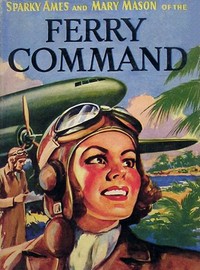
The air above the Brazilian jungles along the dark waters of the Rio Branco in northern Brazil was full of sound. The roar and thunder of many motors beat down upon the sea of waving treetops until it seemed to stir them into animated life. A formation of great, four-motored planes was passing over.
Two natives in a small dugout on the river dropped their paddles into their wooden canoe, then sat staring upward. The river’s current swept them beneath the branches of a dead mango tree. One of them reached up to snap off a brittle branch.
Breaking pieces from this branch he placed them, one by one, in the bottom of the canoe. When there were thirty-eight pieces, he stopped to sit as if in a trance watching those great, man-made birds go sweeping on.
Presently his companion grunted, then pointed at the sky upstream. The first native again looked skyward, then placed two more sticks with the others, making forty in all. Then he drawled a few native words that in our language mean:
“One of these big birds is very sick.”
This native was old. He had lived long beneath the overhanging treetops. He knew the ways of birds and men, but not of airplanes. For all that, he was right. One of these flying things of metal was sick, very sick.
Even as he said the words, there came a sudden burst of thunder, and the larger of the two planes, the one that was not “sick,” a ship so well formed—sleek and beautiful—that a native’s eyes shone at sight of it, pulled away from its slow, sick companion and went speeding along over the forest that lined the downsweep of the river.
“Gone,” said the native. “Now this one will die.” His eyes shone with a new light. Once on the Rio Negro, he had seen one of these man-made birds. There had been much on that plane that he had coveted. And now—
These last two planes were not bombers, but transport planes. It was quite evident that the speeding plane had not deserted its companion, for, in a short time, it came roaring back and a girl’s voice speaking into a radio said:
“There’s a rather large clearing about fifty miles down. Think you can make it?”
“We’ll have to try,” came in a man’s strong, even tone. “We’re on one motor now. The other is cutting out on me. Can’t tell how soon it will quit dead.”
“We’ll tag along,” came in the girl’s voice. “If you make it—”
“If we get that far, we’ll try a landing,” was the answer.
“And if anything goes wrong—”
“You’ll fly right on.” The man’s voice was harsh, insistent. “Remember! Secret—”
“Don’t say it, Sparky!” The girl’s voice rose sharp as an alarmed bird’s. “Don’t say it!”
“All right! All right!” the man’s voice grumbled into the tropical air. “Then I won’t say it. All the same—”
“All the same, if you go down there we’re coming right down after you,” the girl insisted. “You know what our orders were, to fly in pairs. If one plane is disabled, its mate must go to the rescue. All other planes must go straight on. We’re on a mission of destruction. That’s all we know. It’s urgent. We must go through!”
“Okay, sister, that’s why you should fly right on.”
“But we won’t.” The girl spoke quietly. “If you crack up, we’ll be right down. This ship has control. I can land her on a dime.”
“But don’t forget—”
“I never forget,” the girl snapped. “Now go on down there and try your luck. It’s all that’s left to do.”
“What’d he mean—secret?” The blonde-haired girl who sat in the co-pilot seat beside the girl who had carried on that spirited conversation, drawled, “What secret?”
“Sorry, Janet,” was the slow reply. “You’ve heard of military secrets, I suppose?”
“For Pete’s sake, Mary Mason! Yes! Of course, I have, but I don’t see—”
“This is one of them.” Mary Mason, the little girl who piloted a big plane, favored her with a smile.
After that, save for the slow drone of motors, there was quiet in the cabin, a tense sort of calm, such as comes before a storm. After a time the blonde-haired Janet said:
“Sparky’s motors didn’t stop all by themselves.”
“Of course they didn’t. Sparky’s too good a pilot for that.”
“He sure is. It’s the work of the enemy. That’s what it is. He knows. He’s after us, after you and Sparky, Don and me. He’s got us coming down in a jungle and we’re only just out of good, old U.S.A. And think of the dizzy miles still ahead of us! And the enemy dogging our luck all the way!”
“I thought of him before I started,” Mary replied quietly. “Let him do his worst. We’ll win, you’ll see!”
For the swift, powerful twin-motored transport plane flown by Mary Mason, the distance to that native clearing on the Rio Branco was just a jump, but she did not jump. Instead she followed doggedly on behind her limping companion. And as she followed, she found time to think. Those were long, long thoughts.
She was a member of the WAFS, Women’s Auxiliary Ferrying Squadron, this slender girl with the flashing black eyes and trigger-quick fingers. For six wintry months she had flown planes from east to west, from north to south, and all the way back again. Sometimes these planes were transport planes or bombers with comfortable, heated cabins. More often they were open-seated trainers or fighters. She flew them in wind, rain, and snow. Mile after weary mile in lonely solitude she had gone roaring through the night sky to arrive at last at her destination only to be ushered aboard an airways plane and hurried back again.
“It was hard,” she said to Janet Janes, her companion.
“Sure it was,” the other girl agreed. “Looks as if this would be harder.”
“Perhaps,” Mary answered. “But just think! In the past two days it’s been San Francisco to Denver, to Chicago, to Miami!”
“To Caracas, and then to the heart of a jungle where headhunters beat on hollow logs inviting their friends to a feast.” Janet laughed in spite of herself.
“This will be just a pause,” Mary insisted stoutly. “After that it will be Para, to Dakar in Africa, Dakar to Egypt and the pyramids, Egypt to Persia—”
“Under the Persian moon,” Janet sang softly.
“Oh! But they are!” Mary exclaimed. “Every human life is important. Besides, if Sparky killed just one of them, our lives wouldn’t be worth a penny. We’re in the wilds.”