Public-domain ebook
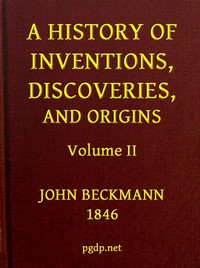
A History of Inventions, Discoveries, and Origins, Volume 1 (of 2)
Language: en1,907 downloads on Project Gutenberg
Subjects
In: History - Other
Public-domain ebook sourced from Project Gutenberg #48151.
Public-domain ebook
Language: en1,907 downloads on Project Gutenberg
Subjects
In: History - Other
Public-domain ebook sourced from Project Gutenberg #48151.
The work is a nineteenth‑century compendium that surveys the origins and development of countless inventions, from the odometer and music‑notating machines to paper‑making, gunpowder and the printing press. It opens with a lofty quotation from Sir John Herschel extolling the virtue of reading, then presents the title page, publishing details, and an extensive contents list that hints at the breadth of topics covered. A translator’s preface follows, explaining that the German original by Professor Johann Beckmann has been revised, enlarged, and carefully rendered into English, with updates to obsolete names and occasional additions that sometimes stray from strict chronology. The author’s own modest disclaimer about the inclusion of seemingly trivial items underscores the book’s ambition to catalogue both major breakthroughs and peripheral curiosities, offering a panoramic view of technological progress.
The prose reflects the scholarly yet conversational style of mid‑Victorian encyclopaedism, blending erudite footnotes with occasional rhetorical flourishes. Its tone is that of a learned lecturer addressing an educated readership, assuming familiarity with classical sources while remaining accessible to the curious layperson. Readers who relish detailed historical surveys, enjoy tracing the lineage of everyday objects, or appreciate the blend of academic rigor and anecdotal charm will find this volume rewarding. It especially appeals to historians of science, collectors of antiquarian knowledge, and anyone intrigued by the tangled pathways through which humanity’s inventions have emerged.
The opening · free to read
CAREFULLY REVISED AND ENLARGED BY WILLIAM FRANCIS, Ph.D., F.L.S., EDITOR OF THE CHEMICAL GAZETTE; AND J. W. GRIFFITH, M.D., F.L.S., LICENTIATE OF THE ROYAL COLLEGE OF PHYSICIANS.
VOL. I.
LONDON: HENRY G. BOHN, YORK STREET, COVENT GARDEN. 1846.
PRINTED BY RICHARD AND JOHN E. TAYLOR, RED LION COURT, FLEET STREET.
CONTENTS.
Page Italian Book-keeping 1 Odometer 5 Machine for noting down Music 12 Refining Gold and Silver Ore by Quicksilver 14 Cold or Dry Gilding 19 Gold Varnish 20 Tulips 22 Canary Bird 32 Archil 35 Magnetic Cures 43 Secret Poison 47 Wooden Bellows 63 Coaches 68 Water-clocks, Clepsydras 82 Tourmaline 86 Speaking-trumpet 93 Ananas.--Pine-apple 102 Sympathetic Ink 106 Diving-bell 111 Coloured Glass.--Artificial Gems 123 Sealing-wax 137 Corn-mills 147 Verdigris, or Spanish Green 171 Saffron 175 Alum 180 Falconry 198 Turf 205 Artichoke 212 Saw-mills 222 Stamped Paper 230 Insurance 234 Adulteration of Wine 245 Artificial Pearls 258 Paving of Streets 269 Collections of Natural Curiosities 282 Chimneys 295 Hungary Water 315 Cork 318 Apothecaries 326 Clocks and Watches 340 Clocks and Watches (additional) 355 Quarantine 373 Paper-hangings 379 Kermes. Cochineal 385 Writing-pens 405 Wire-drawing 414 Buck-wheat 425 Saddles 431 Stirrups 435 Horse-shoes 442 Floating of Wood 454 Lace 463 Ultramarine 467 Cobalt, Zaffer, Smalt 478 Turkeys 487 Butter 499 Aurum Fulminans 509 Garden-flowers 512
ADVERTISEMENT.
In revising Beckmann’s celebrated Work, we have endeavoured to improve it principally by altering such names, characters, descriptions, and opinions as have become obsolete, or are now known to be erroneous; and by such additions as seemed necessary to bring the accounts of the subjects treated of to the present state of knowledge. In some cases, these additions may appear to diverge from the declared object of the work; but in this we have only followed the example of Beckmann himself, who frequently deviates from a strict historical path, and we think advantageously, for the purpose of introducing curious, instructive, or amusing information. In most cases, where the subject under consideration is a process of manufacture, we have given a brief outline of its practice or theory, unless this had previously been done by the author. The translation, also, has been carefully compared with the German, but in only a very few cases could we detect errors which rendered the passages contradictory or unintelligible: on the whole, it is extremely well executed; and too much praise cannot be given to Johnston, for the judicious manner in which he has embodied in one article, detached essays on the same subject, which Beckmann published at different periods, as he acquired fresh information. The only instances in which this had been omitted, are the articles on Turf, Cork, and Quarantine, which were still encumbered with addenda; in the present edition, these have been incorporated. All such quotations from Latin and Greek authors, as might be deemed essential to the understanding of the text, have been given in English; those of a mere critical and philological character, it has been thought advisable to leave untranslated. The book may be classed as a compound of learned research and light reading, suitable both to the popular reader and the scholar; and that character has been preserved in the present edition. To the kindness of John Frodsham, Esq., the present proprietor of Arnold’s Chronometer Establishment, we are indebted for much of the interesting information added to the article on ‘Clocks and Watches;’ and we have also to return our thanks to the publisher, Mr. H. G. Bohn, for the assistance he has constantly afforded us, as well as for his Memoir of the author.
W. FRANCIS. J. W. GRIFFITH.
TRANSLATOR’S PREFACE.
That the arts had their rise in the East, and that they were conveyed thence to the Greeks, and from them to the Romans, is universally admitted. Respecting the inventions and discoveries however of the earliest ages, nothing certain is known. Many of those most useful in common life must have been the production of periods when men were little acquainted with letters, or any sure mode of transmitting an account of their improvements to succeeding generations. The taste which then prevailed of giving to every thing a divine origin, rendered traditional accounts fabulous; and the exaggeration of poets tended more and more to make such authorities less worthy of credit. A variety of works also, which might have supplied us with information on this subject, have been lost; and the relations of some of those preserved are so corrupted and obscure, that the best commentators have not been able to illustrate them. This in particular is the case with many passages in Pliny, an author who appears to have collected with the utmost diligence whatever he thought useful or curious, and whose desire of communicating knowledge seems to have been equal to his thirst for acquiring it.
Of all those nations whose history has been preserved, the most distinguished are certainly the Greeks and the Romans; but, as far as can be judged at this remote period, the former were superior to the latter in point of invention. The Romans indeed seem to have known little, except what they borrowed from the Grecians; and it is evident, by their sending their young men of rank to finish their education in Greece, that they considered that country as the seat of the arts and the sciences, and as a school where genius would be excited by the finest models, while the taste was corrected and formed. From some hints given however by Pliny and other writers, we have reason to conclude that the Romans possessed more knowledge of the arts than the moderns perhaps are willing to allow, and that some inventions, considered as new, may be only old ones revived and again rendered useful.
When Rome, abandoned to luxury and vice, became an easy prey to those hordes of barbarians who overran the empire, her arts shared in the general wreck, and were either entirely lost, or for a time forgotten. The deplorable state of ignorance in which Europe was afterwards plunged during several centuries, retarded their revival; and it was not till a late period, when favoured and protected by a few men of superior genius, that they began to be again cultivated. It cannot however be denied, that several important discoveries, altogether unknown to the ancients, which must have had considerable influence on the general state of society, were made in ages that can hardly be exempted from the appellation of barbarous. As a proof of this may be mentioned the invention of paper[1], painting in oil[2], the mariner’s compass[3], gunpowder[4], printing[5], and engraving on copper[6]. After the invention of the compass and printing, two grand sources were opened for the improvement of science. In proportion as navigation was extended, new objects were discovered to awaken the curiosity and excite the attention of the learned; and the ready means of diffusing knowledge, afforded by the press, enabled the ingenious to make them publicly known. Ignorance and superstition, the formidable enemies of philosophy in every age, began soon to lose some of that power which they had usurped; and states, forgetting their former blind policy, adopted improvements which their prejudice had before condemned.
Though it might be expected that the great share which new inventions and discoveries have at all times had in effecting such happy changes among mankind would have secured them a distinguished place in the annals of nations, we find with regret, that the pen of history has been more employed in recording the crimes of ambition and the ravage of conquerors, than in preserving the remembrance of those who, by improving science and the arts, contributed to increase the conveniences of life, and to heighten its enjoyments. So little indeed has hitherto been done towards a history of inventions and discoveries, that the rise and progress of part of those even of modern times is involved in considerable darkness and obscurity: of some the names of the inventors are not so much as known, and the honour of others is disputed by different nations; while the evidences on both sides are so imperfect, that it is almost impossible to determine to which the palm is due. To Professor Beckmann, therefore, those fond of such researches are much indebted for the pains he has been at to collect information on this subject; and though he has perhaps not been able to clear up every doubt respecting the objects on which he treats, he has certainly thrown much light on many curious circumstances hitherto buried in oblivion.
The author, with much modesty, gives to this work in the original the title of only Collections towards a History of Inventions: but as he has carefully traced out the rise and progress of all those objects which form the subject of his inquiry, from the earliest periods of their being known, as far as books supplied information, and arranged his matter in chronological order, the original title may admit, without being liable to much criticism, of the small variation adopted in the translation. The author, indeed, has not in these volumes comprehended every invention and discovery, but he has given an account of a great many, most of them very important.
Should any one be disposed to find fault with the author for introducing into his work some articles which on the first view may appear trifling, his own words, taken from the short preface prefixed to the first volume of the original, will perhaps be considered as a better exculpation than anything the translator might advance in his favour. “I am sensible,” says he, “that many here will find circumstances which they may think unworthy of the labour I have bestowed upon them; but those who know how different our judgements are respecting utility, will not make theirs a rule for mine. Those whose self-conceit would never allow them to be sensible of this truth, and who reject as useless all ore in which they do not observe pure gold, as they display very little acuteness, must be often duped by the tinsel glare of false metal; and they give me as little uneasiness as those who have no desire to know the origin of inventions, or how they were brought to their present utility. If my extending the term Invention farther than is perhaps usual, by comprehending under it several police-establishments, be a fault, it is at any rate harmless, and on that account may be pardoned without much apology.”
[1] Montfaucon, notwithstanding all his researches in France and Italy, was not able to discover any charter or diploma written on common paper, older than the year 1270. Paper, however, made of cotton, is said to be much older, and to have been introduced into Europe by the Arabs. If we can believe an Arabian author, who wrote in the thirteenth century, quoted by Casiri, in Biblioth. Arabico-Hispana, vol. ii. p. 9, paper (doubtless of cotton) was invented at Mecca by one Joseph Amru, about the year of the Hegira 88, or of the Christian æra 706. According to other Arabian authors, quoted by Casiri and Abulfeda, the Arabs found a manufactory of paper at Samarcand in Bucharia, when they conquered that country in the year of the Hegira 85, or of our æra 704. The art of making paper from silk was, as some pretend, known to the Chinese 180 years before Jesus Christ. See a letter from Father de Mailla to Father Etienne Souciet, in Mémoires des Inscript. et des Belles Lettres, vol. xv. 520.
The book keeps going
Reading is free forever. Sign up and watch scenes appear while you read.



Scenes Storieta drew for other classics.
New illustrated classics
Once or twice a month: the latest books to get full character casts, scene art, and free comic editions. No account needed.