Public-domain ebook
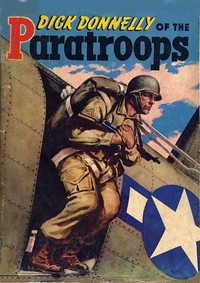
Dick Donnelly of the Paratroops
Language: en341 downloads on Project Gutenberg
Subjects
In: World War II·Historical Novels·Adventure
Public-domain ebook sourced from Project Gutenberg #48226.
Public-domain ebook
Language: en341 downloads on Project Gutenberg
Subjects
In: World War II·Historical Novels·Adventure
Public-domain ebook sourced from Project Gutenberg #48226.
The opening · free to read
The big transport plane flew out of a cloud just as the sun appeared over the flat horizon of the desert to the east. The rolling hills over which the clouds hung low smoothed out as they met and merged with the flat wasteland. A row of trees, the only ones in sight, lined one edge of a rectangle even flatter and smoother than the land near by. A long, low building near the trees, with two small airplanes in front of it, identified the rectangle as an airfield.
Before the transport reached the field, another slid out of the cloud. Suddenly swift fighter planes darted past them, swept low over the airfield with machine guns splattering their bullets over the hard earth, the two small planes, and the low hangar. They circled swiftly, just as a third transport appeared from the clouds, and roared past the field, on the far side of the line of trees. Long streaks of white smoke poured from them, falling lazily and billowing into man-made clouds as dense as those in which the planes had recently been flying. In five minutes the smoke screen was a wall twenty feet thick and a hundred feet high.
Meanwhile, the first transport had circled the field, dropping lower. Suddenly a figure plunged from the side of its fuselage, hurtled toward the ground, and then checked its descent with a jerk as a white parachute billowed out above. Another figure had dropped from the plane before the first ’chute opened, and now it too floated gently to earth behind the smoke screen. In rapid succession, eighteen men leaped from the plane, which sped back toward the hills as another came in to discharge its cargo of soldiers.
As the first man landed, he rolled over the hard earth, tugging at the lines of his parachute to spill the air from it. In a moment it had collapsed and the man had slipped from his harness. Dropping his emergency ’chute, he unfolded the stock of his sub-machine gun and ran forward, crouching, toward the smoke screen, on the other side of which lay the airfield building.
“Jerry!” a voice called from behind him, and he turned.
“Okay, Dick?” the first man called back.
“Yes, sir,” replied the second, running up. “And here come the rest.”
In less than three minutes the eighteen men from the first plane had gathered near their leader, Lieutenant Jerry Scotti.
“We won’t wait for the heavies,” he said. “I think this is a setup. Come on.”
He turned and ran into the cloud of smoke, followed by the others, who held their guns ready. As they broke out of the cloud on the other side, they dropped to the ground. The hangar was not more than a hundred feet away. There was still no sign of activity in or around it. Not a man had been seen since the planes first came over.
“No cover here at all,” muttered the second man, Sergeant Dick Donnelly.
“No opposition, either,” laughed the Lieutenant. “Can’t see a soul.”
“Think they’ve skipped out?” Donnelly asked his companion.
“No—no place to skip to, except by plane,” Scotti replied. “They must be in the hangar, just waiting. The Major said we might not meet any defense at all. Most of these Frenchmen are mighty happy to have us invading North Africa.”
“Sure, but some of ’em are putting up a fight,” the sergeant said. “They’re good soldiers and if their officers tell them to fight back, they fight back.”
“Get back a bit into the protection of the smoke,” Scotti said, and his men pushed themselves back ten feet. “Now let’s give them a burst and see what happens.”
The silence, broken only by the steady drone of airplane motors in the skies overhead, was shattered by the stuttering explosions of sub-machine guns. The bullets thudded into the thick, hard clay walls of the hangar.
Suddenly three rifles and a pistol were thrust through the windows at the rear of the hangar and they fired repeatedly—_into the air_! Then a white flag was thrust from the middle window on a long pole, so quickly that it must have been ready for the purpose.
“We surrendair!” called a voice from the hangar. “Les Américains—zey have conquered us!”
“All right,” shouted Lieutenant Scotti, advancing from the smoke screen about ten feet. “Toss all guns out the window.”
“Oui, oui, at once!” came back the voice.
Half a dozen rifles, three automatics, and two light machine guns were thrust from the windows and clattered to the ground. By this time two other groups of American soldiers had appeared, one to the right and one to the left of Scotti’s group.
“It’s all over,” he called to them. “Hold your fire! They’ve surrendered.”
“My golly!” cried a voice from the group on the left. “What did we come along for—just to take a ride?”
But Lieutenant Scotti had turned his attention back to the hangar.
“Now come out that side door,” he called. “One at a time, with your hands up.”
In a moment the side door of the hangar was opened and out stepped a smiling French officer, his hands in the air. His blue uniform was as trim as his tiny mustache, and he walked erect, with dignity and military precision. Just as the other French soldiers came out behind him, three men appeared from the smoke, which now was lifting somewhat, behind Scotti’s group. Dick Donnelly turned from his officer’s side and called to them.
“Take it easy, boys.” he said with a grin. “The heavy machine guns won’t be needed—unless you want a little target practice later just to keep in trim.”
The men, who had quickly assembled a machine gun dropped by parachute from one of the planes, rushed it forward with all possible speed, stopped in their tracks, dropped their heavy burdens, and looked disappointed.
“Aren’t we ever gonna get any fightin’?” grumbled the first man.
“Wasn’t that little business at Casablanca enough for you?” asked Donnelly.
“Sure, but that was three weeks ago!” was the reply.
By this time the French soldiers were lined up alongside the hangar, their hands in the air. There were two other officers, four enlisted men and four men whose overalls showed that they were mechanics.
“We have resisted,” cried the first officer happily. “Did you not see? We fired our guns in resistance against your attack as we have been commanded. But your superior numbairs overcame us. Yes?”
Lieutenant Jerry Scotti grinned and walked forward.
“Sure, I understand,” he said. “You put up a whale of a fight! Lucky nobody was hurt. You can put your hands down now.”
Scotti turned to his sergeant.
“Sergeant Donnelly, you may send up the flares signaling capitulation of the French airfield after a brief but fierce fight. The other planes can come in now.”
As Dick Donnelly, with a few of his men, hurried off to carry out the Lieutenant’s order, Jerry Scotti extended his hand to the French officer, who grabbed it and shook it heartily, mumbling happy phrases all the time in such an outpouring of words and exclamations that Scotti, whose French was limited, could understand nothing of what was said. But he did know that the man was delighted—so delighted, in fact, that a mere handshake would not suffice to demonstrate his enthusiasm. He flung his arms around Lieutenant Scotti, who looked a little embarrassed, especially at the grins of his own men who stood in a circle around him.
“I feel as if I ought to say something important,” he muttered, “like ‘Lafayette, we are here’ or something.”
The book keeps going
Reading is free forever. Sign up and watch scenes appear while you read.



Scenes Storieta drew for other classics.
New illustrated classics
Once or twice a month: the latest books to get full character casts, scene art, and free comic editions. No account needed.