Public-domain ebook
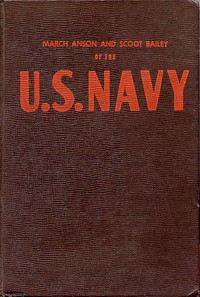
March Anson and Scoot Bailey of the U.S. Navy
Language: en363 downloads on Project Gutenberg
Subjects
In: World War II·Adventure·Novels
Public-domain ebook sourced from Project Gutenberg #48549.
Public-domain ebook
Language: en363 downloads on Project Gutenberg
Subjects
In: World War II·Adventure·Novels
Public-domain ebook sourced from Project Gutenberg #48549.
The opening · free to read
The launch purred smoothly across the calm waters of the harbor, making for the Navy Yard pier. Their feet braced against the slow roll of the boat, two young men stood looking at the huge gray ship they had just left.
“I’m beginning to have my doubts,” Scoot Bailey said almost to himself.
“Same here,” the other replied. March Anson was shorter than his friend, but more solidly and compactly built. His gray-blue eyes were steady and cool, matching the set of his jaw, but the crinkling lines at their corners showed that this apparently serious young man spent a good deal of time smiling or laughing.
“She was a swell ship,” Scoot said sadly.
“_Was!_” exclaimed March. “She still is! Just because Bailey and Anson have left her, don’t you think she can carry on any longer?” A slow smile spread over his face as he turned to look at his friend. But Scoot was serious.
“Oh, sure, March,” he replied. “But she’s out of our lives now. She’s past tense for us. And—well, she’s been just about everything to us for a year now—home, mother, and sweetheart!”
“I know what you mean,” March said. “And it’s natural for us to wonder if we’ve done the right thing in being transferred. Right now we’re looking at what we’re leaving. In another ten minutes we’ll be concentrating on what we’re going to!”
Scoot Bailey turned around and sat down.
“I’m going to start right now,” he grinned. “No use getting sentimental about the old Plymouth at this point. I’m going to start thinking about the Lexington or the Shangri-La or whatever aircraft carrier I’ll be on in a few months.”
“Good idea,” March agreed, sitting beside the tall and gangling young man who now stared ahead at the Navy Yard. “But that’s one trouble right now, Scoot. Neither one of us knows exactly where he’ll be. If you knew exactly what ship you’d be attached to, you could make your thoughts more specific. When you get there, you know you’ll love her just as much as you’ve loved the _Plymouth_—more, in fact, because you’ll be flying at last!”
“Yes, I know, but what about you?” Scoot asked. “I still can’t figure out why you want to be a pigboat man. And what can you dream about now as you look into the future? The name of some fish, that’s all.”
“Sure, subs are named after fish,” March replied. “And they have some swell names, too—the Barracuda, the Dolphin, the Spearfish, the Amberjack!”
“Yes, they sound all right,” Scoot grinned. “But what if you’re assigned to the Cod or the Herring or the Shad? No, I can’t figure out what you see in those stuffy, cramped, oversized bathtubs!”
This light-hearted argument had been going on ever since March Anson and Scoot Bailey had been in the Navy together. Neither one minded the jibes of the other, but the dispute as to the respective merits of air and underwater craft never ended.
“Cozy and snug,” March said stoutly, “that’s what subs are! Not cramped and stuffy! Why—they’re all air-conditioned now!”
“Maybe so,” Scoot said, shaking his head, “but no air-conditioning can match the clear blue sky a couple of miles up there where I’ll be flying! Boy—what a chance! Just what I’ve always wanted!”
Their departure from the cruiser Plymouth was forgotten now as they thought of their futures. Only one aspect of that future was rarely mentioned by either of them, and they tried not to think too much about it. In their new activities they would not be together—these two who had been inseparable friends for so many long years.
They had met in the first year of high school, back in that small Ohio city which now, during war, seemed so many miles and so many years away. Scoot had lived in Hampton all his life, but March had just moved there from the farm which his mother had sold when his father died. A widow with a son only thirteen years old could not run a 160-acre farm, she had decided, not if her son was to get the education she had determined he would have.
So the farm had been sold, and Mrs. Anson and her young son had moved to the near-by city of Hampton. March started high school, and his mother went back to teaching, her profession before she married Clement Anson and settled down to farm life. The money from the farm sale was tucked away in the bank, to be forgotten until the time came for March to enter college.
March and Scoot had sat next to each other in the big assembly hall of Hampton High School on the first day. They had taken to each other at once and from that time had been the closest of friends. Some people had wondered at the deep friendship of these two who, in some ways, seemed so different. Scoot had always been a noisy and boisterous kid, eager for any activity that meant speed, excitement, and a little bit of danger. The more conservative parents shook their heads and called him a little “wild” although he never got into serious trouble.
March Anson, on the other hand, was quiet and serious. On the farm he had worked hard and had learned the value of hard work. In school he studied thoroughly and carefully. Even in sports he was serious, playing games as though he looked on them as work, not as pleasure.
But March and Scoot recognized in each other at once the hidden qualities that lay beneath the surface indications of their character. Scoot saw that March really enjoyed life tremendously. He just didn’t whoop and shout about it. He felt a thrill of pleasure in a tough football game played hard. He loved the talk and chatter of a gang of boys discussing the game afterward, even though he spent more time listening than talking himself. He liked the school dances, even though he was somewhat timid with girls and danced so quietly that he stood out in contrast to the majority of wildly capering youngsters.
Scoot learned to appreciate the slow smile that spread over March’s face when he was enjoying himself. When something amusing happened, he could look at March and see the twinkle in his eye that others seemed to miss.
In the same way, March saw that beneath Scoot’s noisy impulsiveness there was a great deal of calm courage, a daring that had in it nothing of foolhardiness but—on the contrary—a good deal of confidence. Scoot had a serious side that none of his friends, until March came along, had penetrated. He never seemed to study much, but his grades were always good. That was because Scoot never announced, “No, I can’t do that—I have to go home and study now.” Scoot was ready to do anything suggested by anyone, but he still managed to get his studying done, after the play was over.
By the time they graduated from high school together, Scoot and March had both changed a good deal, each one influenced by the other. At a first glance they seemed just the same as always, but March was less retiring, less timid, while Scoot did not always hide under his playful spirit his more serious interests in life.
When they went off to the state university together, they wondered how long it would last, for war was already in the air.
“It’s coming,” Scoot said, “just as sure as shootin’, war’s coming. And I’m going to be in it just about five minutes after it starts.”
“They’ve been staving it off for a long time,” March said, “and maybe they can keep it up a few years longer. But I don’t think they can ever satisfy that Hitler guy. Giving in to a pig won’t work—he’ll just keep demanding more and more! But maybe we’ll get our college education before the guns start popping!”
But the guns had started firing in Europe before their second year. When the first peacetime selective service act was passed in the United States, Scoot was very excited at being below the twenty-year age, and wanted to enlist at once. But it was March who persuaded him against it.
“We can do more good going right on getting our education until they need us,” he insisted. “Then we’ll be that much better equipped to do a good job.”
His argument prevailed over Scoot then, but the war became their favorite topic of conversation from that time on. Many others in the college were not interested. They felt that the war was thousands of miles away, that two big oceans were enough insulation to keep it away from America.
But Scoot and March felt sure it was coming. They followed the war news carefully, their hearts sinking as Hitler’s gangs overran one country after another in Europe. They spent their spare time reading books and articles about the war, the new weapons and tactics that were being used. It was then that Scoot knew that he wanted to be a flier, and then that March first developed his interest in submarines.
“This is an air war!” Scoot insisted. “It’s going to be fought and won in the air!”
“The whole thing?” March demanded. “I wouldn’t deny the importance of planes, but I’d never agree that they’ll do the whole job alone. The country without planes can’t win, I’ll say that much. But look at Germany’s U-boats! Look at the damage they’re doing! If England can’t get her supplies by sea—why, she’s sunk!”
The argument that never ended was begun right then. March and Scoot read everything they could lay their hands on about submarines and airplanes. And when the Japs attacked Pearl Harbor, Scoot wanted to get in a plane and fly by instinct out over the Pacific, to give them a taste of their own medicine. He had just decided to enlist when the Navy’s program for college students was announced—the V-12 plan which carried students through an intensive training course which resulted in commissions as Ensigns.
For March there was no doubt about what course to follow. He signed up for V-12 at once, already sure that he would be sailing in a submarine before the year was out.
Scoot could not make up his mind for a few days. When he had thought of flying, he had always thought of the Army Air Forces. But the Navy had fliers, too. Eventually it was his burning hatred of the Japs that decided him.
“There’s a lot of water between us and them,” he said. “The Navy will have the biggest job in knocking them over—and aircraft carriers will be the answer! Navy it is for me, too!”
So March Anson and Scoot Bailey had joined the Navy. Gone were all thoughts of football, baseball, dances, and parties. And suddenly there seemed to be little difference between the two. Both were now serious, hard-working, for in the Navy’s program there was room for little but serious, hard work. Together they crammed into their heads more mathematics than they had thought of studying in a whole college course. Navigation, engineering, English, Navy custom and tradition—all were crammed into them with an intensity of which they had never thought themselves capable.
Both had put in early their requests for assignment to submarines and to air service. And, though they knew that the Navy tried to place men where they wanted to go, they realized that the Navy’s needs would come first rather than their wishes. So they were disappointed, though not surprised, when both requests were turned down. The submarine school at New London, even though greatly expanded, was full to overflowing. And the applicants for Naval Aviation exceeded by ten times the number that could be accepted.
The book keeps going
Reading is free forever. Sign up and watch scenes appear while you read.



Scenes Storieta drew for other classics.
New illustrated classics
Once or twice a month: the latest books to get full character casts, scene art, and free comic editions. No account needed.