Public-domain ebook
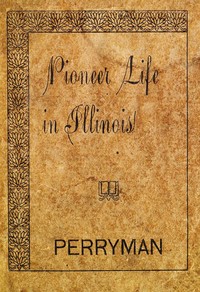
Pioneer Life in Illinois
Language: en285 downloads on Project Gutenberg
Subjects
In: Biographies·History - American
Public-domain ebook sourced from Project Gutenberg #48637.
Public-domain ebook
Language: en285 downloads on Project Gutenberg
Subjects
In: Biographies·History - American
Public-domain ebook sourced from Project Gutenberg #48637.
The opening · free to read
Cares.
IN early days we had a great deal of hard work to clear the land and then to make and keep up the rail fences; and it took four times the work to raise a corn crop as it does now; and it took four times the work to cut the firewood as it does now; and it took so much work to prepare the material and make the clothing. So the pioneers had to keep pretty busy; and when the corn was in roasting-ear we had to watch it pretty closely for the squirrels in the day-time, and the coons in the night would destroy a great deal of it, and later on if it was not gathered early the deer and the turkeys and prairie-chickens would eat it up.
Occupations.
IN pioneer days after the corn was laid by, as we called it, then we had a while that we did not work much. There was not much harvesting to do, as our hay harvest was in the prairie grass, and that was done late in August or September, and during this idle spell the men would hunt and fish, and those that did not have plenty of bees would hunt “bee trees”, and get honey to do them for the year.
The boys would go into the woods and dig Ginseng; and when we would dry it we got twenty-five cents per pound, and when we sold it green we got ten cents per pound, and a boy could make good wages for them times.
Eighty Years Ago.
IT was Eighty Years Ago, in the wild woods, on Mitchell’s Creek, near a good spring, JACOB PERRYMAN, the father of the author of this little book, pitched his cabin. He was of Scotch descent, and my MOTHER was of German descent; they raised a large family, of which we was the sixth.
The writer was born April 26th, 1836, and raised there when it was almost impossible for a boy to get an education; but he was supposed to risk his chances with the wolf and the rattlesnake, and all the dangers seen and unseen of that early day. So you see the writer has lived in Illinois more than three score and ten years, and if, in speaking of my native State, we spread the “paint” on pretty thick, you will pardon us. Maybe we have enjoyed life more than the most of people have, and if the reader of this book finds that the tone of it shows too much of a disposition for mirth, remember it is our nature and we cannot help it, and we attribute it to our raising. The man who lives in Illinois and don’t enjoy life is a man who does not know a good thing when he has it. The man who lives in Illinois and does not see beauties on every hand to make him glad, is mentally cross-eyed.
Sixty Years Ago.
I WANT to sing a little song, Of the people and their ways; And how the people got along Away back in early days. We rather thought the quickest way To let the people know,— We would sing to them Of how we lived, Just Sixty Years Ago.
When coon-skins was two bits apiece, And beeswax was a bit, And eggs four cents a dozen— That was all that we could get; And deer-skins always went at par, And feathers was not slow; And that’s the money people had Just Sixty Years Ago.
And, Oh! that big old fire-place.— It took a sight of wood; We would haul it on a “lizzard”— And we would pile on all we could; We would haul a big long hickory log, Especially when there was snow;— For we worked two yoke of cattle then;— Just Sixty Years Ago.
The school house was of elm logs— The bark was all left on; I never saw no other kind Till I was nearly grown. The children got some learning, But, of course, it was rather slow;— My! how the teacher “licked” the “kids” Just Sixty Years Ago.
And when it came to raising corn, We did not get much rest For the want of tools to work with, We had to do our best. We plowed with wooden mouldboard plow And our lines were made of tow; And that’s the kind of tools we had Just Sixty Years Ago.
And when the people went to church They always wore their best; They wore their home-made pantaloons— I hate to tell the rest. The girls wore striped dresses, And the boys wore shirts of tow;— And that’s the way the people dressed Just Sixty Years Ago.
We did not care for stocks or bonds, They were not in our line;— But, if we wanted whiskey, We got it every time. The boys could bake the “johnnycake” And the girls knew how to mow; Oh! was not we a “jolly set?” Just Sixty Years Ago.
Traveling in Illinois.
IN traveling over the great fertile prairie State of Illinois, and viewing its many railroads, its many beautiful cities and towns, its school houses, its churches, its broad fields of waving grain, its orchards bending under their load of golden fruit, its vast population of industrious and intelligent citizens, its mills, and its factories, one can hardly realize that nearly all of this great improvement has been made in the last sixty years, but such is the case. Sixty years ago these prairies were an unbroken howling wilderness, where the wolf and deer roamed at will and raised their young unmolested, and where the rattlesnake was in his glory. The pioneer had unknowingly blazed the way for what was to come; he did not seem to know that these wild prairies was soon to become the garden spot of the world.
Names of the Early Settlers.
NO better class of citizens has ever lived in Shelby county, or ever will live in Shelby county, than the early settlers; the Rasey’s, the Hall’s, the Pugh’s, the Corley’s, the Rhoades’, the Wakefield’s, the Small’s, the Middlesworth’s, the Gollier’s, the Yant’s, the Smith’s, the Warren’s, the Whitfield’s, the Neal’s, the Killam’s, the Douthit’s, and many others that we could name, who were just as good. The writer feels proud of the memory of such people, and while the most of them have passed away, we thank God that such men and women have lived in the world to make our pathway brighter, and make the world better. And where you find one of those early settlers you find a man whose love for his friends can hardly be severed; a love so true, so deep, so loyal, so God-like that if they possessed no other good trait that one trait alone makes them noble.
Going Back.
NOTWITHSTANDING the many disadvantages of the pioneer life, there was a charm in it which none can describe; and an old man who was here in early days almost feels like he wants to go back and live his boyhood days over in the wild new country, where everything was so near like nature formed it; he wants to see the wild animals gallop over the hills; he wants to hear the howl of the wolf; he wants to hear the cry of the hounds when pursuing the deer or the wolf; he wants to hear the gobble of the wild turkey in the spring-time; he wants to see the prairies covered with wild flowers of all colors; he wants to hear the crack of the rifle that brings down the deer or turkey; he wants to hear the “pop” of the whip as the “big brother” comes up the hill with his two yoke of faithful cattle and their big load of hickory wood; he wants to hear the thud of the flax-brake and the hum of the spinning wheel.
Oh! carry us back to the plain simple life In the log cabin, let us see The roaring log fire in the big fireplace Where the dove of peace hovers Over the hearthstone and delights In the rewards of industry and virtue.
The Drill.
SIXTY years ago there was a law in Illinois that all able-bodied men from the age of 18 to 45 should meet and drill as soldiers every alternate Saturday, from the first Saturday in April till the third Saturday in November. And they mustered at my father’s every time. John L. Perryman, my cousin, was Captain, a large, tall young man, with a powerful voice; we could hear him give the commands very plainly for two hundred yards. He wore a stove-pipe hat, with his long red plume stuck in his hat, and he looked nice and I think he felt big. Ben. Tallman was Orderly Sergeant. I think there was about one hundred men in our precinct; and when Ben. would call the roll, at nine o’clock, every man would answer to his name. Uncle Philip Perryman was fifer, and Harvey Cummings was drummer.
In the morning pretty early the men would begin to come in, and a good many women would come to see the men muster, and some of them would walk three or four miles.
We would listen for the delegation from the West. The fife and drum and the Captain was in that delegation; and when we would hear the music and see that red plume coming around the bend of the road, a boy would think his height was ubout eight feet in his stockings and his avoirdupois was about seven hundred pounds.
James Mitchell run a “still-house” near by and when the men would go into ranks with two or three “snorts” of Mitchell’s “best” they would seem to forget but what they were in the midst of the Revolutionary war, and each man had patriotism and whiskey enough in him for a half-dozen men, but when the whiskey would die in him the patriotism would die too, but the man would live by a small majority.
No Divorce.
IN the early days, when a field was ready to plant in corn, all the boys and girls of the neighborhood would gather there and some would drop the corn and some would cover it with hoes; and sometimes a young man and young woman would meet in the field and stop and talk and sometimes make a bargain to get married; and if it was very warm both would be barefooted; and when they made an engagement, that engagement was made to stay. The divorce court got no work there; and when they got married, all the people for miles around would be there, and all would contribute something to make up a big dinner of the best that the country afforded. The men would get together and cut logs and build them a house and most every family for miles around would give them a quilt or blanket, or pillow, and soon they were pretty well fixed. Those people raised boys and girls of large, strong brain, and some of them boys are in Congress, or the Senate, and some are on the Judges bench, and the girls filling equally as honorable positions. For remember, that our wisest and best statesmen come from the field. Any land that will grow corn will grow statesmen, and the statesmen who grow up between the rows of corn will do to depend upon anywhere.
Billy and the Wolves.
IN early days my Father got Wm. Sullivan to come and help him to butcher a beef, and it was getting dark when they got done, and Mr. Sullivan started home with some of the beef, and the wolves gathered around him so thick that he had to climb a tree to save himself, and he hollered with all his might, but it was windy and no one heard him until nearly morning. My Father heard him and started to go to him, but Billy hollered and told him not to come alone; then he went and got John Hall to come with all his hounds, and when they shot off their guns and the hounds made a great noise, the wolves left, and Billy came down almost chilled; and he said there was between thirty and forty of the wolves. Such was pioneer life in Illinois.
Disadvantages.
WE HAD to work under some great disadvantages; two of the greatest was the want of money to do business with, and the want of tools to work with. The paper money was so uncertain, sometimes a bill which was good to-day was worth nothing to-morrow. It was not Government money; some of it was State money, but sometimes the State could not redeem its money. If you sold a man a horse you would get from twenty-five to forty dollars for him, and if you got it in paper you must go to where they had a “Detector”; a little paper that was issued every two weeks, showing what the different money was worth at the time the “Detector” was issued. You would often get bills representing at least one hundred dollars to get thirty dollars. This bill is worth twenty-five cents to the dollar, and this bill is on a bank which is a little better, it is worth forty cents, and so on; and we got very small prices at best. We had almost no market. Sometimes produce was hauled to St. Louis in wagons and fat hogs were driven to the same market. And the tools we had to farm with were mostly home made, and now farmers would not think of using such tools at all. We had nothing like a harrow or roller, the clods must be broke up with hoes, and the corn must be hoed two or three times; and the wheat and oats must be cut with reap hooks, and if a man would reap one acre per day he was doing well. But the people had what they was used to, and as they did not expect anything better they worked on pretty well contented.
The book keeps going
Reading is free forever. Sign up and watch scenes appear while you read.



Scenes Storieta drew for other classics.
New illustrated classics
Once or twice a month: the latest books to get full character casts, scene art, and free comic editions. No account needed.