Public-domain ebook
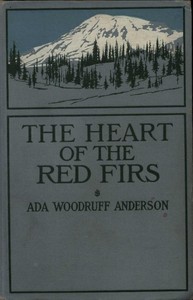
The Heart of the Red Firs: A Story of the Pacific Northwest
Language: en505 downloads on Project Gutenberg
Subjects
Public-domain ebook sourced from Project Gutenberg #48644.
Public-domain ebook
Language: en505 downloads on Project Gutenberg
Subjects
Public-domain ebook sourced from Project Gutenberg #48644.
The opening · free to read
The children were putting away their books. The afternoon sun, streaming through the uncurtained windows, made patches of heat on the hewn cedar flooring, and the new, unpainted desks sent forth pitch and the fragrance of fir. Suddenly a shadow crossed one of these squares of light, and Lem Myers, who was seated nearest the raised sash, whispered an audible warning: "Mose, your dad's comin'."
The boy sprang to his feet and stood facing the open door. The intruder entered without ceremony. He had the lank black hair and mustache, eyes flashing under shaggy brows, of the Canadian-French, and the powerful shoulders and sinewy frame of a voyageur of the Hudson Bay Company. Two hounds which followed him, stopped with their forepaws on the threshold and reconnoitered the room suspiciously.
He strode directly up the aisle to the waiting boy, and laying a hand roughly on his neck, said, with growing heat, "Din' I tell you doan' tek dat gun? Oui, two, t'ree tam I ees say let eet 'lone."
Mose rocked under the grasp but he bore it with the silent fortitude inherited from an Indian mother; the white in him only found expression in the dull glow of his cheek, the tense arms and the hands clenched at his sides.
"Din' I say A'm goin' t'rash you? Nawitka, for sure. T'ief! Cultus Siwash!" And with a climax of invective, hurled forth in a mixture of French, English and Indian, the man raised his hand and struck a hard blow.
Before he could repeat it the teacher stepped between them. She had a bright, speaking face, eyes that laughed or stormed on occasion, a mouth mobile, alluring, with charm of lurking merriment, and a chin delicately square, that lifted when she spoke, with an indescribable air of decision.
"How do you do, Mr. Laramie," she said, and offered her hand, while, at the same time, with the other palm she impelled Mose back into his seat. "You are just in time to hear us sing."
He had ignored the hand, but she quickly placed her chair for him, smiling, and commenced in a clear, full mezzo:
"We now are youthful sailors, we are not far from shore, But soon we mean to journey the ocean o'er and o'er."
She lifted her music book from her desk and found the place for him, but he refused it with a shake of his head, and taking the seat with manifest reluctance, pulled his old squirrel-skin cap over his brows, scowling first at her, then more darkly at Mose, and finally in general at the school.
The children swelled the chorus lustily. And the Canadian liked music. It was his vulnerable point. He began to beat time to this brisk measure with his clumsy boot; cautiously at first, then with great vigor, while his voice broke into a hoarse hum.
The song was hardly finished when she tapped the bell for dismissal.
"It ees gre't museek," said Laramie, rising. "Oui, a gre't song." His glance moved, challenging possible contradiction, and rested on Mose's seat. It was vacant. "Dem it," he cried with returning wrath.
But the teacher went swiftly down the aisle before him. "Here is your gun," she said, and dragged it from behind the door. Her voice trembled a little; entreaty rose through the courage in her eyes.
He took the rifle, turning it in his brawny hands to give it a close scrutiny. When, with a final click of the hammer, he raised his glance, the entreaty was gone; she stood with her arms folded, chin high, watching him. It was as though she measured him.
His mouth worked in an unaccustomed smile. "Say, Mees," he said, "what ees dis you tole dose chillun 'bout de eart' ees roun? You mek fun for dem, yaas?"
There was a silent moment while the amazement came and went in her face; a touch of merriment dimpled her mouth. Then, "It is quite true," she answered, gravely, "the earth is round."
"Roun'? Sacre, Mees, but we mus' fall off."
She shook her head. "Come, I will show you." And she led the way back to her desk, and taking a small globe in her hands, went through the usual explanation slowly, simply, with infinite patience, as she would have told a little child. But Laramie had convictions of his own. He had seen the great Pacific, oh, yes, often, when he had journeyed for the fur company to Nootka; and he had watched ships approach from the far horizon, but to see the masts first proved nothing; a vessel was most all sail. And it was true that once he had met a sailor who said he had taken a ship at Quebec and sailed straight on and on, and without turning back had found himself again at home. But plainly the man had lied, for how could one make la bon voyage up the Fraser, through the big lakes and down the St. Lawrence in a great vessel? Bah, every one knew it could only be done in a canoe. "De eart' roun'?" he concluded. "No, no, Mees, you doan' mek me beli've dat. But it ees gre't joke; oui, a gre't joke, ha, ha. Well, good-by, Mees. Tek care yourse'f."
He shouldered the gun and strode away through the door. At the same time there was the snapping of a twig and a glimpse of retreating bare heels at the corner of the house, and while the Canadian moved down the river trail a pair of keen eyes, set in a ferret-shaped face, peered at him from behind the angle. They were the eyes of Lem Myers. When he had satisfied himself that Laramie was truly on his way he came cautiously to the threshold. The teacher was seated at her desk using her pencil with rapid, decisive strokes. He crossed the floor to the platform before she was conscious of his presence.
"Well, Lem," and she smiled down at him, "are you waiting for me?"
"Wal, yes; thort I'd wait an' see it out." He slipped up behind her chair to look over her shoulder, bending his head as she moved her hand, the better to follow her work. "Oh, gee," he exclaimed suddenly, slapping his knees, "gee. You're a-settin' here a-makin' er picture of him, an' I 'lowed all ther time you was scared."
"Scared?" She suspended her pencil to look at him.
"Yes, Mose was gone an' ther wan't nobody else ter hit."
"Hit? Do you mean he might have struck me?" She rose to her feet, facing the boy. "Do you-- Do men in this settlement ever strike the women?"
He gave her a sidelong glance and thrust his hands deep into his trousers pockets. "You bet," he answered.
There was a brief silence, then she said, and the vibration had not gone from her voice, "No, Lem, I was not afraid, but I might have been if I had known. Where I have lived men never strike women; they have other ways. I was just thinking of Mose. I wanted to ask Mr. Laramie not to be hard with him."
"Oh, don't you bother 'bout Mose. He kin take care hisself. He's got more muscle now'n any other boy in ther hull deestrict, an' it won't be long 'fore he kin turn in an' thrash ther ole man."
There was another silence; the merriment again dimpled her mouth and she looked off through the open door. Lem stooped and picked up a loose sheet that had fluttered from the sketchbook to the floor. "Gee," he said, "gee, but you kin draw."
"Yes?" Her glance returned and rested on the sheet interestedly. "What is it, Lem?"
"Why, it's er picture of ther timber-cruiser an' that ther black horse o' his. Here's ther same nice little star atween ther eyes, an' I've seen him fling up his head an' point one ear jes that erway."
"So you know Colonel," she said, flushing, yet pleased at the recognition. "Mr. Forrest bought him when he was a colt. He broke him, and I am the only woman who ever mounted him."
"I 'low then you kin ride some. Ther ain't never be'n no sech stepper in this hull deestrict. Mill Thornton calc'lated he hed er prize when he raised ther sorrel filly, but gee, I've seen ther black leave her clear out o' sight in less'n er minute."
The teacher laughed softly. "I know, I know, the beauty. And his master, Lem. Did you ever see such a man in the saddle? So straight, so easy, so ready at just the right instant with a quiet word, or else that soft whistle."
"He kin ride," admitted Lem. "I've never seen him fizzle, an' he's be'n out here off an' on considerable; timber-cruisin' first an' then prospectin'. He 'lowed last year he'd struck er gold mine or somethin'."
"I know," she repeated, "I know. It was only a few miles from here he found those splendid indications."
"Yes," said the boy with his impish smile, "an' lost 'em."
"The mineral is there," she said with an upward tilt of her chin. "The ore he brought down assayed remarkably rich. But he had broken his compass that day and a heavy mist settled over every peak and spur. There was absolutely nothing to mark a course from. Still, it's there, Lem, locked in the heart of the hills. He will find it again, sometime."
She went over and took her hat from its peg on the wall, and Lem followed, waiting on the steps while she locked the door.
"There will be no more timber-cruising when he takes his position at the new mills," she said as they started up the trail; "no more chances to prospect. But he is coming out to the settlement before he goes to Seattle, for a last trip into the hills, and, if your mother can go with us, he intends to take me, to see the Cascades at close range, and the canyon and the leaning tower, and spend a night or two in his favorite camp at the headwaters."
The book keeps going
Reading is free forever. Sign up and watch scenes appear while you read.



Scenes Storieta drew for other classics.
New illustrated classics
Once or twice a month: the latest books to get full character casts, scene art, and free comic editions. No account needed.