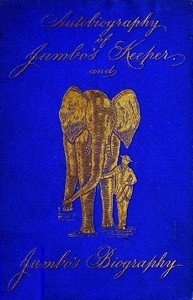
I have travelled through the United States, North, East, South, and West, and have received in my travels the greatest kindness. If “Jumbo” could but speak, I know he would endorse what I say here. I have had the same experience in Great Britain, and the spirit of gratitude impels me to acknowledge my appreciation of the good will of the people of both countries, by dedicating my humble efforts to them, hoping that this attempt may be received with the same kindness that has been always extended to me in person.
Respectfully, MATTHEW SCOTT. BRIDGEPORT, CONN., January 14, 1885.
MY AUTOBIOGRAPHY.
CHAPTER I. MY BIRTH-PLACE AND START IN LIFE.
I purpose giving to the world, for the benefit of my fellow-men, my humble and truthful history. I have many times thought I would do so, not for my own glory, but for the enlightenment of such people as are anxious to obtain knowledge. It is only to-day, January 14, 1885, that I have concluded to set about writing it, and I purpose to give a faithful record of my life, setting forth the various experiences through which I have passed.
I was born at Knowsley, Lancashire, England, in 1834. It was the seat of Lord Derby, the grandfather of the present earl; and from a child I learned to love that family.
The Earls of Derby were, and are, among the greatest statesmen of England.
My start in life was very humble, and I have even now, in my fifty-first year, very little to boast of with regard to this world’s goods. I have lived with Jumbo day and night for twenty years of my life. I am what is called a “self-made man,” and can boast that the knowledge and experience I possess, I have learned while living with wild beasts, latterly in the company of my friend and companion “Jumbo,” the greatest known animal on earth. I suppose my companion and I have seen more human faces than most people, and I have spoken to as many people as almost any other man. My life has been, perhaps, as peculiar and checkered as that of any man of my time of life; yet I claim nothing but to show to the people of the United States and Great Britain, to whom this book is dedicated, what an humble son of toil has passed through in the precarious, though to me, pleasant, occupation of keeper, breeder, and lover of the beasts and birds of the forests and fields of all countries and climes.
CHAPTER II. MY FIRST EXPERIENCE AS A KEEPER.
I have already remarked in the previous chapter that I was born at Knowsley, near Liverpool, England, on the estate of Lord Derby. My father was born at the same place, and was “brewer” to the earl.
My dear, good, and much-loved mother was born on the same estate.
Our family consisted of sixteen sons and one daughter—a goodly number—and I am the fifteenth son (though “better late than never”).
I lost my dear father when I was four years old—he lived to the age of three score years and ten.
My mother lived to survive him several years.
When I was sent to London in 1851, I left the dear old soul hearty and in good spirits, proud of her boy’s going up to the biggest city in the world. I verily believe the good woman thought her fifteenth son was going to turn out something unusual. Although she used to say that I was “a rough, naughty lad, full of devilment,” she also said, in her quaint way, “if you take that lad and strip him naked, and put him on top of a mountain anywhere on the globe, he can get his own living; for, if there’s nobody round the neighborhood of the mountain, he will have the birds and animals feed him, like old Elijah and the raven in the wilderness, or, like John the Baptist, he will live on locusts and honey, and clothe himself with the skins of animals.”
Oh! my dear young readers, such a mother is worth more to you than all the world. You just listen to your mother, and mark every word she says when she advises and directs you, and you cannot fail to get along in life.
I returned from London to Knowsley to visit the dear soul once before she died.
However, to continue my story, I grew up at Knowsley, and at ten years of age was engaged to feed the feathered tribes at the private menagerie of the earl, who was a great lover of birds and beasts, and who spent much time and money in their importation and breeding in Great Britain. I had a great love (I suppose it was inherent) for birds, and I also was proud to earn a few shillings a week for my dear old mother. So I turned in under the guidance of my brother, who had charge of the aviary, and was put to work at cleaning, feeding, breeding, and generally attending to the parrots—that talkative tropical bird, whose tongue imitates so well the speech of man and woman.
It was, perhaps, the happiest week’s work I ever put in, and I assure my readers it was a delightful occupation.
CHAPTER III. MY EXPERIENCE WITH BIRDS AT KNOWSLEY.
“Feed and tend birds,” say you, “a delightful occupation? Oh! I like birds well enough; but then I want the servants, my sister, or mother, to feed and clean after them. I like to see them, and listen to their singing; but I don’t care about the bother of attending to their wants.” Oh, my dear readers, there’s where you miss it. You cannot have the affection of any of the feathered tribe, nor really love the little pets, unless you sacrifice something for them. You must learn how to clean for them, what their various wants are, and you must also study their character to learn their little ways, before you can appreciate them, or they will appreciate you.
To illustrate: When I was crossing the Atlantic with “Jumbo,” I had considerable leisure, and loved to be on the quarter-deck to watch the movements of the “sea gulls,” the birds of the sea that followed and hovered around the stern of the ship all day long. I soon made their acquaintance after leaving Queenstown’s beautiful bay.
I made a practice of filling my pockets with bread at meal times, and when it was a little more stormy than usual, and no persons were on deck, except the officers on duty, I would have all the birds to myself. They would soar around the after part of the steamship, as majestically as eagles soar in the heavens, and with the eyes of hawks, and the swiftness of falcons, sweep over the turbulent green and white waters which the screw of the ship threw madly up as she ploughed the mighty deep.
Sometimes, as the steamer pitched forward, the screw propeller would come to the surface of the waters, and I tell you, my dear readers, that it required some real nerve to sit on the side of the ship with legs dangling over the side, holding on by my left arm to the rigging, and feeding the birds with the right hand, in a rather rough sea. Yet that was, I found, about as good a place to sit as any other, and somewhat better to view the graceful actions of these birds of the briny deep, as the pretty creatures battled with the wind over the mighty waters, which man has not been fully able to master.
There is only one Master of these elements.
When I was a boy in a Sunday-school, we used to sing the following simple hymn, which a thousand times recurs to my mind. I think it apropos to introduce it here, it tells how the waters were mastered only once, and then by the “Great Master.”
“A little ship was on the sea, It was a pretty sight, It sailed along so pleasantly, And all was calm and bright. When lo! a storm began to rise; The wind blew loud and strong, It blew the waves across the sky, It blew the waves along, And all but One were sore afraid Of sinking in the deep. His head was on a pillow laid, And he was fast asleep. ‘Master, we perish; master, save!’ He rose; rebuked the wind and wave, And stilled them with a word. And well we know it was the Lord, Our Saviour and our Friend, Whose care of those who love his word Will never, never end.”
CHAPTER IV. MY LIFE AT LORD DERBY’S SEAT, KNOWSLEY, ENGLAND.
But to continue the story of my experiences on the voyage. As I sat in the position heretofore described, I fed these seagulls, and the pleasure and delight that filled my soul as the hundreds of birds swooped down from their heights to the surface of the troubled waters was very great. They picked up every crumb, and that without confusion. There was no scrambling for the food, such as was indulged in by the poor two-legged creatures down in the steerage, when the steward pitched his tin of fish or flesh on the floor of the cabin. The bird that first reached a crumb of bread took it up, and the others soared away to take another chance, which I soon gave them. I learned much from these birds in their native element, to be added to my stock of knowledge gathered from them in their imprisoned state in the Gardens at Knowsley, and at the Zoölogical Gardens, London.
Now, if I had not sacrificed a little comfort, and taken the trouble to feed them, they would not have had the confidence in me which to my mind they plainly exhibited. Nor would I have learned their ways. I could tell the reader a great deal more of the habits of these birds, but lack of space prevents me doing so.
The real lover of the feathered tribes always feeds and nurses them. It is a fact that you cannot love, or have the affection of any bird or other animal, without attending to its wants, to some extent.
I was about five years in charge of the parrots at Knowsley, and was very fond of them. In fact, to be candid, I was loth to leave them; but as I had grown into a sharp, active stripling of a lad, as nimble and as athletic as a young panther, I was told to go up higher, and was appointed keeper to those most beautiful and graceful of all animals, the deers and antelopes, as well as some other larger natives of the forest.
I passed several years in this position, growing up into manhood, at times contending actively with the wilder and more unmanageable animals. I have read in the good old Bible of young David having killed the lion, when he was keeping his father’s sheep on the plains of Palestine.
My experience teaches me that the statement of David is true, and I can understand how, without any use of miraculous power, the stripling could and did slay the lion. I know how it is done, and can do it if necessary, and could have done it when I was a stripling of seventeen years of age. But I would rather heal a sore, take a thorn out of a foot, nurse an animal through inflammation of the bowels, with its disagreeable attending consequences, than I would slay any brute.
But, perhaps, my readers may think this a weakness. However, I respectfully but firmly disagree with you, and take the negative side.
Why, I have nursed “Jumbo,” the largest, most intelligent, and certainly the most powerful living animal in creation. He weighs nearly eight tons; he stands to-day nearly twelve feet high in his “bare feet.” He can swing by his step, at “walking gait,” the largest suspension bridge that man has ever built. He is now at his majority, and ready for all the duties of manhood. He was given to me a baby, and I have been more than a father to him, for I have performed the duties and bestowed the affections of a mother as far as my humble ability would permit. I am proud of my boy, “Jumbo.” All the experience shared with him is a pleasure to me, and is a great reward, which I am thankful for in these my older days. I feel them creeping on, but so long as I am permitted the company of dear old Jumbo, I shall be quite contented.