Public-domain ebook
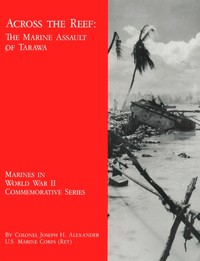
Across the Reef: The Marine Assault of Tarawa
Language: en1,168 downloads on Project Gutenberg
Subjects
In: World War II·History - American·History - Modern (1750+)
Public-domain ebook sourced from Project Gutenberg #48836.
Public-domain ebook
Language: en1,168 downloads on Project Gutenberg
Subjects
In: World War II·History - American·History - Modern (1750+)
Public-domain ebook sourced from Project Gutenberg #48836.
Across the Reef: The Marine Assault of Tarawa is a detailed military history that concentrates on the planning and execution of the 1943 amphibious operation against Betio Island in the Gilbert Islands. The narrative opens in August of that year, when Vice Admiral Raymond A. Spruance and Major General Julian C. Smith meet in New Zealand to plot the assault, and it quickly moves into the intricate debates over landing craft, the barrier reef, and the formidable Japanese defenses. By tracing the chain of command, from Spruance and Admiral Turner to Colonel David M. Shoup and Lieutenant Colonel Evans F. Carlson, the book lays out the strategic pressures, logistical constraints, and tactical innovations that made Tarawa a watershed battle for the United States Marine Corps.
The work is written in a straightforward, documentary style typical of mid‑20th‑century official histories, relying heavily on operational reports, personal papers, and contemporary newspaper accounts. Its voice is that of an informed chronicler who balances technical description with vivid detail, making the text accessible to readers who appreciate rigorous military analysis without requiring prior knowledge of the Pacific war. Students of World War II, naval historians, and anyone fascinated by the evolution of amphibious doctrine will find the book both informative and engaging.
The opening · free to read
In August 1943, to meet in secret with Major General Julian C. Smith and his principal staff officers of the 2d Marine Division, Vice Admiral Raymond A. Spruance, commanding the Central Pacific Force, flew to New Zealand from Pearl Harbor. Spruance told the Marines to prepare for an amphibious assault against Japanese positions in the Gilbert Islands in November.
The Marines knew about the Gilberts. The 2d Raider Battalion under Lieutenant Colonel Evans F. Carlson had attacked Makin Atoll a year earlier. Subsequent intelligence reports warned that the Japanese had fortified Betio Island in Tarawa Atoll, where elite forces guarded a new bomber strip. Spruance said Betio would be the prime target for the 2d Marine Division.
General Smith’s operations officer, Lieutenant Colonel David M. Shoup, studied the primitive chart of Betio and saw that the tiny island was surrounded by a barrier reef. Shoup asked Spruance if any of the Navy’s experimental, shallow-draft, plastic boats could be provided. “Not available,” replied the admiral, “expect only the usual wooden landing craft.” Shoup frowned. General Smith could sense that Shoup’s gifted mind was already formulating a plan.
The results of that plan were momentous. The Tarawa operation became a tactical watershed: the first, large-scale test of American amphibious doctrine against a strongly fortified beachhead. The Marine assault on Betio was particularly bloody. Ten days after the assault, Time magazine published the first of many post-battle analyses:
Last week some 2,000 or 3,000 United States Marines, most of them now dead or wounded, gave the nation a name to stand beside those of Concord Bridge, the Bon Homme Richard, the Alamo, Little Big Horn and Belleau Wood. The name was “Tarawa.”
The Gilbert Islands consist of 16 scattered atolls lying along the equator in the Central Pacific. Tarawa Atoll is 2,085 miles southwest of Pearl Harbor and 540 miles southeast of Kwajalein in the Marshalls. Betio is the principal island in the atoll.
The Japanese seized Tarawa and Makin from the British within the first three days after Pearl Harbor. Carlson’s brief raid in August 1942 caused the Japanese to realize their vulnerability in the Gilberts. Shortly after the raid, the 6th Yokosuka Special Naval Landing Force arrived in the islands. With them came Rear Admiral Tomanari Saichiro, a superb engineer, who directed the construction of sophisticated defensive positions on Betio. Saichiro’s primary goal was to make Betio so formidable that an American assault would be stalled at the water’s edge, allowing time for the other elements of the Yogaki (“Waylaying Attack”) Plan to destroy the landing force.
The Yogaki Plan was the Japanese strategy to defend eastern Micronesia from an Allied invasion. Japanese commanders agreed to counterattack with bombers, submarines, and the main battle fleet. Admiral Chester W. Nimitz, Commander-in-Chief, Pacific Fleet/Commander in Chief, Pacific Ocean Areas (CinCPac/CinCPOA), took these capabilities seriously. Nimitz directed Spruance to “get the hell in and get the hell out!” Spruance in turn warned his subordinates to seize the target islands in the Gilberts “with lightning speed.” This sense of urgency had a major influence on the Tarawa campaign.
The Joint Chiefs of Staff assigned the code name Galvanic to the campaign to capture Tarawa, Makin, and Apamama in the Gilberts. The 2d Marine Division was assigned Tarawa and Apamama (a company-sized operation); the Army’s 165th Regimental Combat Team of the 27th Infantry Division would tackle Makin.
By coincidence, each of the three landing force commanders in Operation Galvanic was a major general named Smith. The senior of these was a Marine, Holland M. “Howling Mad” Smith, commanding V Amphibious Corps. Julian C. Smith commanded the 2d Marine Division. Army Major General Ralph C. Smith commanded the 27th Infantry Division.
Spruance assigned Rear Admiral Richmond Kelly “Terrible” Turner, veteran of the Guadalcanal campaign, to command all amphibious forces for the operation. Turner, accompanied by Holland Smith, decided to command the northern group, Task Force 52, for the assault on Makin. Turner assigned Rear Admiral Harry W. “Handsome Harry” Hill to command the southern group, Task Force 53, for the assault on Tarawa. Julian Smith would accompany Hill on board the old battleship USS Maryland (BB 46). The two officers were opposites--Hill, outspoken and impetuous; Julian Smith, reserved and reflective--but they worked together well. Spruance set D-Day for 20 November 1943.
Marine Corps Personal Papers, Boardman Collection
Japanese Special Naval Landing Force _troops mount a British-made, Vickers eight-inch naval cannon into its turret on Betio before the battle. This film was developed from a Japanese camera found in the ruins while the battle was still on._]
Colonel Shoup came up with an idea of how to tackle Betio’s barrier reefs. He had observed the Marines’ new Landing Vehicle Tracked (LVT or “Alligator”), an amphibian tractor, in operation during Guadalcanal. The Alligators were unarmored logistic vehicles, not assault craft, but they were true amphibians, capable of being launched at sea and swimming ashore through moderate surf.
Shoup discussed the potential use of LVTs as assault craft with Major Henry C. Drewes, commanding the 2d Amphibian Tractor Battalion. Drewes liked the idea, but warned Shoup that many of his vehicles were in poor condition after the Guadalcanal campaign. At best, Drewes could provide a maximum of 75 vehicles, not nearly enough to carry the entire assault and following waves. Further, the thin hulls of the vehicles were vulnerable to every enemy weapon and would require some form of jury-rigged armor plating for minimal protection. Shoup encouraged Drewes to modify the vehicles with whatever armor plate he could scrounge.
General Julian Smith was aware that a number of LVT-2s were stockpiled in San Diego, and he submitted an urgent request for 100 of the newer models to the corps commander. Holland Smith endorsed the request favorably, but Admiral Turner disagreed. The two strong-willed officers were doctrinally equal during the planning phase, and the argument was intense. While Turner did not dispute the Marines’ need for a reef-crossing capability, he objected to the fact that the new vehicles would have to be carried to Tarawa in tank landing ships (LSTs). The slow speed of the LSTs (8.5 knots max) would require a separate convoy, additional escorts, and an increased risk of losing the element of strategic surprise. Holland Smith reduced the debate to bare essentials: “No LVTs, no operation.” Turner acquiesced, but it was not a complete victory for the Marines. Half of the 100 new LVT-2s would go to the Army forces landing at Makin against much lighter opposition. The 50 Marine vehicles would not arrive in time for either work-up training or the rehearsal landings. The first time the infantry would lay eyes on the LVT-2s would be in the pre-dawn hours of D-Day at Tarawa--if then.
As replacement troops began to pour into New Zealand, General Smith requested the assignment of Colonel Merritt A. “Red Mike” Edson as division chief of staff. The fiery Edson, already a legend in the Corps for his heroic exploits in Central America and Guadalcanal, worked tirelessly to forge the amalgam of veterans and newcomers into an effective amphibious team.
Intelligence reports from Betio were sobering. The island, devoid of natural defilade positions and narrow enough to limit maneuver room, favored the defenders. Betio was less than three miles long, no broader than 800 yards at its widest point and contained no natural elevation higher than 10 feet above sea level. “Every place on the island can be covered by direct rifle and machine gun fire,” observed Edson.
The elaborate defenses prepared by Admiral Saichiro were impressive. Concrete and steel tetrahedrons, minefields, and long strings of double-apron barbed wire protected beach approaches. The Japanese also built a barrier wall of logs and coral around much of the island. Tank traps protected heavily fortified command bunkers and firing positions inland from the beach. And everywhere there were pillboxes, nearly 500 of them, most fully covered by logs, steel plates and sand.
The Japanese on Betio were equipped with eight-inch, turret-mounted naval rifles (the so-called “Singapore Guns”), as well as a large number of heavy-caliber coast defense, antiaircraft, antiboat, and field artillery guns and howitzers. Dual-purpose 13mm heavy machine guns were prevalent. Light tanks (mounting 37mm guns), 50mm “knee mortars,” and an abundance of 7.7mm light machine guns complemented the defensive weaponry.
The Japanese during August replaced Saichiro with Rear Admiral Meichi Shibasaki, an officer reputed to be more of a fighter than an engineer. American intelligence sources estimated the total strength of the Betio garrison to be 4,800 men, of whom some 2,600 were considered first-rate naval troops. “Imperial Japanese Marines,” Edson told the war correspondents, “the best Tojo’s got.” Edson’s 1st Raider Battalion had sustained 88 casualties in wresting Tulagi from the 3d Kure Special Naval Landing Force the previous August.
Admiral Shibasaki boasted to his troops, “a million Americans couldn’t take Tarawa in 100 years.” His optimism was forgivable. The island was the most heavily defended atoll that ever would be invaded by Allied forces in the Pacific.
Task Force 53 sorely needed detailed tidal information for Tarawa. Colonel Shoup was confident that the LVTs could negotiate the reef at any tide, but he worried about the remainder of the assault troops, tanks, artillery, and reserve forces that would have to come ashore in Higgins boats (LCVPs). The critical water depth over the reef was four feet, enough to float a laden LCVP. Anything less and the troops would have to wade ashore several hundred yards against that panoply of Japanese weapons.
Major Frank Holland, a New Zealand reserve officer with 15 years’ experience sailing the waters of Tarawa, flatly predicted, “there won’t be three feet of water on the reef!” Shoup took Holland’s warnings seriously and made sure the troops knew in advance that “there was a 50-50 chance of having to wade ashore.”
In the face of the daunting Japanese defenses and the physical constraints of the island, Shoup proposed a landing plan which included a sustained preliminary bombardment, advance seizure of neighboring Bairiki Island as an artillery fire base, and a decoy landing. General Smith took this proposal to the planning conference in Pearl Harbor with the principal officers involved in Operation Galvanic: Admirals Nimitz, Spruance, Turner, and Hill, and Major General Holland Smith.
The Marines were stunned to hear the restrictions imposed on their assault by CinCPac. Nimitz declared that the requirement for strategic surprise limited preliminary bombardment of Betio to about three hours on the morning of D-Day. The imperative to concentrate naval forces to defend against a Japanese fleet sortie also ruled out advance seizure of Bairiki and any decoy landings. Then Holland Smith announced his own bombshell: the 6th Marines would be withheld as corps reserve.
The book keeps going
Reading is free forever. Sign up and watch scenes appear while you read.



Scenes Storieta drew for other classics.
New illustrated classics
Once or twice a month: the latest books to get full character casts, scene art, and free comic editions. No account needed.