Public-domain ebook
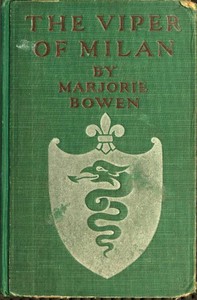
The Viper of Milan: A Romance of Lombardy
Language: en6,114 downloads on Project Gutenberg
Subjects
Public-domain ebook sourced from Project Gutenberg #48963.
Public-domain ebook
Language: en6,114 downloads on Project Gutenberg
Subjects
Public-domain ebook sourced from Project Gutenberg #48963.
The Viper of Milan is a historical adventure set in Lombardy during the early Renaissance, when the Visconti dynasty was consolidating power over northern Italy. The novel opens on a sun‑lit summer road of 1360, describing the contrast between the blooming countryside, the glittering walls of Milan, and the ragged peasants trudging toward the city. A striking banner bearing the green viper of Gian Galeazzo Maria Visconti appears, heralding the arrival of a lavish coach and a lone, handsome rider whose presence alone freezes the crowd. Through this vivid tableau the author plunges the reader directly into a world of looming tyranny, fierce loyalties, and the raw tension between opulent courts and oppressed villagers, promising a narrative driven by dialogue and action rather than exhaustive period detail.
Bowen’s prose reflects the late‑Victorian romance tradition, with a lyrical yet brisk style that favors dramatic scenes over elaborate description. The language is rich in visual detail but never lingers, keeping the emotional tempo high. Readers who enjoy fast‑moving historical fiction, especially stories that foreground political intrigue, personal ambition, and the stark divide between aristocracy and common folk, will find this work compelling. Its focus on the Visconti’s ruthless expansion and the vivid portrayal of 14th‑century Lombardy will appeal to fans of classic adventure tales and to those who appreciate a narrative that treats history as a stage for human drama.
The opening · free to read
It is significant that at this precise moment when the historical novel shows so much apparent exhaustion, that there should appear such an example as The Viper of Milan, which, while actually the latest of its class, might almost be the first, so free is it from any trace of fatigue or affectation. Here is a novel in which the author writes of the past with as much sans-gêne as though she were writing of the present. She moves there so perfectly at home in the mind of her period that she does not need to note all those minor details which are its outer manifestation. She makes no attempt at an elaborate reconstruction of an epoch, but surrenders herself rather to that plastic spirit of an age which molds the souls of its men and women and makes them the channel of characteristic expression in thought, feeling and action. Actually, we know of no novel that gives a more concrete, vivid and brilliant impression of the Italy of the early Renaissance; but as a matter of fact there is a total absence of that set description which forms the staple of the ordinary historical novel. The method of the author is strictly dramatic and narrative, her story is given as exclusively as possible through dialogue and action. What description there is is wholly incidental, and there is never any slacking of the emotional tension, any interruption of the swift course of events for the sake of mere word-painting which, however gorgeous, is bound to be obtrusive.
In all this, of course, Miss Bowen receives some assistance, some inspiration, as it were, from that particular phase of the past with which she deals. It would be difficult for anyone to write of Italy as it emerges from the Middle Ages without catching something in the narrative itself of that swift play of passion and impulse, of that tense, highly-wrought tendency to dramatic climax, which starts into life from the pages of the barest records of the period. And what a period it was! At the moment which Miss Bowen has chosen, Visconti, that sinister embodiment of the Lombard blend of Gothic vigor and Latin cruelty, holds the stage in Northern Italy. He has just vanquished Verona, seized Isotta d'Este and driven her husband, Della Scala, into exile. From that point we are shown in a series of swift scenes the coalition of the d'Estes under Della Scala against Visconti, the rapid triumph of this reaction up to a certain point, and then its equally rapid wasting under the assaults less of Milanese prowess than of Milanese treachery. The final isolation of Della Scala from his allies, and the supreme test to which his fidelity is subjected by the almost diabolic genius of Visconti, make one of the most superb climaxes with which we are familiar in romantic drama or in historical fiction.
Nor does the author seem to fall short of the opportunity offered her for the vivid and moving portrayal of the great passions involved in so high an action. For many it will constitute the prime marvel of an extraordinary book that its author, a young girl of fifteen or sixteen, who knew nothing of Italy, or of the Italian character, save, through books, could have conceived and written it. But if we grant the extraordinary precocity of talent implied in the mere writing of such a book as The Viper of Milan, it is, perhaps, less remarkable than it at first appears that Miss Bowen should have been so successful in grasping the purely Italian side of her subject, in rendering the Italian psychology. For is not youth the Italian age of life? Is there not something in the ardent dreams and in the swift, uncontrollable impulses of young natures, that finds itself in the spirit of that race which though the eldest is still the youngest race of Europe? The Italian soul, complex as it may appear upon the surface, is in essence simple. It is the soul of desire, of desire for the dream realized. Such is the desire even of a Visconti, and the soul of such a man makes him as simple to seize upon as the ogre of a fairy tale.
A fairy tale!--historical novels are all fairy tales, or approximate to fairy tales, for the same reason, perhaps, that all the fairies, Puck, Oberon and the rest of them, were once people in history. Under all the complexity and confusion of man's mental life there lies the invincible demand for the simple and the absolute in his view of the past as of the universe. The scholar and the scientific historian seek to build up stone by stone, from the dust-heap of the ages, the intricate web of the past; but the historical novelist, closer to the imagination of the race, seeks rather to reproduce the past in its broad outlines, in its ideal aspects of sharply defined and sharply opposing forces.
We hear much to-day of the death of the historical novel as a form of art. And this is because at its best to-day it has seemed a clever reconstruction of the past, a pastiche, as the French call it, a work of erudition, rather than an appropriation of the past for the purpose of effecting a romantic release from the uncompromising and prosaic conditions of the present. It is no wonder that the old romantic form of Scott and Dumas, being reduced to so lifeless a formula, should occasionally appear moribund. But it should be remembered that what proceeds from the mind, and is part of it, can always be renewed from the mind, and that forms in art are constantly being revitalized by some fresh creative impulse. And so often as there shall appear a writer like Miss Bowen capable of properly appraising the past, not as a shop stuffed with strange articles of attire and antiquities, but as a splendid stage set for the performance of a moving human drama, just so often will the historical novel renew its attraction over the minds of all men in new creations.
The book keeps going
Reading is free forever. Sign up and watch scenes appear while you read.



Scenes Storieta drew for other classics.
New illustrated classics
Once or twice a month: the latest books to get full character casts, scene art, and free comic editions. No account needed.