Public-domain ebook
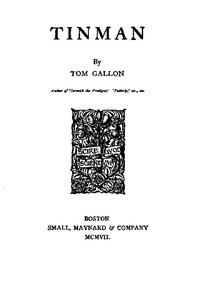
Tinman
by Tom Gallon
Language: en257 downloads on Project Gutenberg
Subjects
Public-domain ebook sourced from Project Gutenberg #48989.
Public-domain ebook
by Tom Gallon
Language: en257 downloads on Project Gutenberg
Subjects
Public-domain ebook sourced from Project Gutenberg #48989.
The opening · free to read
I had made up my mind to be an artist; to that direction all my thoughts and dreams and ideas tended. I would paint great pictures; I would wander through the cities of the world, and see the pictures other men had painted; I would live a life that had in it nothing of commercialism, and nothing of the sordid. I did not know then how circumstances mould a life and change it; how rough-fingered Fate can step in, and tear asunder in a moment the fair threads we have woven, and twist and tangle them, and ruin the fabric. Like many another poor fool before me, I told myself that I could do what I liked with my life, and shape it in what fashion I would.
Up to this time--that is, the time when I began to think for myself, and to take my life into my own hands--I had not met my guardian. I had had one or two curt and business-like notes from him during my schooldays; and when I went to London I found that he had taken a lodging for me, and had made various arrangements for my future. He was a little contemptuous as to the profession I had adopted; but shrugged his shoulders, and suggested that it was no real concern of his. I met him first, on my coming to London, at his office in the City--an office in a narrow dingy court, where he was in a position of some authority as manager to a big firm. I know nothing of business, and knew nothing then; I only know that he received me in a private room, and that I had a dim understanding that in another room still more private was one greater than himself, to whom he looked for instructions, just as all those below him looked to him. Jervis Fanshawe, with half a dozen little white stops let into the edge of the big desk at which he sat, to enable him to communicate with his subordinates, was evidently a power to be reckoned with.
I think, in that moment when I first saw the man, that I knew instinctively I did not like him. He was leaning forward across the great desk, with his arms stretched out upon it, and with a paper-knife balanced between his hands lengthwise; he seemed to be summing me up, and making up his mind about me. He was a man of about thirty-five, inclined to baldness, and with a long clean-shaven face; he gave one the impression that if he had allowed his beard to grow, it would have been singularly black. His nose was long and thin, with rather wide nostrils; and there was a deep cut in the very centre of his chin. Altogether it was a strong face, and a sinister.
I was beginning to feel uncomfortable when at last he dropped the paper-knife, and stood up to shake hands with me. "So you are Charles Avaline?" he said. "I'm glad to see you. How old are you? I forget times and dates."
"I shall be twenty in a month," I replied, "but I feel much older."
"Most people do at your age," he retorted. "Well--there are certain arrangements to be made about your future--your income, and so on"--he was looking down at the desk, and shifting some papers about uneasily there--"and perhaps it would be better if you came round to my rooms to-night to see me. I've got an old-fashioned place in Bloomsbury; perhaps you'll dine with me there. I'll write the address down for you; seven sharp, please."
I felt myself dismissed, and went away, to make acquaintance with that London that I felt was to be my home for some considerable time to come. Boy that I was, I wandered its streets happily enough for the greater part of the day, feeling that this was my kingdom, and that I had come into full possession of it already. Here I was to work, and live, and dream, and be happy. I have thought since of that day--dreamed those dreams again--and laughed to think that it was really to be the one day in all my life that I was to see London with those eyes at all.
It was a fine night, and I walked to Bloomsbury; having some difficulty in finding it, because my pride forbade that I should appear a country bumpkin, unacquainted with London, and under the necessity of asking my way. Coming to the house hurriedly and a little late, I saw a man who had been going along before me mounting the steps of the house, and tugging at the bell. Having rung, he turned about, with his hands on his hips, and with a cane in one hand resting against his hip, and surveyed me, as I waited a couple of steps below him, awkwardly enough, for the door to open. He had the advantage of being bigger and older than I was, to say nothing of the two steps upon which he was mounted.
He was a big young man, some ten years older than myself; very well dressed, and with a swaggering air upon him that made me even then feel my blood tingle a little. He stared down at me, and pulled at a little dark moustache he wore; and then looked over my head. I was glad when the door was at last opened, and when he faced about, and marched in.
There was another uncomfortable pause, in a room that was apparently my guardian's sitting-room, until my guardian put in an appearance; a pause during which the big young man and myself wandered about uncomfortably, and looked at the few pictures, or stared out of the window. Then Jervis Fanshawe came in, and introduced us.
"This is a--a friend of mine--Mr. Gavin Hockley," he said, glancing at the other man a little resentfully, as I thought. "My ward--Mr. Avaline." The young man glanced at me for a moment, and nodded, and turned away. "We can go in to dinner; we're a small party--but none the worse for that, I hope."
It was not a cheerful dinner, by any means. We sat round a circular table, and were waited upon by a silent, elderly woman, who was evidently very much afraid of Mr. Fanshawe. The dinner was plain and substantial, and I was young and hungry; the wines, I believe, were good, although I was no judge of that particular department. I only know that the man Hockley drank a great deal, and told some stories I did not understand, and some that I understood only too well. He absolutely ignored me, even when I made a remark (which was but seldom), and he talked to my guardian with an easy insolent familiarity that I did not then understand. Strangely, too, my guardian seemed to defer to him in all matters, and to be afraid of contradicting even the most outrageous statement.
"I'm thinking," said Hockley, towards the close of the dinner, and pausing for a moment, with his glass held near to his lips--"I'm thinking of going down to Hammerstone Market again."
I saw that Jervis Fanshawe looked up at him quickly; when he replied, he spoke more sharply than he had yet done. "What for?" he asked.
"I'm thinking of going down--for the fishing," replied Hockley; and as I looked at him I saw that his face was creased in a grin, and that he was watching Fanshawe. "That is, of course," he added, with a guffaw, "my sort of fishing."
"You won't be welcome," said my guardian sourly; and the other man responded with an oath that he could find his welcome anywhere.
After we had left the table, I saw Jervis Fanshawe take the other man aside, and begin talking to him in a low voice, as though impressing something upon him. But Hockley shook him off, and answered whatever had been said aloud.
"I tell you I'm going--and the best thing you can do is to go with me. If it comes to that, you know what I am when I get a bit excited; I might need your restraining hand. You'd better make up your mind when you'll go, and I'll make my arrangements accordingly."
My guardian said nothing, and the other man threw himself into a large armchair, and began to smoke. It was quite late, and I had already begun to think about going, when he got up, and went off without so much as a word of farewell to either of us. Only at the door, with his hat on the back of his head, he came back to demand an answer to the question he had put at least an hour before.
"What date will suit you--next week?" he asked.
Jervis Fanshawe did not look at him; he was nervously twisting his hands together behind his back. "I shall go down on Tuesday to Hammerstone Market," he said, "and I shall stay at the house."
"Good. I shall stay at the George." Hockley lurched out of the doorway, and we heard him slam the outer door of the house as he went away.
And instantly there came a remarkable change over my guardian. In all my life I never remember to have seen a man so suddenly become a wild beast in a moment as Jervis Fanshawe did then. He ran to the door, and pulled it open, and spluttered out blasphemies into the darkness of the staircase; slammed the door, and came back into the room again, and raged up and down there, saying horrible things about Hockley until my blood seemed to run cold. And all the time taking not the faintest notice of me at all.
Presently he sat down at the table, pulling at his lips with his long fingers, and still muttering and breathing hard; it was like the gradual dying away of a storm. After a time I ventured to speak to him, and to wish him good-night; I believe I muttered some thanks for my entertainment. As he took no notice of me, I went to the door, and found my way to the place where my hat was; I was going out, when I heard his voice calling to me sharply. I went back, and found him waiting there, with a face that was comparatively calm.
"I don't know much about you artist fellows," he said, without looking at me--"but I believe you sketch--paint out of doors--don't you?" As I murmured that we did sometimes do that kind of thing, he went on hurriedly: "I know a place where you would probably find some good bits to sketch; you'd better go down with me. It's the place that fellow spoke of just now--Hammerstone Market. I've got to go down there--on business; old Patton lives there."
"Patton?" I asked vaguely; for I seemed to have seen the name somewhere.
"Yes, yes," he replied impatiently. "Patton & Co.: the people for whom I am manager. You were in their place to-day. He has a country house--down there--and I go down when I like. We'll go on Tuesday; pack your things; I want you to make a bit of a splash down there--play the gentleman. Do you understand?"
"Not quite," I said.
"I want to take the wind out of this fellow's sails--this beast Hockley," he said. "I'd grind him to powder, if I had the chance--crush him to nothing. You and I will play our own game, Charlie"--(it was the first time he had called me by that name, and I was a little surprised)--"and make him put his tail between his legs. There--we won't talk any more about it; good-night!"
I walked home to the rooms Mr. Jervis Fanshawe had taken for me with my head in a whirl. I know that I fell asleep that night, with a vague idea that in some extraordinary fashion my guardian was in the power of Gavin Hockley, and was obliged, in a sense, to do what that young man suggested. Perhaps the mere act of thinking about that drove me into the dream I presently had; for I remember that I thought presently I was standing in a room, and that Hockley was before me, with that grin upon his face; in that dream I felt that some one put a weapon into my hand. Dreams are but intangible things, and this was a confused one, with only the face of Hockley grinning at me from out of it, and the knowledge in my own mind that I held a weapon of some sort gripped in my right hand. And then the face was gone, and I seemed to wake up, to see him at my feet, with blood upon him. I woke, trembling and shuddering, and glad to see the calm moon staring in at me from the little street outside. It took me a little time to shake off the horror of the thing. But I was young, and youth needs sleep; so that I presently slept until morning.
The book keeps going
Reading is free forever. Sign up and watch scenes appear while you read.



Scenes Storieta drew for other classics.
New illustrated classics
Once or twice a month: the latest books to get full character casts, scene art, and free comic editions. No account needed.