Public-domain ebook
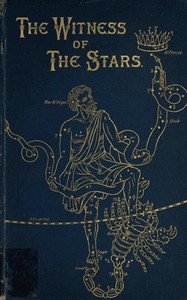
The Witness of the Stars
Language: en1,342 downloads on Project Gutenberg
Subjects
Public-domain ebook sourced from Project Gutenberg #49018.
Public-domain ebook
Language: en1,342 downloads on Project Gutenberg
Subjects
Public-domain ebook sourced from Project Gutenberg #49018.
The Witness of the Stars is a scholarly work that seeks to unite biblical prophecy with the ancient lore of astronomy. It opens with a detailed preface that acknowledges the contributions of earlier researchers, most notably Miss Frances Rolleston and Dr. Seiss, before explaining the author’s aim to present the “witness of the stars to prophetic truth” in a more organized form. The introductory material outlines the book’s reliance on historic star‑names preserved in classical atlases, cites a range of sources from Arabic astronomers to 19th‑century celestial maps, and frames the discussion within a theological argument that the heavens themselves proclaim divine purpose, as illustrated by extensive scriptural citations.
Written in the earnest, polemical style of late‑Victorian theological scholarship, Bullinger’s prose is dense with biblical exegesis, classical references, and technical astronomical terminology. The tone is devotional yet argumentative, reflecting the era’s confidence in reconciling science and Scripture. Readers who appreciate meticulous biblical study, historic astronomy, and the apologetic efforts of 19th‑century evangelical thinkers will find this volume rewarding, while those seeking a light narrative or modern scientific analysis may prefer a different approach.
The opening · free to read
[Transcribers Note: This e‐book contains countless special symbols, and characters from uncommon character sets. If you see unrenderable characters, you may need to change to a font that has the needed Unicode blocks. It uses these uncommon character sets: Greek (Unicode U+0370 through U+03FF), Greek Extended (U+1F00 through U+1FFF), Hebrew (U+0590 through U+05FF), and Miscellaneous Symbols (U+2600 through U+26FF). Hebrew pointings and Greek markings are as provided in the original book, and some differ from the usual pointings and markings for those words.]
PREFACE.
Some years ago it was my privilege to enjoy the acquaintance of Miss Frances Rolleston, of Keswick, and to carry on a correspondence with her with respect to her work, Mazzaroth: or, the Constellations. She was the first to create an interest in this important subject. Since then Dr. Seiss, of Philadelphia, has endeavoured to popularize her work on the other side of the Atlantic; and brief references have been made to the subject in such books as Moses and Geology, by Dr. Kinns, and in Primeval Man; but it was felt, for many reasons, that it was desirable to make another effort to set forth, in a more complete form, the witness of the stars to prophetic truth, so necessary in these last days.
To the late Miss Rolleston, however, belongs the honour of collecting a mass of information bearing on this subject; but, published as it was, chiefly in the form of notes, unarranged and unindexed, it was suited only for, but was most valuable to, the student. She it was who performed the drudgery of collecting the facts presented by Albumazer, the Arab astronomer to the Caliphs of Grenada, 850 A.D.; and the Tables drawn up by Ulugh Beigh, the Tartar prince and astronomer, about 1450 A.D., who gives the Arabian Astronomy as it had come down from the earliest times.
Modern astronomers have preserved, and still have in common use, the ancient names of over a hundred of the principal stars which have been handed down; but now these names are used merely as a convenience, and without any reference to their significance.
This work is an attempt to popularize this ancient information, and to use it in the interests of truth.
For the ancient astronomical facts and the names, with their signification, I am, from the very nature of the case, indebted, of course, to all who have preserved, collected, and handed them down; but for their interpretation I am alone responsible.
It is for the readers to judge how far my conclusions are borne out by the evidence; and how far the foundation of our hopes of coming glory are strengthened by the prophecies which have been written in the stars of heaven, as well as in the Scriptures of truth.
For the illustrations I am greatly indebted to Jamieson’s Celestial Atlas, 1820; Flammarion’s L’Étoiles; Sir John W. Lubbock’s Stars in Six Maps, 1883; and to the late Mr. Edward J. Cooper’s Egyptian Scenery, 1820. For the general presentation and arrangement of the Constellations I am responsible, while for the drawings my thanks are due to my friend Miss Amy Manson.
It is the possession of “that blessed hope” of Christ’s speedy return from Heaven which will give true interest in the great subject of this book.
No one can dispute the antiquity of the Signs of the Zodiac, or of the Constellations. No one can question the accuracy of the ancient star‐names which have come down to us, for they are still preserved in every good celestial atlas. And we hope that no one will be able to resist the cumulative evidence that, apart from God’s grace in Christ there is no hope for sinners now: and apart from God’s glory, as it will be manifested in the return of Christ from Heaven, there is no hope for the Church, no hope for Israel, no hope for the world, no hope for a groaning creation. In spite of all the vaunted promises of a religious World, and of a worldly Church, to remove the effects of the curse by a Social Gospel of Sanitation, we are more and more shut up to the prophecy of Gen. iii. 15, which we wait and long to see fulfilled in Christ as our only hope. This is beautifully expressed by the late Dr. William Leask:—
And is there none before? No perfect peace Unbroken by the storms and cares of life, Until the time of waiting for Him cease, By His appearing to destroy the strife? No, none before.
Do we not hear that through the flag of grace By faithful messengers of God unfurled, All men will be converted, and the place Of man’s rebellion be a holy world? Yes, so we hear.
Is it not true that to the Church is given The holy honour of dispelling night, And bringing back the human race to heaven, By kindling everywhere the Gospel light? It is not true.
Is this the hope—that Christ the Lord will come, In all the glory of His royal right, Redeemer and Avenger, taking home His saints, and crushing the usurper’s might? This is the hope.
May the God of all grace accept and bless this effort to show forth His glory, and use it to strengthen His people in waiting for His Son from Heaven, even Jesus which delivered us from the wrath to come.
Ethelbert W. Bullinger.
August 31st, 1893.
INTRODUCTION.
For more than two thousand five hundred years the world was without a written revelation from God. The question is, Did God leave Himself without a witness? The question is answered very positively by the written Word that He did not. In Rom. i. 19 it is declared that, “that which may be known of God is manifest in them; for God hath showed it unto them. For the invisible things of Him from the creation of the world are clearly seen, being understood by the things that are made, even His eternal power and Godhead; so that they are without excuse.” But how was God known? How were His “invisible things,” i.e., His plans, His purposes, and His counsels, known since the creation of the world? We are told by the Holy Spirit in Rom. x. 18. Having stated in v. 17 that “Faith cometh by hearing and hearing by the Word (ῥήμα, the thing spoken, sayings) of God,” He asks, “But I say, Have they not heard? Yes, verily.” And we may ask, How have they heard? The answer follows—“Their sound went into all the earth (γή) and their words (ῥήματα, their teaching, message, instruction) unto the ends of the world (οἰκουμένη).” What words? What instruction? Whose message? Whose teaching? There is only one answer, and that is, THE HEAVENS! This is settled by the fact that the passage is quoted from Ps. xix., the first part of which is occupied with the Revelation of God written in the Heavens, and the latter part with the Revelation of God written in the Word.
This is the simple explanation of this beautiful Psalm. This is why its two subjects are brought together. It has often perplexed many why there should be that abrupt departure in verse 7—“The law of the Lord is perfect, converting the soul.” The fact is, there is nothing abrupt in it, and it is no departure. It is simply the transition to the second of the two great Revelations which are thus placed in juxtaposition. The first is the Revelation of the Creator, El, אֵל, in His works, while the second is the Revelation of the Covenant Jehovah, יְהוָה, in His Word. And it is noteworthy that while in the first half of the Psalm, El is named only once, in the latter half Jehovah is named seven times, the last being threefold (Jehovah, Rock, and Redeemer), concluding the Psalm.
Let us then turn to Ps. xix., and note first—
The Structure(1) of the Psalm as a whole.
A | 1‐4‐. The Heavens. B | ‐4‐6. “In them” (בָּהֶם) the Sun. A | 7‐10. The Scriptures. B | 11‐14. “In them” (בָּהֶם) Thy Servant.
In the Key to the Psalms, p. 17, it is pointed out that the terms employed in A and B are astronomical,(2) while in A and B they are literary. Thus the two parts are significantly connected and united.
Ewald and others imagine that this Psalm is made up of two fragments of separate Psalms composed at different periods and brought together by a later editor!
But this is disproved not only by what has been said concerning the structure of the Psalm as a whole, and the interlacing of the astronomical and the literary terms in the two parts, but it is also shown by more minute details.
Each half consists of two portions which correspond the one to the other, A answering to A, and B to B. Moreover, each half, as well as each corresponding member, consists of the same number of lines; those in the first half being, by the cæsura, short, while those in the last half are long (or double).
A | 1‐4‐. Eight lines B | ‐4‐6. Six lines A | 7‐10. Eight lines B | 11‐14. Six lines
If we confine ourselves to the first half of the Psalm(3) (A and B, verses 1‐6), with which we are now alone concerned, we see a still more minute proof of Divine order and perfection.
The Structure of A and B.
A & B | C | 1. The heavens. | D | 2. Their testimony: incessant. (Pos.) | E | 3. Their words inaudible. (Neg.) | D | 4‐. Their testimony: universal. (Pos.) | C | ‐4‐6. The heavens.
Here we have an introversion, in which the extremes (C and C) are occupied with the heavens; while the means (D, E and D) are occupied with their testimony.
The following is the full expansion of the above, with original emendations which preserve the order of the Hebrew words and thus indicate the nature of the structure:—
C | a | The heavens b | are telling(4) c | the glory(5) of God: c | and the work of his hands b | is setting forth(6) a | the firmament. D | d | Day after day(7) e | uttereth(8) speech, d | And night after night e | sheweth knowledge. E | f | There is no speech (what is articulate) g | and there are no words (what is audible); g | and without being audible, f | is their voice (what is articulate). D | h | Into all the earth (as created) i | is their line(9) gone forth; h | And into the ends of the world (as inhabited) i | Their sayings. C | j | For the sun He hath set a tent (an abode) in them; k | l | and he as a bridegroom (comparison) m | is going forth from his canopy, (motion: its rising) l | he rejoiceth as a mighty one (comparison) m | to run his course. (Motion: its rapid course.) k | n | from the end of the heavens (egress) o | is his going forth (egress) o | and his revolution (regress) n | unto their ends (regress): j | and there is nothing hid from his heat (i.e., from him)(10)
Surely there is something more referred to here than a mere wonder excited by the works of the Creator! When we read the whole passage and mark its structure, and note the words employed, we are emphatically told that the heavens contain a revelation from God; they prophesy, they show knowledge, they tell of God’s glory, and set forth His purposes and counsels.
It is a remarkable fact that it is in the Book of Job, which is generally allowed to be the oldest book in the Bible,(11) if not in the world, that we have references to this Stellar Revelation. This would be at least 2,000 years before Christ. In that book the signs of the Zodiac and the names of several stars and constellations are mentioned, as being ancient and well‐known.
The book keeps going
Reading is free forever. Sign up and watch scenes appear while you read.



Scenes Storieta drew for other classics.
New illustrated classics
Once or twice a month: the latest books to get full character casts, scene art, and free comic editions. No account needed.