Public-domain ebook
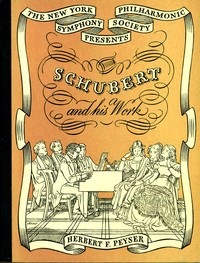
Schubert and His Work
Language: en333 downloads on Project Gutenberg
Subjects
In: Biographies·Music
Public-domain ebook sourced from Project Gutenberg #49026.
Public-domain ebook
Language: en333 downloads on Project Gutenberg
Subjects
In: Biographies·Music
Public-domain ebook sourced from Project Gutenberg #49026.
The opening · free to read
The most lovable and the shortest-lived of the great composers, Franz Seraph Peter Schubert was doubly a paradox. He was the only one of the outstanding Viennese masters (unless one chooses to include in this category the Strauss waltz kings) actually born in Vienna; and, though there has never been a composer more spiritually Viennese, Schubert inherited not a drop of Viennese blood. His ancestry had its roots in the Moravian and Austrian-Silesian soil. His grandfather, Karl Schubert, a peasant and a local magistrate, lived in one of the thirty-five towns called Neudorf in Moravian-Silesian territory and married the daughter of a well-to-do farmer, acquiring by the match a large tract of land and ten children of whom the fifth, Franz Theodor Florian, was destined to beget an immortal.
At eighteen Franz Theodor, who was born in 1763, determined to follow the example of his elder brother, Karl, and become a schoolmaster. He went to Vienna and secured a post as assistant instructor in a school where Karl had already been teaching for several years. In spite of starvation wages he married (1785) Maria Elisabeth Vietz, from Zuckmantel, in Silesia, the very town whence the Schuberts had originally emigrated to Neudorf. She was a cook, the daughter of a “master locksmith,” and she was seven years older than her husband. The couple had fourteen children, nine of whom died in infancy. The survivors were Ignaz, Ferdinand, Karl, Therese and our Franz Peter, who came twelfth in order.
A year after his marriage father Schubert was appointed schoolmaster of the parish of the Fourteen Holy Helpers, in Lichtental, one of the thirty-four Viennese suburbs (or Vorstädte), located at greater or lesser distances from the “Inner Town,” which in those days represented Vienna proper. The schoolhouse (unless it has been demolished in the late war) still stands. Franz Theodor took lodgings for himself and his family a few steps away at the House of the Red Crab (Zum rothen Krebse), Himmelpfortgrund 72, now Nussdorfer Strasse 54 and since 1912 a Schubert museum, owned by the municipality of Vienna. Here Franz Seraph Peter was born on January 31, 1797, at half past one in the afternoon.
Father Schubert’s position was far from lucrative; in fact, it offered no salary at all, nothing but a tax of one gulden a month per child levied on the parents. And yet this inflexible, God-fearing pedagogue, imposed such merciless economies and Spartan discipline on himself, his family and his pupils that he not only managed to make both ends meet but, when Franz Peter was four, to buy the schoolhouse where he taught and to take up his quarters there. In modern times the little house had become a garage, though a memorial tablet placed on it in 1928 reminded the passerby that Schubert lived and taught there for several years besides composing under its roof a number of his works, among them Der Erlkönig.
Not the least remarkable thing about Father Schubert was the fact that, despite the endless grind of making a living, teaching and raising a family, he should have found time to cultivate music. Yet he was a tolerable amateur cellist and his great son’s first music teacher. After giving the boy “elementary instruction” in his fifth year and sending him to school in his sixth he taught Franz Peter at the age of eight the rudiments of violin playing and practised him so thoroughly that the boy was “soon able to play easy duets fairly well.”
The youngster was next handed over to his elder brother, Ignaz, who gave him some piano instruction. But here an uncanny thing happened! The child showed such an instinctive grasp of everything his brother tried to teach him that Ignaz, nonplussed, confessed himself hopelessly outstripped. Franz, for his part, declared he had no need of help but would go his own way in musical matters. Thereupon his parents entrusted him to the choirmaster of the nearby Lichtental parish church, one Michael Holzer, who knew something about counterpoint and consumed more alcohol than was good for him. It was not long before poor Holzer was experiencing with his pupil the same difficulties as Ignaz. He had the little fellow sing and was delighted by his bright voice and his musical accuracy. He let him accompany hymns on the organ, had him improvise and modulate back and forth, taught him a little piano and violin, familiarized him with the viola clef and a few principles of thorough-bass. But in the end his labors were largely superfluous. Holzer admitted that “the lad has harmony in his little finger.” A nearby shop of a piano maker offered a more fertile field for experiments in harmony. Released from the organ loft Franz Peter hurried to this shop and spent hours there forming chords on the keyboard.
It is not impossible that Schubert may have made a few attempts at composition at this stage, though there is no actual proof. But a real turning point came on May 28, 1808. On that date there appeared in the official journal, the Wiener Zeitung, an announcement that two places among the choristers of the Imperial Chapel (the so-called Sängerknaben) had to be filled. Father Schubert saw his chance. A chorister who showed the necessary qualifications could enjoy free tuition, board and lodging at the Imperial Konvikt (or Seminary); and if the boy distinguished himself “in morals and studies” he might remain even after his voice had changed. The Konvikt was a former Jesuit school reopened in 1802 by the Emperor Franz and supervised by a branch of the Jesuits called the Piarists. In addition to ten choristers there were pupils of middle and high school standing. The Konvikt occupied a long, cheerless building which in modern times looked quite as bleak as it did in Schubert’s day.
The tests took place on September 30, 1808, and the examiners consisted of Antonio Salieri, a prolific opera composer, an intimate of Gluck and Haydn, a teacher of Beethoven and an implacable enemy of Mozart; the Court Kapellmeister Eybler; and a singing teacher at the school, Philip Korner. Schubert presented himself for the examination wearing a grayish smock, which caused the other boys to jeer and call him a miller. But as millers were popularly supposed to be musical the young mockers agreed that he could not fail. They were right. Not only did he meet all the requirements but his voice and musicianship aroused the surprise and enthusiasm of the committee. Schubert was promptly accepted. In other subjects required, as well as in music, he easily surpassed the other competitors. Not in vain was he his father’s son!
So the boy shed his “miller’s” vesture and put on the fancy, gold-braided togs of the Sängerknaben. In a few days he was settled at the Konvikt. He was amenable to discipline—having learned it plentifully at home—and does not appear to have suffered the tribulations of some other Konvikt scholars who were less conformable and more adventurous. The shyness which clung to him more or less throughout his life made him shun his fellow students as much as he conveniently could. The food was poor and scanty and even four years later we find him appealing pathetically to his brother Ferdinand for a few pennies a month to buy a roll or an apple as a fortifying snack between a “mediocre midday meal and a paltry supper” eight hours later! The music room at the school was left unheated, hence “gruesomely cold” (anyone who has experienced the unheated corridors of a Viennese house in winter can shudder in sympathy!). But there was plenty of music and the school orchestra, in which Schubert occupied the second desk among the violins, delighted him.
Every evening this orchestra played an entire symphony and ended up with “the noisiest possible overture.” The windows were left open in summer and crowds used to collect outside, till the police dispersed them because they obstructed traffic. The concerts were conducted by a singularly lovable old Bohemian organist, viola player and teacher, Wenzel Ruziczka, who at an early date defended and explained some of the boldest “modernisms” in Schubert’s compositions. The orchestra performed a good deal of trivial music but every now and then there would be works by Haydn, Mozart, Cherubini, Méhul and even some of the less taxing scores of Beethoven. Schubert on these occasions felt himself in heaven! He was “entranced” by the slow movements of Haydn, but his god was Mozart. With a subtlety of perception almost uncanny in a boy of twelve he said that the G minor Symphony “shook him to the depths without his knowing why.” He called the overture to the Marriage of Figaro the “most beautiful in the whole world,” then quickly added “but I had almost forgotten that to the Magic Flute.” It is certain that this student orchestra was a most valuable factor in Schubert’s musical education. It was with these young players in mind that he composed his First Symphony in October, 1813, at the age of sixteen.
At a first violin desk in front of Schubert there played another youth, some nine years older, a student of law and philosophy from Linz, Josef von Spaun, and thus began one of those Schubertian friendships that was to last for life and play an important part in Schubert’s story. Amazed by the beautiful playing he heard behind him, Spaun looked around and saw “a small boy in spectacles.” Not long afterwards he surprised the youngster in the freezing music room trying a sonata by Mozart. Franz confided to his sympathetic new friend that, much as he loved the sonata, he found Mozart “extremely difficult to play” (another acute observation!). Then, “shy and blushing,” he admitted that he “sometimes put his thoughts into notes.” However, he trembled lest his father get wind of the fact, for while Franz Theodor had no objection to music as a pastime and also had every reason to be satisfied that it paid for his son’s education and kept a roof over his head, he had other plans for him in mind. The real business of the young man’s life was to be schoolmastering. No two ways about it!
So Franz Peter had need to be wary. Besides, there was another obstacle to his composing. Music paper was scarce and costly. He did, it is true, rule staves on paper himself but even ordinary brown paper was not plentiful. So the generous Spaun, though of a rather restricted budget, bought paper out of his own allowance and did not remonstrate when Schubert used up the precious commodity “by the ream.” The only difficulty, now, was that Franz composed in study hours and fell back in his school work, a fact that was not slow in coming to his father’s notice. And yet the records of the Konvikt do not show that Schubert was a poor student. At various times certificates signed by the school director, Father Innocenz Lang, pronounce him “good” or “very good” in almost everything, while in Greek he is even described as “eminent.” Somewhat later when at normal school, preparing to teach in his father’s schoolhouse, his weaker subjects were mathematics, Latin and “practical religion.”
The book keeps going
Reading is free forever. Sign up and watch scenes appear while you read.



Scenes Storieta drew for other classics.
New illustrated classics
Once or twice a month: the latest books to get full character casts, scene art, and free comic editions. No account needed.