The opening · free to read
In this way the stories came to be handed down from father to son, in Brittany (whose people are of the same family as the Welsh) as well as in Wales and England, and by this means alone were they prevented from being lost. But in the reigns of Henry II. and Richard I., they were set down on paper, and so became literature. Before this, however, a British writer had written out some of the tales, and from him as well as from the lips of the bards and story-tellers of their own generation, the writers in the time of Henry II. were able to collect their information.
Now, it will be remembered that the second and third crusades were being carried on during the reigns of Henry II. and Richard I., and many English and French Knights were therefore fighting in the fields of Palestine.
The story-teller, whose living depended on the welcome his stories met with, instead of telling them according to tradition, altered them to suit the tastes of his hearers. Thus, the old heroes of tradition were placed upon prancing horses, clothed in coats of mail, and armed with lances as if they had been vassals of King Henry or King Richard. And in this way the story-teller called up before the minds of the listeners pictures of deeds of chivalry, such as husbands and brothers were performing for the Christian faith in far-off Palestine. The writers of the time, both English and French, set them down as they heard and knew them, and so in their altered and historically inaccurate form they have reached us at the present day.
One of the most famous of the books compiled by old English writers was the “Historia Britonum,” which was written (in Latin) by Geoffrey, Bishop of Asaph. It contained an account of a war which King Arthur waged in Western Europe, but made no mention of the Holy Grail.
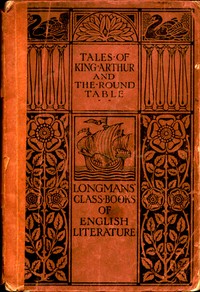
From this and other books of romances compiled in England, and very largely, too, from books of French romances, Sir Thomas Malory obtained the material for his “Morte d’Arthur,” which was written in 1470. This is the most famous of the early books of Arthurian legend, and it is from the “Morte d’Arthur” that most of the stories in this book are taken. Some, however, are taken from the “High History of the Holy Graal,” translated from the French by Dr. Sebastian Evans. The language throughout has been modified with a view to making the legends more easy of study.
The book keeps going
Keep reading, and see it illustrated
Reading is free forever. Sign up and watch scenes appear while you read.
Scenes Storieta drew for other classics.