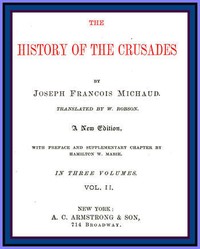
WITH PREFACE AND SUPPLEMENTARY CHAPTER BY HAMILTON W. MABIE.
IN THREE VOLUMES.
VOL. I.
NEW YORK: A. C. ARMSTRONG & SON, 714 BROADWAY.
PREFACE.
THE publication of a new edition of this standard work finds its justification in the wide-spread interest in historical study and in the importance of the events which it describes with such fullness and accuracy. The popular demand for histories of the best class is unprecedented in the annals of book-making, and is substantial evidence of a growing taste for the most important literature. The standard historians have one after another been published in attractive editions, and are rapidly filling the libraries of English-speaking people everywhere. In this remarkable development of popular interest in historical literature, so striking an episode as that of the Crusades could not be left without its record, and the story is nowhere told so entertainingly and comprehensively as in the pages of Michaud. It is a story worthy of careful study, not only on account of its intrinsic interest, but because of its significance in that larger history of Europe of which it forms, in many respects, the most dramatic and picturesque chapter.
There has been of late an immense advance in the methods of historical investigation, and the contemporaneous historian studies the events which he undertakes to portray from a new standpoint. It would be difficult to find in any other department of literary work a wider difference of method and aim than that which separates Robertson’s Charles V. from Freeman’s Norman Conquest of England. The clue is no longer sought in the hands of trained diplomatists, but in the broad, though less obvious, unfolding of the popular life. To the most advanced school of historians Robin Hood is almost as important as Richard I. The historical writer of the last age worked with a pictorial imagination, weaving his story about the striking characters and episodes of an age; the same writer to-day, with an imagination trained in philosophical methods, discerns the dimly outlined movement of national life behind the pageantry of courts, the struggles of parties, and the rush of events. It is doubtless this very deepening of historical study and broadening of historical effect which has made the history the rival of the romance in popular interest. The studied narrative of Hume repels in spite of its trustworthiness, while Green’s portrayal of the national development against a background of equally trustworthy fact charms a host of readers into repeated perusals.
The epoch of the Crusades is important from the standpoint of either school. Prescott and Professor Seeley would each find in it material to his fancy. Studied with an eye to pictorial effect, what series of events could be more impressive than that which chronicles the successive campaigns to capture and hold Jerusalem? If chivalry was ever anything more than an aftergrowth of fancy and sentiment, it was in the fierce struggles which centered around the Holy City. The virtues of Feudalism were never more strikingly illustrated than during the brief period in which a handful of knights held Jerusalem against a circle of hostile nations. Separated by long and perilous marches from Europe, hemmed in by enemies whose multitude made their own scanty ranks insignificant, sustained by a courage that nothing could daunt, a purpose that nothing could defeat, a skill in arms which made their skeleton armies a host, they long maintained the hopeless struggle of a Christian colony against Asia in arms to destroy it.
Tancred, Godfred de Bouillon, Richard and Saladin, are names which have made knighthood synonymous with honor, loyalty, and courage. Their personal exploits, no less than the larger achievements in which they bore their part, make the age of the Crusades a field from which literature has been enriched with heroic characters and dramatic incidents from the days of Raoul de Caen and Tasso to the present. These expeditions furnish the most striking episode in European history, inspired as they were by religious emotion, prosecuted under the most perilous conditions, displaying in the most effective contrasts the loftiest and the basest passions of men, and foreordained from the beginning to a disastrous failure, which hangs over the narrative as invisibly, but as inevitably, as the doom which overshadows a Greek tragedy. If they had no deeper interest than that which attaches to wide and varied disclosures of character, to vast and varied achievements, these warlike pilgrimages would be worthy the most thoughtful study.
The Crusades have, however, a deeper significance than any isolated personages or events, however picturesque or imposing, ever possess. They brought two civilizations into conflict, and no events are more important than those which secure the contact of different civilizations. In contemporaneous history nothing is so suggestive of change as the wonderful return of Western upon Eastern civilization in Egypt, Syria, India, and Japan. The contact of Western with Eastern knowledge and thought in the Crusades was by no means so fruitful as that which came about through the conquests of Alexander and, later, of Rome, but it was not without great results. The Crusades established an intercourse between the East and the West, which if often hostile, has nevertheless kept an open channel for that interchange of thought and industry, which in the single department of comparative philology has made possible a marvelous advance into an unsuspected region of knowledge. The study of Sanskrit has opened an epoch in historical and literary investigation, which Professor Fiske declares will be not less fruitful in the intellectual progress of the world than was the age of the Renaissance.
The Crusades united for the first time the warring States of Europe in a common purpose and a common enterprise. It accustomed the overburdened people to the thought of a higher authority than that of the special tyranny under which they happened to be born, and so prepared the way for the growth of larger ideas of authority and citizenship. The power of Feudalism was measurably weakened by the disasters which overtook successive expeditions led by the flower of chivalry, and this result made possible the unfolding of the monarchical principle which was to play so important a part in the political development of Europe. In short, the wide disturbance which these successive expeditions to the East introduced, loosened perceptibly the iron framework of feudal tyranny which held European society bound and helpless, and by gradual disintegration prepared the soil for the seeds of popular institutions.
H. W. M.
BIOGRAPHICAL NOTICE.
WE are not of those who think that readers are without curiosity as to the position in life, actions, and fortunes of the authors who afford them instruction or pleasure; the eagerness with which the birthplaces of men of genius are sought for and commemorated; the fondness with which their most trifling actions are dwelt upon; and the endless collections that are made of their conversations and sayings, prove that this cannot be the case.
In a prefatory memoir, we can scarcely go into so many details of the life of Michaud, as, perhaps, the subject deserves. Michaud was not a mere author, whose history may be read in his works. He lived at a momentous period, and was no idle spectator of passing events; a complete life of Michaud would, indeed, swell to a history of France from 1790 to 1839.
Joseph François Michaud, born at Albens, in Savoy, on the 19th of June, in the year 1767, was descended from a family that traced its nobility beyond the tenth century. One of his ancestors, Hugh Michaud de Corcelles, was deservedly distinguished by the emperor Charles V. The father of Joseph was obliged to leave his country, in consequence of what is termed by his biographer, a piece of boyish rashness, but which we prefer relating to any of the warlike deeds of the abovenamed Hugh. Whilst on a shooting party, he sought refreshment in a cottage, and found the mistress of it in the greatest distress; for, at the moment of his entrance, officers were bearing away her humble furniture, for the paltry sum of sixty francs. He offered to pay the amount if they would come with him to his home; but they refused, and continued their operations in his presence. This irritated him to such a degree, that he threatened to make use of his gun; and, at length, struck one of them so severe a blow with the stock of it, that the fellow died immediately. He retired to a place near Bourg, in Bresse, where he married; and he afterwards established himself as a notary and commissary at Terrier, in that province. An early death left his widow burdened with a numerous family, of which Joseph was the eldest. Notwithstanding this calamity, he received an excellent education at the college of Bourg, and acquired great credit as a rhetorician and a composer of French verses. His studies and some juvenile travels completed, it became necessary for him to fix upon a mode of getting a living; and the narrowness of his mother’s resources confining his efforts to trade, he went into the house of a bookseller at Lyon, attracted, no doubt, by the affinity between the bookseller and the man of letters. He remained here till 1790, when the passage of the rich, influential, and intellectual Countess Fanny de Beauharnais through that city, aroused all the provincial muses to make their offerings to the great lady. Among the poets, Michaud was so successful, that he thought himself warranted in following her to Paris, with the view of pursuing a literary career under her auspices. Immediately on his arrival, he laid the contents of his poetical portfolio before the public, and soon became the associate of Cerisier, in the Gazette Universelle, and with Esménard, in the Postillon de la Guerre. His opinions and early associations led him towards the Royalist party, to which the accession of his talents was very acceptable. He may be said to have been faithful to his colours, through all the disasters of the unhappy cause he had embraced; for, in spite of imprisonment, banishment, and repeated concealments, we find him, in 1799, publishing two satirical pamphlets against Buonaparte, by the orders of Louis XVIII. One of his escapes was so well managed, and so opportunely effected, that we will offer an account of it to our readers. He had been sent prisoner to Paris, walking between two mounted gendarmes, who were directed not to spare him, and if fatigue relaxed his speed, they were to refresh him with the flat sides of their sabres. As he entered Paris in this forlorn condition, he was met by his zealous friend Giguet, whose sorrow only set his fertile brain to work to devise means for his escape. As Michaud was, during many days, conducted from his prison to the Tuileries, to undergo examination, Giguet at first thought that the best way would be to blow out the brains of the two gendarmes that escorted him; but this he rejected as unworthy of a man of genius. Choosing a point in Michaud’s passage that would answer his purpose, he stopped the party, and affecting to know nothing of the matter, and not to have seen his friend since his arrival in Paris, was eager in his inquiries as to how his health was, what he was doing, where he was going, and insisted upon his breakfasting with him. “No, no,” answered Michaud, “I have a little affair yonder, at the Tuileries, just a few words of explanation to give—only the business of a minute or two.—Begin breakfast without me, I shall be back presently.” “That won’t do; that won’t do; they do not despatch people so quickly as all that. Perhaps they won’t begin with you; let us have our breakfast first. I dare say these gentlemen (pointing to the gendarmes) have not breakfasted, and will have no objection to a cutlet and a glass of Bourdeaux wine! and here’s the best house in Paris, close at hand.” The gendarmes, after a little faint hesitation, suffered themselves to be seduced; and prisoner, guards, and friends were soon comfortably seated at table. They eat, they drink, they pass bumper toasts, and talk a little about everything; but most particularly about Bresse and the good cheer that was there always to be met with—but the pullets of Bresse! never was such eating as the pullets of Bresse! The mouths of the gendarmes watered at the bare description of them. “Parbleu, gentlemen,” cried Giguet, “since you have never partaken of our country pullets, I will undertake to convince you that there are none such in the eighty-three departments. We have plenty of time; you can eat a little bit more, and appetite comes with—— drinking (and he filled the glasses). Waiter, here! a Bresse pullet! no tricks, mind; it must be from Bresse—not from Mans. But, stop; Michaud, you understand these things better than anybody; have an eye to these fellows, go down into the kitchen, and see that they don’t cheat us. Good health to you, gentlemen.” Whilst they are drinking, Michaud rises, and is soon out of the house. Giguet had the art to keep the guards another half-hour at table, by saying his friend was only watching the cooking, for a Bresse pullet was worth nothing if not roasted à la Bresse; and when they discovered Michaud was not in the kitchen, he asserted it must either be a joke, or else he was ill, and gone home; and contrived to lead them a long useless search in a way directly opposite to that which he knew the late prisoner had taken. Michaud’s escape was a happy one; for that very day, the council had condemned him to death. Poor Giguet’s friendly zeal cost him nearly a month’s imprisonment, and placed his life even in jeopardy.