Public-domain ebook
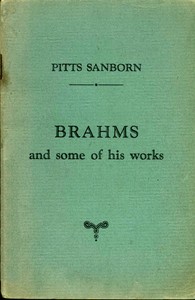
Brahms and some of his works
Language: en319 downloads on Project Gutenberg
Subjects
In: Biographies·Music
Public-domain ebook sourced from Project Gutenberg #49127.
Public-domain ebook
Language: en319 downloads on Project Gutenberg
Subjects
In: Biographies·Music
Public-domain ebook sourced from Project Gutenberg #49127.
The opening · free to read
In the then free city of Hamburg Johannes Brahms was born on May 7, 1833. His parents were in humble circumstances, and Johannes was born in a poor part of the city. But his father was a well-trained musician and an accomplished double-bass player, and his mother, seventeen years his father's senior, was a woman of fine spirit and unusual intelligence.
From an early age Johannes was clearly destined for a musical career, and at six he had already begun to learn the rudiments of music from his father, who purposed making an orchestral player of him. When he was eight he began to take piano lessons of Otto Cossel, his father feeling he had nothing more to teach the child. Cossel pronounced him an excellent pupil, but complained that he wasted time on his "everlasting composing."
Two years later Cossel, convinced that he deserved more advanced instruction, took him to his own teacher, Eduard Marxsen, the royal music director in the adjacent city of Altona. Marxsen accepted the new pupil unwillingly, but presently he was impressed with the keenness of the boy's mind. Beginning with piano lessons, he later studied composition, and Marxsen, thorough about all instruction, encouraged him to compose as well as to perfect himself as a pianist. Incidentally, Johannes became a great reader of books.
At the age of eleven Johannes appeared, together with his father, as pianist at a private subscription concert organized to raise money to continue his education. Then and there an impresario wanted to engage him for a concert tour that was to include America. But Cossel protested effectively against his being exploited as a prodigy. Nevertheless, the Brahms family was so poor at this time that Johannes was obliged to add to their income by playing the piano in sailors' resorts. This work, which often lasted into the morning hours, affected his health adversely.
He continued to compose, however, and a turning point came when he had the chance to undertake a tour with the young Hungarian violinist Eduard Remenyi. In the course of this association he not only got acquainted with Hungarian national dances, which were to influence considerably his compositions, but he met a variety of important musicians, among them Joachim, Liszt, Cornelius, Raff, Berlioz, and, above all, Robert and Clara Schumann. Thereafter Robert Schumann, until his tragic death, was the young man's champion and mentor, and Clara Schumann became his devoted lifelong friend.
Concerto for Piano and Orchestra in D Minor, No. 1, Op. 15
Although Brahms's earlier works included not only compositions for the piano, songs, and chamber music, but also the Serenade for Full Orchestra in D, it was not till the spring and summer of 1854 that we find him engaged on a symphony. This made such progress that in January, 1855, he could write to Robert Schumann: "I have been trying my hand at a symphony during the past summer, have even orchestrated the first movement and composed the second and third."
The symphony was never completed as such, however, but turned into a sonata for two pianos. Still, this was not the end of the matter. Advised that the musical contents of the sonata deserved a more imposing form, Brahms was persuaded to mould the material into a concerto. Accordingly the first two movements took up a corresponding position in the D minor Piano Concerto, the third becoming the chorus "Behold All Flesh" in "A German Requiem."
The first public performance of the concerto took place in Hanover on January 22, 1859, at one of the Court subscription concerts in the Royal Theatre, Brahms being the pianist, Joachim the conductor. Though the cognoscenti admired the new work, the public in general found it a hard nut to crack. And as a matter of notorious fact the concerto was to make its way slowly. Only in the present century, for instance, has it won full recognition in this country.
The first movement (Maestoso, D minor, 6-8) has a long orchestral introduction before the piano enters. Over a roll on the kettledrums the chief subject is announced in the strings:
The second subject is given out by the piano in F major. The movement ends with an extended and brilliant coda. The second movement (Adagio, D major, 6-4) bears in the manuscript score the motto: "Benedictus qui venit in nomine Domini." Max Kalbeck, Brahm's biographer, says that this inscription refers to Robert Schumann, whose death had affected Brahms deeply and whom he had sometimes addressed as "Mynheer Domine." The first theme, to which the fanciful may fit the Latin words, appears in the strings and bassoons, to be taken up later by the solo instrument. The movement has a contrasting middle section. The finale is a long and elaborate Rondo (Allegro non troppo, D minor, 2-4), ending in a majestic and triumphant coda.
This concerto, owing to the exceeding prominence given to the orchestra, really ranks as an orchestral composition, and it was years before Brahms attempted another on a like scale. In 1873 he brought out the "Variations on a Theme by Haydn." Though meanwhile he had written copiously, only the two modest Serenades had been composed for orchestra.
Variations for Orchestra on a Theme by Haydn, Op. 56a
Now a permanent resident of Vienna, Brahms spent his summer holiday in 1873 at Tutzing on the Starnbergersee in southern Bavaria. A version of the Variations for two pianos Brahms marked "Tutzing, July, 1873." Whether it was the first of the two versions we do not know. On November 2 the orchestral version was brought out in Vienna at a Philharmonic Concert, Otto Dessoff conducting.
The theme by Haydn comes from an unpublished divertimento for wind instruments, preserved at the State Library in Berlin, which is inscribed "Divertimento mit dem Chorale St. Antoni." Though the melody of the chorale is usually supposed to be Haydn's own, we cannot be sure that he had not taken it from a chorale that has now disappeared.
In Haydn's key of B-flat major the theme
is given out andante in 2-4 time and repeated. Eight variations follow:
I. (Poco piu animato, major mode). Throughout the initial variation the concluding notes of the introduction ring like a tolling of bells.
II. (Più vivace, minor mode). The clarinets and bassoons take the lead. The violins supply an arpeggio figure.
III. (Con moto, major mode). The theme in this tranquil section is given first to the oboes and bassoons.
IV. (Andante con moto, minor mode). New melodic material enters. Oboe and horn announce the theme.
V. (Vivace, major mode). Flutes, oboes, and bassoons have the melody.
VI. (Vivace, minor mode). Brilliant like its predecessor, this variation introduces a new figure.
VII. (Grazioso, major mode). In Siciliano rhythm (6-8), the seventh variation is generally regarded as the crowning glory of the set. Against a descending scale for first violins and clarinets, violas and piccolo play the melody. Then the first violins give out a theme whose first four notes provide the movement with its rhythmic basis. There is a wealth of fascinating detail.
VIII. (Presto non troppo, minor mode). In a mysterious whisper of muted strings the last variation leads darkly to the Finale. (Andante, major mode). A ground bass, five measures long and repeated twelve times below a variety of harmonies, occupies much of this summing up. At a signal from the triangle an outburst of vernal life sweeps through the orchestra, ending with the theme in fortissimo proclamation.
Owing, no doubt, to the experience with the symphony that at last became a piano concerto, Brahms was cautious about trying his hand again at a symphony. In 1862 he had made, however, a version of the Symphony in C minor, without the introduction, of which he wrote to his friend Albert Dietrich, the composer. According to his biographer Walter Niemann, he once remarked it was "no laughing matter" to write a symphony after Beethoven, and the same authority points out that when he had finished the first movement of the C minor symphony he declared to another friend, Hermann Levi, the noted conductor: "I shall never compose a symphony! You have no conception of how the likes of us feel when we hear the tramp of a giant like him (Beethoven) behind us."
This extreme modesty persisted, for Niemann assures us that ten years after the completion of the Fourth Symphony Brahms alluded to that majestic work as "halbschürig" ("mediocre").
Opening Brahms's series of four, the Symphony in C minor was given for the first time on November 4, 1876, at the Grand Ducal Theatre, Karlsruhe. It seems that immediately before the orchestral parts were copied for the first rehearsal Brahms abridged the Andante and the Allegretto, saying that he had the Finale to think of. Otto Dessoff, who had left Vienna for Karlsruhe, conducted the performance, as he had done in the case of the "Haydn" variations at Vienna. Brahms had a low opinion of him. He had even written while Dessoff was still in Vienna:
"Now Dessoff is absolutely not the right man for this, the only enviable post in Vienna. There are special reasons why he continues to beat time, but not a soul approves. Under him the orchestra has positively deteriorated." Three days after the première at Karlsruhe the symphony was repeated at Mannheim, this time with the composer as conductor.
At first the C minor Symphony won little more than a success of esteem. Even Hanslick, Brahms's Viennese prophet, was not wholly enthusiastic. Typical is the judgment expressed by the revered John S. Dwight in his Journal of Music after the symphony had been made known to Boston, when it was scarcely fourteen months old. He felt it as something "depressing and unedifying, a work coldly elaborated, artificial; earnest, to be sure, in some sense great, and far more satisfactory than any symphony by Raff or any others of the day which we have heard, but not to be mentioned in the same day with any symphony by Schumann, Mendelssohn, or the great one by Schubert, not to speak of Beethoven's.... Our interest in it will increase, but we foresee the limit; and certainly it cannot be popular; it will not be loved like the dear masterpieces of genius."
In spite of this dark prophecy, the symphony has long been one of the most popular, and it is now the established fashion to find in it not only magnitude and ruggedness, but pathos, tenderness, and a profound humanity.
A portentous introduction (Un poco sostenuto, C minor, 6-8) prefaces the first movement (Allegro, C minor, 6-8). The first theme is given out by the violins in the fifth measure. The second theme (E-flat major) appears in the woodwind. The character of the movement is austere and epic.
The second movement (Andante sostenuto, E major, 3-4) is imbued with a profound lyricism, which flowers into some of the loveliest pages in all Brahms.
Instead of a scherzo there follows a movement marked "Un poco allegretto e grazioso" (A-flat major, 2-4), which Grove aptly characterizes as "a sort of national tune or Volkslied of simple sweetness and grace." The opening subject is sung first by the clarinet. The place of a trio is delightfully filled by a contrasting middle section (B major, 6-8).
The book keeps going
Reading is free forever. Sign up and watch scenes appear while you read.



Scenes Storieta drew for other classics.
New illustrated classics
Once or twice a month: the latest books to get full character casts, scene art, and free comic editions. No account needed.