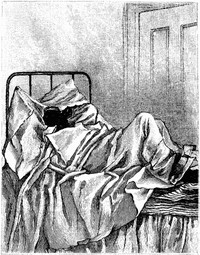
A TWO-HEADED FAMILY.
A TRUE STORY OF WHAT TWO BOYS DID.
BY GEORGE CARY EGGLESTON.
Everybody talked, of course, when it was known that Bob Towne had run away, and had taken his brother Ned with him, and everybody said it was a shame. By everybody I mean all the people in the little Mississippi town in which Bob's mother lived. They did not know why Bob had run away, and they did not know where he had gone; but they talked about it all the same. They said it was a shame for him to leave his widowed mother, and worse still to take his little brother with him, though not one of them could have suggested any possible way in which Bob could have helped his mother by staying. Bob was "curious," however, and people never think well of persons whom they do not understand. Bob was fond of books, for one thing, and because he read a great deal, and did not "sit around" in the village, they said he was morose; and so when the news spread that Bob had gone away in the night, and had taken his brother with him, everybody said, "I told you so," in a tone which indicated that that was the very worst thing they could say.
Bob's mother had a letter, however, which convinced her that her boy was not heartless at any rate. She said nothing about this letter--found in Bob's room--but she read it over and over again, and cried over it, and even kissed it sometimes in secret. The letter was brief and simple. It said:
"MY DEAR MOTHER,--Please don't feel badly at my going away: it is my duty. When I found, after father's death, that the estate was worth so little, and that you had almost nothing except the house you live in, I made up my mind that I must be the head of the family, although I am only fourteen years old. After a good deal of thinking, I have hit upon a plan to make some money, I think, and as Ned wants to join me, I'm going to take him with me. Neither of us can earn anything here, but I believe we can where we're going. At least you won't have us to feed. We shall work for you and for our little sisters, and if we make anything, it will all be yours. If we don't, we will at least have tried. When we succeed we'll let you know where we are. We hate to go away without kissing you and little Kate and Mary and Susie, but we must, else you will never let us go. Good-by, and God bless you, mother!"
That was all the trace Bob and Ned left behind them, and nobody could guess where they had gone.
Two days after their disappearance the boys presented themselves to a gentleman who had been a friend of their father, living fifty miles away, and after exacting from him a pledge of secrecy, Bob introduced his business.
"You said last year at our house that you would let any man who chose to get up your swamp land use it for ten years, or something of that sort."
"Yes, I said this: I have ten thousand acres on the Tallahatchee; part of it was under cultivation before the war, but it has grown up in cane so that it is worth almost nothing now to sell, and I haven't the capital nor the energy at my time of life to get it up again. It is superb land, capable of yielding three bales of cotton to the acre, and if it was under cultivation again it would sell for fifty dollars an acre. What I proposed was to let young Bowling go there and get up as much as he pleased of it, cut and sell all the wood he chose, use the land rent free for ten years, and at the end of that time receive from me a bonus of five dollars an acre for all the land brought under cultivation. But what of it? Bowling didn't accept the offer."
Bob explained his own purpose to accept it in a small way, going into the swamp country, and making what money he could with his own hands, for his friend knew he had no capital.
"But, my dear boy," said the gentleman, "a white man can't work in the swamp, and you have no money to hire negroes with."
"Did any white man ever try it?" asked Bob.
"Not that I ever heard of."
"Besides," said Bob, "we're not white men; we're only white boys, and we won't be very white either, after we've been at work a few months."
After a good deal of explanation and discussion, Major Singer consented to let the boys try their plan, though he had no confidence in it.
"I'll do this," he said. "You may go into the swamp, cut and sell all the wood you can to steamboats when they come up, and cultivate all the land you choose to grub, without any charge for rent. I'll give you a mule and a cart, and enough bacon and meal to last you for a month or two. By that time you'll be tired of the experiment, and you can return the mule and cart on your way home."
Bob asked for the privilege of paying for the mule and cart out of the proceeds of his first crop, and, laughing, the Major consented, naming one hundred dollars as the price.
Five days later the boys ate their supper of bacon and ash-cake on a log on the banks of the Tallahatchee River. It was a lonely, desolate swamp region, and the log on which they sat was twelve miles distant from the nearest human habitation. They were a trifle lonely there in the wild woods, but they had a camp fire and courage, and those go a long way.
The next day they set to work and built a hut to live in, with a rude bunk for a bed. Then Bob "prospected." Much of the land about them had once been cultivated, and there were no trees of any considerable size upon the parts which had been fields; but the growth of cane and brush-wood was appalling.
"Never mind," said Bob. "It is only September now, and we'll get a few acres cleared by spring. Our first work must be to cut a big pile of wood to sell to the steamboats when they come up; if we don't, we can't buy ploughs or food for our farming operations."
"When will the boats come?" asked Ned.
"Late in the fall or in the winter, whenever the river gets high enough. It isn't navigable now, but when it rises, the steamboats come up to get loads of cotton."
With brave hearts the boys set to work chopping and hauling cord-wood. They made very little progress the first day, but after they had practiced for a few days they became more expert, and at the end of a week they found by measurement that they could together cut and haul about a cord each day. One grown man would have accomplished more than this; but the boys were satisfied. They had brought a grindstone and some iron wedges with them, and there was no reason to doubt that they could maintain their average of a cord a day. The mule kept in good condition on swamp grass and young cane.
Bob laid out, next the river, the little field which he hoped to get ready for cultivation, and before attacking the timber land he took care to cut into cord-wood all the trees in that little patch which were big enough for the purpose. Then the young pioneers went into the woodlands a little further up stream, and there made rather better progress. The fall was unusually dry. No rain fell, and the river got steadily lower. Meantime the wood-pile had grown by the last of November to more than sixty cords--enough to pay the boys well for their work whenever the steamboats should come. But when could they come? This question was giving Bob a good deal of uneasiness, because his bacon and meal were running low, and he had spent all the money he had for the axes and other implements. If the river should not rise before the meat gave out, what should he do? Bob did not know, and the fact troubled him.
In one way the dry season served him well. It parched the swamp, and one morning, Ned, who had shrewdly observed this, went out and applied a torch to the dried-up grass and leaves. The fire swept fiercely over the projected field, and when it had burned out, a good deal more than half the work of clearing that field for cultivation was done. But this did not help the boys to live through the winter, and that was a perplexity. If they could not manage it, all their work would be thrown away; and Bob passed many anxious hours thinking and planning, but with no other result than to make him sleepless.
Still it did not rain, but one morning Ned came in from observing his water-marks, and reported that the river had risen about three inches during the night. This puzzled Bob, and he carefully watched the water. At noon it had risen two inches more. During the night it rose fully a foot. Then Bob began to suspect the truth.
"I have it, Ned," he said.
"Well, how is it? Where does the water come from?"
"From the Mississippi River. That river is high from rains in the north, and it has broken through one of the passes into the Tallahatchee. We'll have steamboats here yet."
"Well, I hope they'll come soon," said Ned. "I've fried our last slice of bacon, and we have only a few pounds of meal left."
"We can eat the mule," said Bob, "rather than starve; but we'll wait on short rations and hope."
There had been a great crop of cotton grown on the Tallahatchee that year, and the dry fall had enabled the planters to pick it more thoroughly than usual. Knowing this, the owners of steamboats at Vicksburg were watching the reports of the water in the Yazoo and Tallahatchee as eagerly as Ned and Bob were watching the water itself, each anxious that his boat should be the first to go up the river.
On the 12th of December Ned cooked the last of the meal. The boys went to bed that night out of food. The next morning they had no breakfast, and had begun to think of killing the mule, or making a journey to the nearest plantation, when about noon a boat appeared. She blew her whistle, and stopped her engines.
"What do you ask for your wood?" shouted the Captain.
"Three and a half," answered Bob.
"Give you three and a quarter, and take all you've got," said the Captain.
"Will you throw in a decent dinner?" asked Bob.
"Yes."
And with that the boat made her landing, and the wood, sixty-three cords, was measured. Then the boys went on board to dinner. There they learned that in consequence of the prolonged dry season all the people along the river had been too busy picking cotton to cut any wood, and hence the boat had been obliged to send her own men ashore twice to chop wood for her engines. Knowing that other boats were coming, the Captain of this one had made haste to buy all of Bob's wood, meaning to take a part of it at once, and the rest on his way down the river. He had driven a sharp bargain, under the circumstances, but Bob was well satisfied when he received $204.75 for the pile. His first care was to buy of the Captain a good supply of provisions; his next to write a letter to his mother, inclosing a fifty-dollar bill, and, without telling her where he was, giving her news of his own and Ned's health, and promising to write again at the next opportunity. This letter the Captain took to post at Vicksburg.