Public-domain ebook
The Girl's Own Paper, Vol. XX, No. 979, October 1, 1898
by Various
English409 downloads on Project GutenbergDownload EPUB
Public-domain ebook sourced from Project Gutenberg #49179.
Public-domain ebook
by Various
English409 downloads on Project GutenbergDownload EPUB
Public-domain ebook sourced from Project Gutenberg #49179.
The opening · free to read
"You don't mean to say it, my dear sir! You're absolutely jesting. I'm compelled to believe that you are pleased to talk nonsense. To take the boy! Impossible!"
"I never was more sober in my life, I do assure you, ma'am."
"The thing is incredible. No, sir, I cannot believe it. 'Tis bad enough that you should be going abroad at all at this time, you and your wife. But to place an innocent babe of eleven years in the power of that wicked Corsican----Close upon thirteen, say you? Well, well, twelve years old! 'tis much the same. My dear sir, war is a certainty. We shall be embroiled with France before six weeks are ended."
"That is as may be. We intend to be at home again long before six weeks are gone by. A fortnight in Paris; nothing more. The opportunity is not to be lost; and as you know, all the world is going to France just now. So pray be easy in your mind."
Colonel Baron adjusted his rigid stock, and held his square chin aloft, looking over it with a benevolent though combative air towards the lady opposite. Mrs. Bryce was a family friend of long standing, and she might say what she chose; but nothing was farther from his intentions than to alter his plans, merely because Mrs. Bryce or Mrs. Anybody-Else chose to volunteer unasked advice. There was a spice of obstinacy in the gallant Colonel's composition.
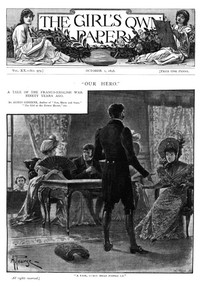
Despite civilian dress--swallow-tailed coat, brass buttons, long flapped waistcoat, white frilled shirt-front, and velvet knee-breeches, with silk stockings, the Colonel was a thorough soldier in appearance. He had not yet left middle age behind, and he was still spare in figure, and upright as a dart.
Mrs. Bryce, a lively woman, in age perhaps between thirty and thirty-six, had bright twinkling eyes. She was dressed much a la mode, in the then fashionable figured muslin, made long and clinging, her white stockings and velvet shoes showing through it in front. The bonnet was of bright blue; and a silk spencer, of the same colour, was cut low, a large handkerchief covering her shoulders. A short veil descended below her eyes. She used her hands a good deal, flirting them about expressively as she talked.
Upon an old-fashioned sofa, with prim high back and arms and a long "sofa-table" in front, sat the Colonel's wife, Mrs. Baron, a very graceful figure, young still, and in manner slightly languishing. Though it was early in the afternoon, she wore a low-necked frock, with a scarf over it; and her hands toyed with a handsome fan. A white crape turban was wound about her head. Beside her was Mr. Bryce, a short man, clothed in blue swallow-tailed coat and brass buttons--frock-coats being then unknown. His face was deeply scored and corrugated with small-pox.
The wide low room, with its large centre-table and ponderous furniture, had one other inmate; and this was a lovely young girl, in a short-waisted and short-sleeved frock of white muslin. A pink scarf was round her neck; dainty pink sandalled shoes were on her small high-instepped feet; long kid gloves covered the slender round arms; a fur-trimmed pink pelisse lay on a chair near; and from the huge pink bonnet on her head tall white ostrich-feathers pointed skyward. Polly Keene was on a visit to the Barons, and she had just come in from a stroll with Mr. and Mrs. Bryce. Young ladies, ninety years ago, did not commonly venture alone beyond the garden, but waited for proper protection. Polly had the softest brown velvet eyes imaginable, a delicate blush-rose complexion, and a pretty arch manner.
Upon a side table stood cake and wine, together with a piled-up pyramid of fruit, for the benefit of callers. Afternoon tea was an unknown institution; and the fashionable dinner-hour varied between four and half-past five o'clock.
"A fortnight in Paris! And what of Nap meanwhile?" vivaciously demanded Mrs. Bryce. "What of old Boney? That is the question, my dear sir. What may not that wicked tyrant be after next?"
In those days even old friends and relatives used the terms "sir" and "madam" very often one to another.
"Buonaparte has a good deal to answer for, ma'am, but really I do not imagine that he will have the responsibility of hindering this little scheme of ours," Colonel Baron replied.
Mrs. Bryce turned herself briskly towards the sofa.
"If I were you, Harriette, I'd refuse to go. Then, at least, you wouldn't have it on your conscience if everything gets into a muddle."
Mrs. Baron's large languid grey eyes opened rather more widely than their wont.
"My dear Harriette, wake up, I entreat of you. Pray listen to me. Doubtless all the world is going to France. Nothing more likely, since half the world consists of idiots, and another half of madmen. That is small reason why you two need comport yourselves like either."
"Do you really suppose there will be war again so soon?" asked Mrs. Baron incredulously.
"Do I suppose? Why, everybody knows it. Jim knows it. Your husband knows it. There can't be any reasonable doubt about the matter. The treaty of Amiens is practically at an end already. Nap has broken his pledges again and again. And this last demand of his--why, nothing could be more iniquitous."
"Dear me; has he made any fresh demand?" Mrs. Baron's eyes went in appeal to her husband, for she had no very great faith in Mrs. Bryce's judgment. The Colonel had no chance of responding.
"Even you can't surely have forgot that, my dear Harriette. He desires that we should give over to his tender mercies the unfortunate Bourbon Princes, who have fled to us for refuge: and no doubt in the end he would demand all the refugees of the Revolution. He might as well demand England herself. And he will demand that, in no long time. 'Tis an open secret that he is already making preparations for the invasion of our country."
"Boney doesn't believe that England, single-handed, will dare to oppose him," remarked Mr. Bryce. "He thinks a nation of seventeen million inhabitants is certain to go down before a nation of forty millions."
"Let him come, and he'll soon learn his mistake," declared Mr. Bryce's valiant better half. "But you, Harriette--with public affairs in this state--you positively intend to let your crazy husband drag you across the Channel?"
"But I do not think my husband crazy, and I wish very much to go," she said, slightly pouting. "I have never been out of England. The wars have always hindered me."
"And you absolutely mean to take the young ones too!"
"We intend to take Roy," the Colonel said, as his wife's eyes once more appealed to him. Children in those days seldom travelled, unless as a matter of necessity; therefore the Colonel's voice was proportionately determined.
"I never heard such a scheme in my life. To take the boy away from his schooling----"
"No; his school has just broken up for some weeks. Several cases of small-pox; so it is considered best. Roy has not been in the way of any who have sickened; therefore he is all right. We mean to have him with us."
"And Molly? Not Molly too?"
"No, not Molly. One will be enough."
Colonel Baron did not wish to betray that he had strenuously opposed the plan, and had given in with reluctance to his wife's entreaties.
"I thought the two never had been parted?"
"That has been folly. It is time such fantasies should be broken through. Roy must go to a boarding-school in the autumn; and this will pave the way."
Mrs. Baron lifted a lace handkerchief to her eyes.
"My dear heart--a school five miles off. You will think nothing of it when the time arrives," urged the Colonel, who till then had gone against his own better judgment, keeping the boy at home and allowing him to attend a day-school. He had won his wife's consent to the boarding-school in the autumn only that morning, by yielding to her wish that Roy should go to Paris. The Colonel's graceful wife was something of a spoilt child in her ways; and resolute as he could show himself in other directions, he seldom had the will to oppose her seriously.
"Indeed, I should say so too," struck in Mrs. Bryce. "You don't desire to turn him into a nincompoop; and between you and Molly, my dear Harriette, he hasn't a chance. School will make a man of him. And what's to become of Molly?"
From the Painting by COMTE.
GIRL'S OWN PAPER. ORFORD SMITH, L^{D.} S^{t.} Albans. LONDON.]
Mrs. Baron was still gently dabbing her eyes with the square of lace, and the Colonel answered--
"My wife's step-mother wishes to have Molly in Bath for a visit. She will travel thither with Polly early next week."
The book keeps going
Reading is free forever. Sign up and watch scenes appear while you read.



Scenes Storieta drew for other classics.
New illustrated classics
Once or twice a month: the latest books to get full character casts, scene art, and free comic editions. No account needed.