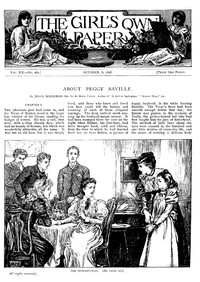
"Edith! This is from Mrs. Saville. Just look at this!"
Instantly there came a sound of hurried rising from the other end of the room; a wicker-work basket swayed to and fro on a rickety gipsy table, and the Vicar's wife walked hurriedly towards him, rolling half-a-dozen reels of thread in her wake, with an air of fine indifference.
"Mrs. Saville!" she exclaimed eagerly. "How is my boy?" and without waiting for an answer she seized the letter and began to devour its contents, while her husband went stooping about over the floor picking up the contents of the scattered basket and putting them carefully back in their places. He smiled to himself as he did so, and kept turning amused, tender, little glances at his wife as she stood in the uncarpeted space in the window, with the sunshine pouring in on her eager face. Mrs. Asplin had been married for twenty years and was the mother of three big children, but such was the buoyancy of her Irish nature and the irrepressible cheeriness of her heart, that she was in good truth the very youngest person in the house, so that her own daughters were sometimes quite shocked at her levity of behaviour, and treated her with gentle, motherly restraint. She was tall and thin like her husband, and he, at least, considered her every whit as beautiful as she had been a score of years before. Her hair was dark and curly; she had deep-set grey eyes and a pretty fresh complexion. When she was well and rushing about in her usual breathless fashion, she looked like the sister of her own tall girls; and when she was ill, and the dark lines showed under her eyes, she looked like a tired, wearied girl, but never for a moment as if she deserved such a title as an old or elderly woman. Now, as she read, her eyes glowed, and she uttered ecstatic little exclamations of triumph from time to time, for Arthur Saville, the son of the lady who was the writer of the letter, had been the first pupil whom her husband had taken into his house to coach, and as such had a special claim on her affection. For the first dozen years of their marriage all had gone smoothly and well with Mr. and Mrs. Asplin, and the vicar had had more work than he could manage in his busy city parish; then, alas, lung trouble had threatened; he had been obliged to take a year's rest, and to exchange his living for a sleepy little parish, where he could breathe fresh air, and take life at a slower pace. Illness, the doctor's bills, the year's holiday, ran away with a large sum of money; the stipend of the country church was by no means generous, and the vicar was lamenting the fact that he was shortest of money just when his children were growing up and he needed it most, when an old college friend, Major Saville, requested, as a favour, that he would undertake the education of his only son, for a year at least, so that he might be well grounded in his studies before going on to the military tutor who was to prepare him for Sandhurst. Handsome terms were quoted, the vicar looked upon the offer as a leading of Providence, and Arthur Saville's stay at the Rectory proved a success in every sense of the word. He was a clever boy who was not afraid of work, and the vicar discovered in himself an unsuspected genius for teaching. Arthur's progress not only filled him with delight, but brought the offer of other pupils, so that he was but the forerunner of a succession of bright, handsome boys, who came from far and wide to be prepared for college, and to make their home at the vicarage. They were honest, healthy-minded lads, and Mrs. Asplin loved them all, but no one had ever taken Arthur Saville's place. During the year which he had spent under her roof he had broken his collar bone, sprained his ankle, nearly chopped off the top of one of his fingers, scalded his foot, and fallen crash through a plate-glass window. There had never been one moment's peace or quietness; she had gone about from morning to night in chronic fear of a disaster; and, as a matter of course, it followed that Arthur was her darling, ensconced in a little niche of his own, from which subsequent pupils tried in vain to oust him.
Mrs. Saville dwelt upon the latest successes of her clever son with a mother's pride, and his second mother beamed and smiled and cried, "I told you so!" "Dear boy!" "Of course he did!" in delighted echo. But when she came to the second half of the letter her face changed, and she grew grave and anxious. "And now, dear Mr. Asplin," Mrs. Saville wrote, "I come to the real burden of my letter. I return to India in autumn, and am most anxious to see Peggy happily settled before I leave. She has been at this Brighton school for four years, and has done well with her lessons, but the poor child seems so unhappy at the thought of returning, that I am sorely troubled about her. Like most Indian children, she has had very little home life, and after being with me for the last six months, she dreads the prospect of school, and I cannot bear the thought of sending her back against her will. I was puzzling over the question yesterday, when it suddenly occurred to me that perhaps you, dear Mr. Asplin, could help me out of my difficulty. Could you--would you, take her in hand for the next three years, letting her share the lessons of your own two girls? I cannot tell you what a relief and joy it would be to feel that she was under your care. Arthur always looks back on the year spent with you as one of the brightest of his life; and I am sure Peggy would be equally happy. I write to you from force of habit, but really I think this letter should have been addressed to Mrs. Asplin, for it is she who would be most concerned. I know her heart is large enough to mother my dear girl during my absence, and if strength and time will allow her to undertake this fresh charge, I think she will be glad to help another mother by doing so. Peggy is bright and clever like her brother, and strong on the whole, though her throat needs care. She is nearly fifteen--the age, I think, of your youngest girl, and we should be pleased to pay the same terms as we did for Arthur. Now, please, dear Mr. Asplin, talk the matter over with your wife, and let me know your decision as soon as possible."
Mrs. Asplin dropped the letter on the floor and turned to confront her husband.
"Well!"
"Well?"
"It is your affair, dear, not mine. You would have the trouble. Could you do with an extra child in the house?"
"Yes, yes, so far as that goes. The more the merrier. I should like to help Arthur's mother, but----" Mrs. Asplin leant her head on one side, and put on what her children described as her "ways and means" expression. She was saying to herself, clear out the box room over the study. Spare chest of drawers from dressing-room--cover a box with one of the old chintz curtains for an ottoman--enamel the old blue furniture--new carpet and bedstead, say five or six pounds outlay--yes! I think I could make it pretty for five pounds. The calculations lasted for about two minutes, at the end of which time her brow cleared, she nodded brightly, and said in a crisp, decisive tone, "Yes, we will take her. Arthur's throat was delicate too. She must use my gargle."
The vicar laughed softly.
"Ah! I thought that would decide it. I knew your soft heart would not be able to resist the thought of that delicate throat! Well, dear, if you are willing, so am I. I am glad to make hay while the sun shines, and lay by a little provision for the children. How will they take it, do you think? They are accustomed to strange boys, but a girl will be a new experience. She will come at once, I suppose, and settle down to work for the autumn. Dear me! dear me? It is the unexpected that happens. I hope she is a nice child."
"Of course she is. She is Arthur's sister. Come! the young folks are in the study. Let us go and tell them the news. I have always said it was my ambition to have half-a-dozen children, and now, at last, it is going to be gratified."
Mrs. Asplin thrust her hand through her husband's arm, and led him out of the room, down the wide flagged hall, towards the distant room whence the sound of merry young voices fell pleasantly on the ear.
(To be continued.)
OUR PUZZLE POEM REPORT: "PREPOSITIONS."]
SOLUTION.
PREPOSITIONS.
A preposition is a word Which other words with nouns relates, And as its name denotes is heard Before the noun it dominates.
The noun, poor thing, objects in case, And this may partly be because It much dislikes the minor place Assigned to it by grammar's laws.
But if you take away its noun, The preposition's altered quite, Into an adverb has it grown Which puts things in a diff'rent light.
For now this lordly part of speech Which erstwhile governed, needs must be Slave to a verb, and this should teach A lesson in humility.
Lily Belling, Wribbenhall, Bewdley, Worcestershire. Isabel Borrow, 219, Evering Road, Upper Clapton. M. A. C. Crabb, c/o Miss May, 10, Beaufort East, Bath. Edmund T. Loader, 5, Richmond Terrace, Brighton. Nellie Meikle, 2, Newsham Drive, Liverpool. M. Theodora Moxom, Hillside, Ilfracombe. Hilda Pickering, 42, Linnæus Street, Hull. Elizabeth Yarwood, 59, Beech Road, Cale Green, Stockport.
Five Shillings Each.
Eliza Acworth, 9, Blenheim Mount, Bradford. Nannette Bewley, 40, Fitzwilliam Place, Dublin. M. S. Bourne, 14, The Broadway, Bromley, Kent. Ellen H. Kemp, Haughley Vicarage, Suffolk. Ethel C. McMaster, 23, Ross Road, Wallington, Surrey. Mabel Wheeler, Holmesdale, Winkfield, Windsor.
Very Highly Commended.
Rev. S. Bell, E. Blunt, J. A. Center, Edith Collins, R. D. Davis, E. M. Le Mottee, Jas. S. Middleton, Alice M. Motum, H. W. Musgrave, J. D. Musgrave, Mrs. Nicholls, Gertrude Smith, Ellen C. Tarrant, Violet C. Todd, Horace Williams.
Highly Commended.
Guy Baily, Elizabeth A. Collins, Eva Gammage, Mrs. A. D. Harris, Edward St. G. Hodson, Edith L. Howse, Annie G. Luck, May Merrall, F. Miller, Margaret G. Oliver, E. Phillips, M. G. Phillips, Alice M. Seaman, Katie Whitmore.
Honourable Mention.
Mrs. Adkins, Muriel V. Angel, Mrs. Astbury, Mrs. L. Bishop, M. Bolingbroke, Louie Bull, Helen M. Coulthard, Constance Daphne, B. Duret, Annie K. Edwards, C. M. A. Fitzgerald, Edith E. Grundy, Edith M. Higgs, S. D. Honeyburne, J. Hunt, Ethel L. Jollye, Edith B. Jowett, Carlina V. M. Leggett, Mrs. R. Mason, Wm. E. Parker, A. A. L. Shave, Helen Singleton, Clara Souter, W. Fitzjames White, Emily Wilkinson, Henry Wilkinson, Amy G. Wiltshire, Emily C. Woodward, Diana C. Yeo, Sophia Yeo.
EXAMINERS' REPORT.
The general opinion seems to be that "Prepositions" was a very difficult puzzle. It was certainly unpopular, judging by the number of solutions sent in, but we were inclined to think that this was accounted for by the subject. Who wants to learn anything about prepositions in the middle of summer, and who would be so extremely foolish as to spend any of the precious--not to say "honied"--hours over a grammatical puzzle? In the summer of 1897 about fifteen hundred individuals tried to unravel a page full of curious suppositions. But then suppositions are always dear to the girl mind, while prepositions seldom are, because they pertain to a science which the girl mind (as a rule) little understands. So the subject repelled, and as the difficulty also repelled, we begin to be surprised that there were any solutions at all.