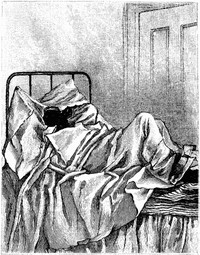
"RIGHT ABOUT FACE."
BY MARY D. BRINE.
"Now, right about face!" September cries, "Right about face, and march!" cries she; "You, Summer, have had your day, and now, In spite of your sorrowful clouded brow, The children belong to me.
"Come, fall into line, you girls and boys, Tanned and sunburned, merry and gay; Turn your backs to the woods and hills, The meadow ponds and the mountain rills, And march from them all away.
"Are you loath, I wonder, to say farewell To the summer days and the summer skies? Ah! time flies fast; vacation is done; You've finished your season of frolic and fun; Now turn your tardy eyes
"Toward your lessons and books, my dears. Why, where would our men and women be, If the children forever with Summer played? Come, right about face," September said, "And return to school with me."
SOMETHING ABOUT SHIPS.
Sailing vessels carry either square-sails or fore-and-aft sails. A square-sail is one the head of which is "bent" or made fast to the jack-stay--an iron rod on a yard. Fore-and-aft sails, instead of being bent to yards, are mostly supplied with a boom or gaff, or both. The lower corners of square-sails are called clews. The fore-sail and mainsail are often called the courses. Sail is seldom carried on the cross-jack (pronounced krojik) yard, the lowest yard on the mizzenmast.
The courses, when "set," are kept down by means of ropes leading from the clews fore and aft, called tacks and sheets. Above the courses come the topsails; above the topsails, the top-gallant-sails; and next above, the royals. Some very large ships carry still loftier sails, called sky-sails.
Most merchant ships carry double topsails, one above the other, for greater ease in handling; but on men-of-war, having large crews, single topsails are the rule.
The head-sails are those which the bowsprit and the booms it supports carry forward. These are the foretopmast stay-sail, the jib, and flying-jib. Large vessels carry even more head-sails. The spanker, or driver, as our merchantmen sometimes call it, is a fore-and-aft sail, and is the aftersail of a ship or bark.
A compass being divided into thirty-two points, sailors consider the horizon at sea as having an equal number of divisions, and speak of a ship as sailing within five or six points of the direction the wind is blowing from.
When the sails of a ship are filled with wind, they are said to be drawing or full. A good sailor is never so happy as when with a whole-sail breeze he sees all his canvas spread and drawing, and feels himself "off before it."
THE BROKEN VASE.
BY MRS. W. H. SNYDER.
"Now," said Mary, impatiently, as she came in from school, "I shall have to draw another hateful old design, for she wouldn't accept the one I took in this morning. She said it was drawn carelessly, and that I hadn't followed her directions, and that I had made thick lines, and hadn't properly erased my guide lines. She was ever so hard to please, and I hate her."
"I am sorry to see my little girl in such a bad humor to-day," said mother. "I thought I heard her say this morning that Miss Jones was 'so nice.'"
"Oh yes, but she isn't always nice. She's dreadfully particular sometimes--at least with me. She was pleasant enough to Jenny Kirkland and Clara Sackett, and she almost always says to those two girls, 'You have done very well, and you deserve a great deal of credit.' And to make matters worse, Miss Howland had to go and say, 'Mary, you must bring in a better design to-morrow, or I shall have to discredit you.' Well, I'll bring her in a design to-morrow," and she added, in an under-tone, "I'll just copy it off of grandpa's old Nantgru vase." So saying, she approached the table upon which stood the vase, with a few flowers in it tastefully arranged, and throwing her hat and books petulantly down, the corner of her geography struck the vase, and it fell upon the floor, and was shattered into half a dozen pieces.
Emma and Walter, hearing the crash, hastened in.
"See what I have done!" said Mary, sitting down upon a chair with tears in her eyes, and holding up a portion of the broken vase. "I am so sorry that I have broken dear grandpa's vase."
"And grandpa will be sorry too," said Emma, "for he highly prizes his vase. Grandpa"--as the old gentleman walked feebly into the room--"Mary has broken your vase, and she is very sorry."
Grandpa took the fragments in his trembling hand, and looked almost lovingly upon them.
"Oh, grandpa," exclaimed Walter, sympathetically, "I think father will be able to mend it with some of his new cement when he comes home to-night."
"I hope so, my boy," said the old gentleman, "for I value it very much. It was given to me many years ago by my friend Mr. Barr, who had a large porcelain manufactory in Worcester, England."
"Please, grandpa," said Walter, "tell us something of the history of your vase."
Grandpa sat down in the large easy-chair, and the children gathered around him, anticipating a pleasant story, for grandpa told a great many pleasant things about events that happened during his youth.
"One sultry day in May, in the year 1811," began grandpa, "I went to visit my friend Mr. Barr in Worcester. Mr. Barr had one of the most celebrated china manufactories in England. Barr, Flight, & Barr was a firm widely known in those days.
"I accompanied my friend to his factory, for I was greatly interested in the manufacture of porcelain, and indeed of any article. After spending several hours in passing from room to room, I noticed that it was growing dark, and drawing out my watch, saw that it was but little after four o'clock. Mr. Barr remarked at the same time, 'I shouldn't be surprised if we had a shower before long.' Just as we were speaking we heard the rumbling of distant thunder.
"We then walked to a window that looked out toward the east, and noticed that very dark clouds were rising in that direction, and that they extended to the south. We stood some time watching the rising storm. The sky in an incredibly short time presented a very threatening appearance. Inky clouds piled up rapidly in huge masses, and the continuous roar of distant thunder and the terrible flashes of forked lightning filled us with apprehension as to what the storm would be when it reached us.
"About this time Mr. Barr's attention was directed to something in another part of the building, and for a while we lost sight of the storm, but suddenly we were startled by a tremendous clap of thunder, accompanied by a flash of dazzling brightness, and then the storm swept upon us in all its fury.
"The roar of the tempest, the crashing of thunder, and the dashing of hail-stones against the windows and upon the roof of the factory were really appalling. Awe-stricken, we stood and listened.
"Presently a man rushed into the room, and approaching Mr. Barr, said, 'Oh, sir, I do believe that every winder in the whole factory is broke with the hail. I never in my life see such stones before; they are surely five or six inches round.'
"This was no exaggeration. We hurried through the rooms on the exposed sides of the building, and everywhere destruction met our view: broken glass, hail-stones, and broken china were scattered over the floors. The tempest continued to rage with unabated fury long after ordinary storms would have exhausted themselves or have passed away.
"After a while men came in with pale and anxious faces, and told us that the river Severn had risen six feet in one hour, and that it was still rapidly rising, and they feared great distress would be occasioned by the flood.
"The time seemed interminable while we waited and watched for the storm to subside. At last, as if reluctantly, the thunder became more and more distant, and the lightning flashes less dazzling and terrific. Every one breathed more freely now. We felt as if a terrible dream had been upon us, and we were just waking from it. By-and-by the clouds drifted away, and only occasionally a far-off flash illumined the horizon. The air was wonderfully pure, and the moon and stars shone out brightly over a scene of desolation.
"That night I spent at Mr. Barr's house, and the following morning, after visiting the factory, we took a drive through the town, and out into the surrounding country. In the city, gardens were laid waste, trees were torn and almost stripped of their foliage, and nearly every window that faced the east was broken. One of the newspapers of the day said that the town looked as if it had been besieged.
"But the country--oh, how sad and desolate it looked! The fields of grass and corn that yesterday were so beautiful, and the luxuriant crops that promised such all abundant harvest, were everywhere beaten down and destroyed. The river, too, had risen twenty feet during the storm, and had swept madly over the adjacent fields, carrying away houses and barns, destroying many peaceful and pleasant homes, and sweeping herds of cattle from the pastures."[1]
[1] A true account.
"As we reached the top of a certain hill, I looked anxiously toward the river for a picturesque little cottage that I had often admired on account of its pretty porch that was overrun with roses and honeysuckle, and because of the fine elms that overshadowed it. I had always imagined that place to be the home of some refined person. All the surroundings indicated it, although it was quite apparent that the owner was not wealthy.
"'Ah,' said Mr. Barr, looking in the same direction, 'the Professor's little cottage has gone too!' He reined in his horses, and sat silently looking toward the spot.