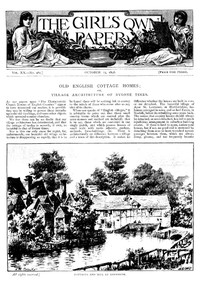
As our papers upon "The Characteristic Church Towers of English Counties" appear to have interested our readers, it is possible they may be willing to peruse these remarks upon the old dwellings, and some other objects which surround country churches.
We fear there can be no doubt that our village architecture has deteriorated, and that the cottage of to-day is scarcely, if ever, as beautiful as that of former times.
Nor is this our only cause for regret, for, unfortunately, our beautiful old village architecture is disappearing so rapidly, that it is to be feared there will be nothing left to convey to the minds of those who come after us any idea of its charm.
When one speaks of "English villages," it is advisable to point out that those small country towns which are erected after the same manner and method are included; that is to say, those which are contained in one single parish, and which possess houses of small scale with rustic adjuncts, gardens, orchards, farm-buildings, etc. There is architecturally no difference between a village and a town of this description. It makes no difference whether the houses are built in rows or are detached. The beautiful village of Ayot St. Lawrence, in Hertfordshire, has houses arranged in rows, and so had Eaton, in Norfolk, before its rebuilding some years back. The notion that country houses should always be detached, or semi-detached, has led to much injudicious arrangement in suburban building estates. If there is land to spare, isolate your houses, but if not, no good end is answered by detaching them so as to leave wretched narrow passages between them, which are always damp, gloomy, and too frequently become receptacles for disused and broken articles, which would be far better put on the fire or given to the dustman. If houses are detached, or semi-detached, there should always be a space twelve or fifteen feet between them (unless, of course, the houses are very low), otherwise the rooms bordering upon the opening are damp and cold.
English country towns differ completely from continental ones chiefly for this reason. On the Continent, towns were nearly always fortified and surrounded by walls, though often their population was that of a mere village. These little fortified places are in Germany called "dwarf cities," to distinguish them from the "dorf," or "village." In England, however, small towns were rarely fortified or walled, except when they were situated upon the sea-coast, where they had to be ready to resist the landing of some foreign enemy. Lyme-Regis, Dorsetshire, is an example of a small English fortified town, and it is quite strange how much the place (of course we refer to the old portions of it) impresses one with its continental aspect, because directly a town is "circumvallated," every building within it has to be erected upon a contracted space, and the houses are consequently developed in height, so that they in no way differ from those of a city; in fact, the small town might, architecturally, be a piece of some large city.
Such English towns as Amersham, Lavenham, Clare, Wheathamstead, etc., are, architecturally, large villages, and probably originated in the same manner--_i.e._, they were dependencies upon some lordship or monastery.
The English word "village" is derived from the Roman word "villa." The villa was the castle or manorial house of the proprietor of the land surrounded by a series of humble structures inhabited by his labourers and "serfs." This was the "village" or dependency of the villa, and hence its inhabitants were called "villains" (villani). Now we are aware that some modern writers attempt to derive these words from the German "wealh" (a welchman), yet the old and usually received idea seems so obvious that we accept it.
How the meaning of the words "villa" and "villain" have been changed, and yet how singularly the old word "village" has retained its meaning!
The modern stucco, semi-detached "desirable residence," with its four or six rooms, with its "rustic porch" and gritty front garden, is a strange parody upon the stately villa of old, and the good, honest villager is neither a "villain" nor "a Welshman." He may sometimes be the latter, and justly proud of his origin, but, in any case, he is very unlike our conception of a villain. If recent newspaper reports can be trusted, that character is rather personified by the London "loafer" and his most modern representative "the Hooligan."
When the villages increased in size and became important, usually in the 13th century, many of them claimed municipal privileges, were called towns, and erected "town halls," which are often highly-picturesque structures. That at Ledbury, Herefordshire, is an interesting example which probably dates from the 16th century. They are generally supported upon pillars so as to leave the ground-floor an open, covered space which served as a market.
Very charming are these villages and small country towns with their quaint old cottages and picturesque little houses bordering the wide street. Great elms shade the foot-path, and sweet gardens are at the side or back of each dwelling. Perhaps a clear river winds its way amidst the ruddy buildings, its banks converted into diminutive kitchen-gardens, and crossed here and there by bridges. The long low building of a water-mill seems to block the way altogether, but in reality it simply utilises the water to turn its wheels, and we shall find the river on the opposite side with its waters banked up some six or eight feet higher, changed in character, looking more still and deep, reflecting the surrounding objects in a still, silent pool, shaded by lofty trees, its banks clothed with deep grass plantains, huge docks and marsh mallows, a spot where, on a sunny day, an irresistible inclination seizes one to lie down on the cool earth. The clinging foliage seems to second the invitation, and one throws oneself down upon this sweet verdant couch to "dream with one's eyes open," for who could close them in such an enchanting spot? But somehow or other, whether it is the "whirr" of the water-wheel, the fragrant scents of the plants we are crushing, or the peace surrounding one, time seems to glide away, and, upon consulting our watch, we discover the mysterious fact that the day has become two hours shorter! Of course we have not been to sleep!
Such village scenes and sensations are to be witnessed at Amersham, Cringleford, and many other spots in England which have still retained their old village surroundings.
(To be continued.)
HOUSEHOLD HINTS.
A GOOD black straw hat and bonnet, changed at the seasons with suitable blossoms, is the most economical and ladylike fashion, but the artificial flowers should be very good of their kind--those with silk or velvet petals look the best and most natural, and can be used a second season if carefully brushed and put away.
THOSE who have to wear spectacles and eyeglasses should be very careful that the centre of the glass is exactly opposite the centre of the eye. If not, they should be altered to make them so.
IF hair is washed with soap it is apt to make it brittle, so it should be afterwards rinsed with a little borax in water.
A LITTLE ammonia in the water in which china is washed makes it glossier and nicer in appearance.
A DRESS well made and of good material outlives several that are not, and gives more satisfaction to the wearer, but it should be carefully chosen as to colour, and not be too aggressive in pattern or tint.
"OUR HERO."
BY AGNES GIBERNE, Author of "Sun, Moon and Stars," "The Girl at the Dower House," etc.
"A letter from Paris! Grandmamma, a letter from Paris!" cried Molly, as she rushed into the dining-room of Mrs. Fairbank's Bath house, situated not far from the renowned Pump-room. "Look! And it will be about Roy! And it is in my papa's handwriting."
Polly followed close in rear of the eager child, hardly less eager herself. She might at least hope for a message from Denham, perhaps to say that a letter was coming.
Mrs. Fairbank, a comely elderly lady--in these days, with the same weight of years, she would be no more than cheerfully middle-aged--adjusted her horn spectacles, laid the letter on her knee, tied her loosened cap-strings, and scrutinised Molly's excited face.
"You make too much of things, child," she remarked. "Whatever may befall, it is never worth while to discompose yourself."
Then she lifted the letter, examined it, weighed it in either hand, laid it down anew, and resumed her knitting. Molly's agony of suspense and Polly's wistful eyes alike failed to touch her. Young folks, if well brought up, were expected to submit without question to the will of their elders, and Mrs. Fairbank had always been an excellent disciplinarian. This was, in her eyes, much too good an opportunity for a lesson in self-control to be neglected.
Molly stood, squeezing her hands together, wondering if the slow moments would ever pass. Mrs. Fairbank serenely knitted, stopped to count, and knitted again.
"I met Mrs. Peirce and Will in Milsom Street after breakfast," she observed. "Mrs. Peirce informed me that the Admiral had a letter yestere'en from his nephew, Mr. Albert Peirce."
Mrs. Fairbank's eyes wandered round the room in quest of something else to remark upon.
"My dear Polly, you must surely have forgot! That piece of knitting which was to have been done to-day----"
"I'll set to work upon it, ma'am. It won't take me but a very short time. O Jack!"--and a note of relief could be heard.
"Jack!" gasped Molly, under her breath.
"My dear Jack!" and Mrs. Fairbank suspended her knitting to glance up in pleased surprise.
The young man who walked in--he was hardly more than a boy in years--bore small resemblance to Polly, though he was her brother. He was of squarer build, slightly under medium height, and muscular in make; his features were irregular, and the eyes were light blue instead of brown. Beyond those good-humoured blue eyes and a fresh complexion, Jack Keene had no pretensions to good looks; but many people, beside his grandmother, counted him a very pleasant young fellow. Mrs. Fairbank, after the manner of old ladies, simply doted on her grandson. In her view he could almost do no wrong.
"Jack, Jack, there's a letter," whispered Molly, clutching at him. "And, oh! she won't open it. She won't tell us how they are!"
"All right," murmured Jack. He understood Molly's whisper and the look in Polly's face; and as he kissed his grandmother he took up the letter which reposed upon her knee. No human being except Jack might have ventured on such a liberty, but he was a privileged being. "Ah, from France!" quoth Jack, with composure. "Will you allow me to open it, ma'am? You are busy, and news of any sort or kind from France in these days is to be welcomed."
Mrs. Fairbank took the letter from him with as near an approach to displeasure in her manner as she ever showed towards Jack.
"You are pleased to be impatient," she remarked, with a sound of reproof.
"Exceedingly, ma'am." Jack was always extra polite when bent upon his own way.